

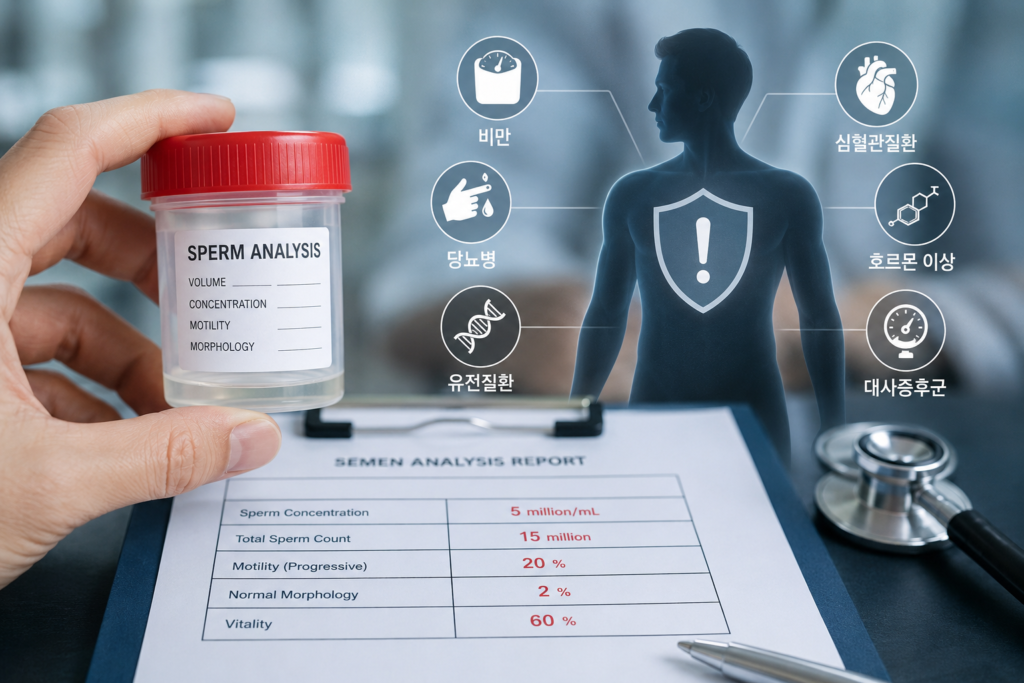
For a long time, the clinical view of oligozoospermia—a low sperm count—was simple: it was a barrier to pregnancy. The diagnostic focus was narrow, and the clinical interest rarely extended beyond the goal of conception. However, a paradigm shift is underway. Medical researchers are increasingly recognizing that sperm count is not merely a marker of reproductive potential; it is a critical “vital sign” reflecting a man’s systemic health.
The Complexity of Spermatogenesis Sperm production is one of the most metabolically demanding processes in the human body. It requires the seamless orchestration of the endocrine system (the brain-testicular axis), robust vascular health, efficient metabolism, and cellular integrity. Because this process is so complex, it is exceptionally sensitive. When a man’s health begins to decline—due to chronic stress, metabolic imbalance, or vascular issues—the testicles are often among the first organs to signal distress.
Hidden Drivers: Obesity, Diabetes, and Cardiovascular Health The link between lifestyle and sperm quality is now well-documented:
- Obesity: Excessive adipose tissue disrupts hormonal balance, converting testosterone into estrogen and raising scrotal temperatures, both of which are detrimental to spermatogenesis.
- Diabetes: Chronic hyperglycemia damages micro-vasculature and peripheral nerves. Recent studies indicate that this damage extends to the testicles, impairing sperm production and increasing DNA fragmentation rates.
- Cardiovascular Health: Sperm production relies on healthy blood flow. Research shows that men with low sperm counts often exhibit higher risks for hypertension, metabolic syndrome, and cardiovascular disease. Vascular endothelial dysfunction, which impairs heart health, can simultaneously compromise the blood supply to the testes.
The Danger of “Performance Enhancers” One of the most concerning trends in male fertility is the misuse of exogenous hormones, including anabolic steroids. Many men turn to these for aesthetic or performance reasons, unaware that they are essentially telling the brain to stop producing natural testosterone. This often leads to a rapid, and sometimes irreversible, collapse of sperm production—a stark reminder that hormonal interference carries profound biological consequences.
Sperm Count as a “Biomarker” for Longevity Perhaps most striking is recent data suggesting that sperm quality may be correlated with life expectancy. Large-scale cohort studies have indicated that men with optimal semen parameters tend to live longer. This leads researchers to view semen quality as a “vitality biomarker,” reflecting the internal health status of the entire body.
A Call for a New Screening Paradigm This evolving understanding mandates a change in how we approach male health. Currently, most men treat sperm analysis as a “fertility-only” test, sought only when pregnancy struggles arise. However, medical experts argue that semen analysis should be viewed as a “comprehensive health report card.”
A diagnosis of oligozoospermia (WHO criteria: <16 million sperm per mL) should not just be a trigger for fertility discussions; it should be a prompt for a deeper clinical review of:
- Body mass index and metabolic status.
- Endocrine and hormonal profiles.
- Genetic integrity (including Y-chromosome micro-deletion testing for severe cases).
- Cardiovascular risk factors.
Conclusion: The First Warning Light A low sperm count is often the body’s first “check engine” light. It serves as an early indicator that metabolic, hormonal, or systemic stressors are at play. By shifting our perspective, we can stop viewing oligozoospermia solely as a fertility issue and start addressing it as a crucial opportunity to improve a man’s long-term health, longevity, and overall well-being.
Sources: International studies on male reproductive health; systematic reviews on the association between semen parameters and systemic disease; WHO laboratory manual for the examination and processing of human semen.
Disclaimer: This report is for informational purposes. A diagnosis of oligozoospermia should be evaluated by a urologist or reproductive specialist to assess both fertility and broader health markers.