
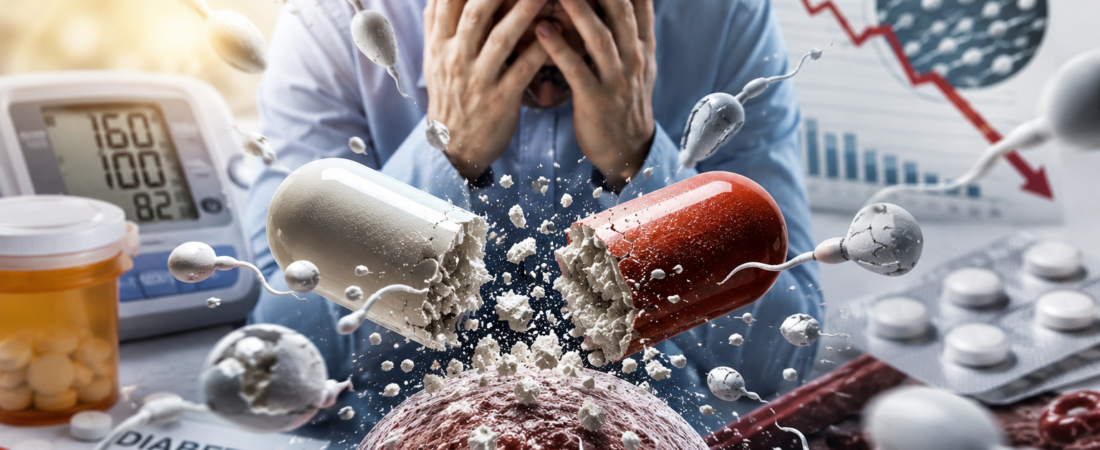

“It Wasn’t the Medication, It Was the Disease”… The Warning of Diabetes and Hypertension That Crushes Male Fertility
Mr. A, a man in his 40s who visited a hospital to conceive a child, received unexpected results. His sperm count was significantly lower than normal, and his motility was poor.
He first suspected the blood pressure medication he had been taking for years. He followed up with questions about whether his diabetes or blood pressure medication might have destroyed his sperm. However, the test results told a different story.
The problem was not the medication, but the disease that made the medication necessary.
As male infertility patients have increased recently, misunderstandings that blood pressure and diabetes medications are harmful to sperm have also spread. However, the perspective of the reproductive medicine community is the exact opposite. In most cases, what threatens sperm is not the medication, but uncontrolled diabetes and hypertension themselves.
Many people think of diabetes and hypertension only as problems of the heart or cerebral blood vessels. That is not the case. The testicles are also organs that rely on countless microvessels. Sperm are not cells created overnight.
It takes about 70 to 90 days from the time a new sperm is generated until it is ejaculated. During that long period, even the slightest fluctuation in blood flow, oxygen supply, or hormonal environment can cause the quality of the sperm to drop sharply.
Diabetes attacks this process head-on. If high blood sugar levels persist, the lining of the blood vessels is damaged, and reactive oxygen species (ROS) increase. As a result, sperm motility decreases and DNA damage increases. Recently, research results have been appearing consecutively showing that the Sperm DNA Fragmentation Index (DFI) appears higher in men with diabetes. This means that even if fertilization occurs, it can affect embryo development and the maintenance of pregnancy.
Hypertension is no different. As blood pressure rises, microvascular function declines, and testicular blood flow decreases. This is why a decrease in sperm count, reduced motility, and worsening erectile function appear simultaneously. In fact, when analyzing male infertility patients, it is not uncommon to find cases accompanied by hypertension and diabetes.
What is more dangerous is that many men do not know this fact.
Even if blood sugar is high, there is no pain. Even if blood pressure is high, daily life is possible. Therefore, it is common for men to leave the disease untreated for years. However, in the meantime, their sperm quietly change. It is not rare for fertility to signal a warning light long before a myocardial infarction or stroke occurs.
Then, is there really no problem with blood pressure and diabetes medication?
Some blood pressure medications have reports of associations with decreased libido, erectile dysfunction, or ejaculation disorders. Ejaculation abnormalities are also rarely observed with certain diabetes medications. However, experts explain that these are issues of sexual function and should be distinguished from issues that directly damage sperm.
What is actually more dangerous is stopping medication arbitrarily. If you stop taking medication for the purpose of preparing for pregnancy and your blood pressure and blood sugar worsen, you may increase not only the risks to your sperm health but also your cardiovascular risks simultaneously.
Recently, the era in which only women were tested at fertility treatment sites is ending rapidly. This is because the fact that male factors account for nearly half of all infertility is being repeatedly confirmed. In particular, for men after 40, chronic disease management status often determines sperm quality more than age itself.
Many men stare at the caps of their blood pressure medication bottles and worry about the health of their sperm. However, it is more likely that what is actually ruining their sperm is not the pills inside the bottle, but the blood sugar and blood pressure that have been left uncontrolled for years.
Sperm are more honest than you think. You must not forget that as soon as the blood vessels in your body begin to collapse, one of the very first cells to send that signal is sperm.