
One Egg, One Sperm… And the Fingertips of an Embryologist
Couples preparing for In Vitro Fertilization (IVF) are usually very cautious when choosing a physician, yet they rarely scrutinize the most crucial factor: laboratory cultivation technology, specifically the skilled expertise of the embryologists.
Ironically, one of the most critical moments in IVF does not occur in the consulting room, but in the laboratory. A simple example of this is Intracystic Sperm Injection (ICSI).
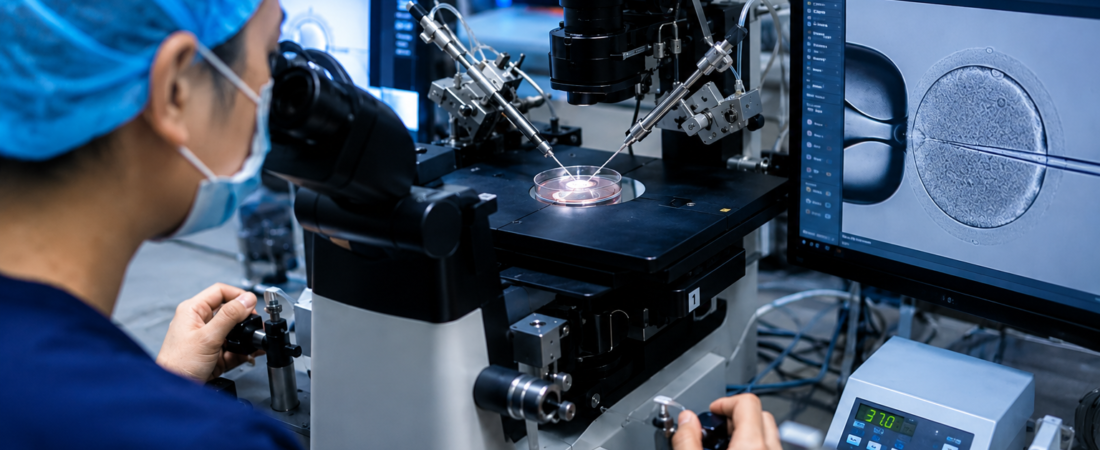
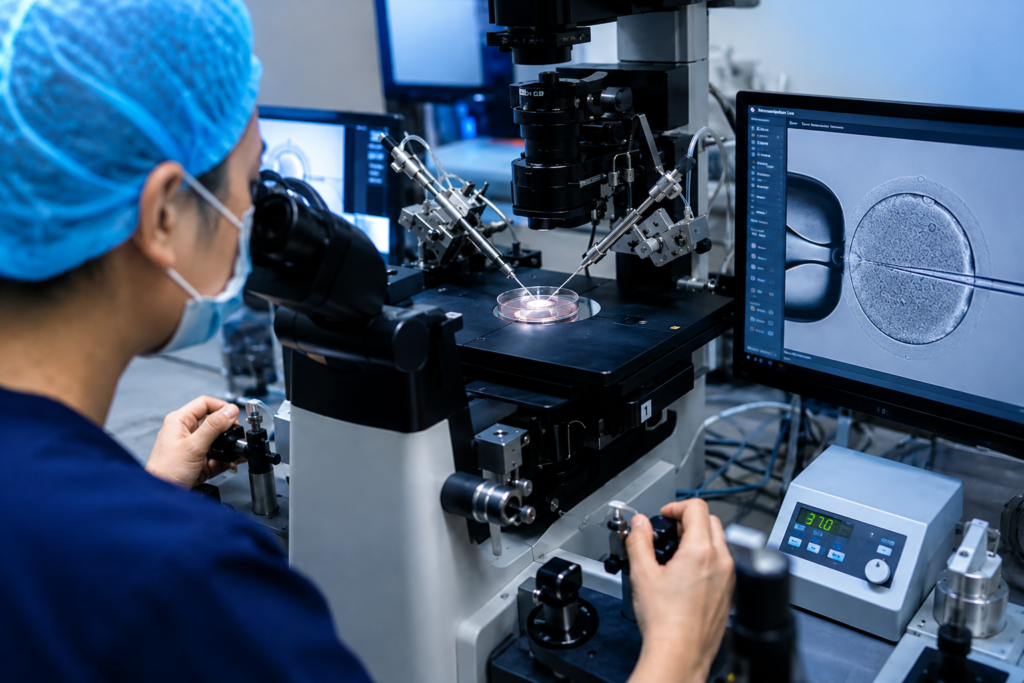
ICSI is a technique where an embryologist selects a single sperm under a microscope and injects it directly into the egg. It is, in essence, a “forced fertilization.”
The basic principle of standard IVF is to place several carefully selected sperm around an egg and wait for natural fertilization to occur. However, fertilization has a fixed window of opportunity; missing this window leads to IVF failure. Therefore, ICSI is chosen when sperm count is low, motility is poor, there is a history of failed fertilization, or when the number of eggs retrieved is so small that not a single one can be wasted.
Women undergoing IVF often do not consider ICSI technique and the skills of the embryologist to be very important. It may look like a simple task of inserting sperm with a thin needle while looking through a microscope. It is far from simple.
An egg is only about 100 micrometers (0.1 mm) in diameter—slightly thicker than a human hair. Inside it lies genetic material with the potential to become a human being. The embryologist must fix this tiny cell with a holding pipette and then pierce the cell membrane with a glass needle—much thinner than a hair—to inject the sperm.
This process is neither careless nor automated. A significant portion depends on the fingertips of the embryologist. This is why differences in proficiency translate into major differences in outcomes.
The first problem an inexperienced researcher faces is damage to the egg. If the egg is held too firmly or the angle of the needle’s entry is not optimal, the cell membrane can be compromised. In some cases, excessive cytoplasm leaks, or the egg may degenerate before fertilization.
Sperm selection is also not simple. The average person might think all moving sperm are the same, but skilled embryologists observe everything: the shape and size of the sperm head, the morphology of the neck, and even the movement of the tail. This is because, even within the same semen sample, the specific sperm selected can influence subsequent embryo development patterns.
Evaluating egg maturity is also critical. Not all retrieved eggs are in a fertilizable state. ICSI shows the best results with mature eggs (MII). Experienced researchers identify mature eggs quickly, but for the inexperienced, this judgment can be difficult.
Speed is another variable that cannot be ignored. An egg begins to age the moment it is retrieved. A skilled embryologist can process dozens of eggs stably in a short amount of time, but a lack of experience extends the working time. This increases the amount of time the eggs are exposed to the external environment, creating conditions unfavorable for embryo development.
Of course, this does not mean that every novice researcher causes problems. Most IVF centers have sufficient training and oversight systems, and crucial procedures are carried out under the verification of experts.
However, one fact remains clear: even if the same doctor retrieves the eggs and the same doctor performs the embryo transfer, the capability of the laboratory in between can vary from hospital to hospital.
In the IVF field, it is often said that “the laboratory is the heart of the hospital.” It is also said that while patients remember the doctor, the embryo “remembers” the laboratory.
When discussing IVF success rates, people often focus only on the fame of the fertility doctor. However, one must not overlook the fact that at the moment fertilization occurs, it is not a doctor sitting in front of the microscope, but an embryologist.
The laboratory is a space invisible to the patient, making it all the more difficult to evaluate. However, moving forward, you should judge potential IVF clinics based on how many IVF procedures they have performed to date and whether they are comfortably performing over 1,000 IVF cycles annually.