
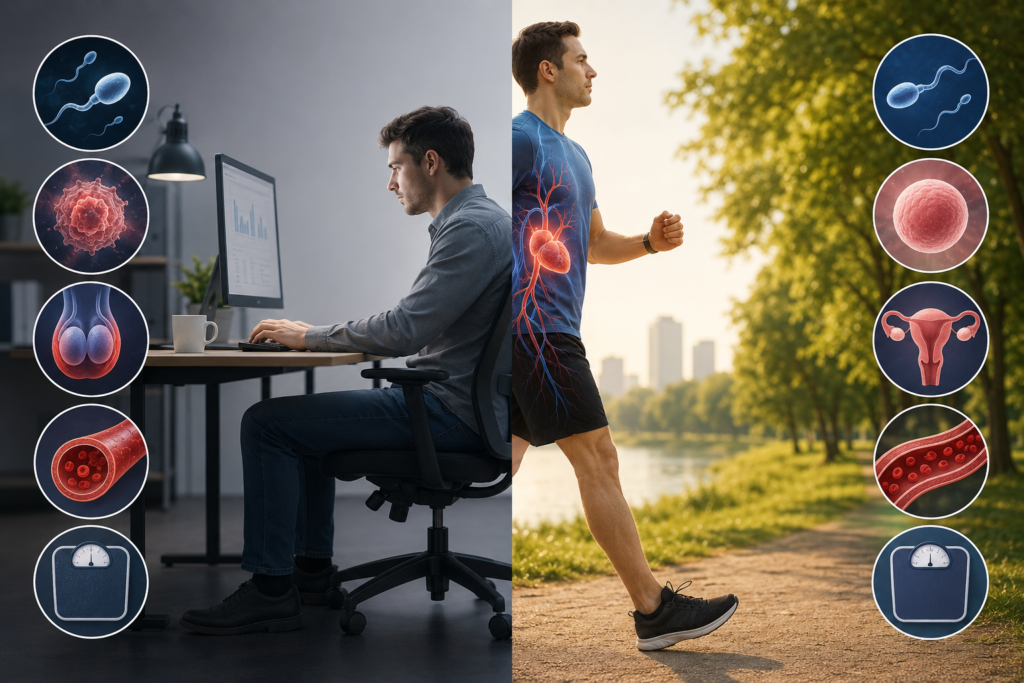
Have you ever heard of “lifestyle-induced infertility”? Many people instinctively seek the cause of infertility within the reproductive organs themselves—the uterus, ovaries, or sperm. However, human reproduction is not an isolated event; it is the culmination of a complex, whole-body system. Success depends on cardiovascular health, efficient circulation, balanced hormones, and minimal systemic inflammation. In essence, fertility is the “report card” of your overall health.
Modern society has turned us into the most sedentary generation in human history. We sit while we commute, sit while we eat, and sit on the couch while we scroll through our phones. For many, sitting for over 10 hours a day is the norm. The problem is that as the body loses its capacity for movement, reproductive health often crumbles alongside it.
The Impact on Male Fertility: Temperature and Circulation For men, the most immediate consequence of prolonged sitting is elevated testicular temperature. The testes are located outside the body because they require an environment 2–3°C cooler than the core body temperature to produce sperm efficiently. Sitting for hours—especially for office workers or professional drivers—creates a “miniature greenhouse,” compressing the scrotum against the thighs and trapping heat.
Studies consistently show that sedentary lifestyles correlate with decreased sperm count, lower motility, and a higher percentage of abnormally shaped sperm. Beyond temperature, the lack of movement impairs blood flow. Reproductive organs rely on circulation to deliver oxygen and nutrients; restricted blood flow negatively impacts testicular and prostate function, and even testosterone production.
The Impact on Female Fertility: Metabolic and Vascular Health Women are equally vulnerable. A sedentary lifestyle drives insulin resistance, disrupting blood sugar regulation and promoting fat storage, which in turn fosters a state of chronic inflammation. This cascade wreaks havoc on hormonal balance.
For women with Polycystic Ovary Syndrome (PCOS), sedentary habits can significantly exacerbate ovulatory dysfunction. As insulin resistance worsens, androgen levels rise, and ovulation becomes irregular. Furthermore, ovaries rely on pelvic circulation; walking and active movement increase blood flow to the pelvic region, whereas remaining seated for long periods leads to venous congestion, potentially hindering ovarian function and embryo implantation rates.
The Role of Oxidative Stress In recent years, “oxidative stress” has emerged as a critical buzzword in fertility. Excess reactive oxygen species (ROS) can damage sperm DNA and impair mitochondrial function in eggs. A sedentary lifestyle is a primary driver of this systemic oxidative stress, accelerating the aging of gametes.
The Power of Simple Movement The good news is that fertility is responsive. You do not need extreme athletic feats to see improvement. A simple 30-minute brisk walk can:
- Improve insulin sensitivity and vascular function.
- Reduce systemic inflammation.
- Boost testosterone levels and improve pelvic blood flow.
- Enhance sperm quality and support regular ovulation.
Conversely, moderation is key; excessive, extreme exercise (such as marathon training) can also suppress reproductive function, proving that the goal is consistent, moderate movement rather than intensity.
Conclusion: Reproductive Health is Built, Not Bought In the fertility clinic, we often see couples with “unexplained infertility” whose test results appear normal. When we look deeper, we find the answers in their daily lives: sleep, stress, and their activity levels.
Human beings were designed to move. A life spent primarily in a chair is an anomaly that our bodies were not built to sustain. The cost is paid in subtle, quiet ways: diminished libido, declining sperm quality, ovulatory dysfunction, and hormonal imbalances.
If you are reading this while seated, perhaps the most effective fertility treatment is to stand up and walk for 30 minutes. Fertility is not found on a pharmacy shelf; it is forged through the daily rhythm of movement.
Sources: This article is based on clinical data regarding lifestyle factors and fertility.
Disclaimer: This report is for informational purposes. If you have been struggling with conception for over a year, consult a fertility specialist for a comprehensive assessment, as reproductive health is multifactorial.