
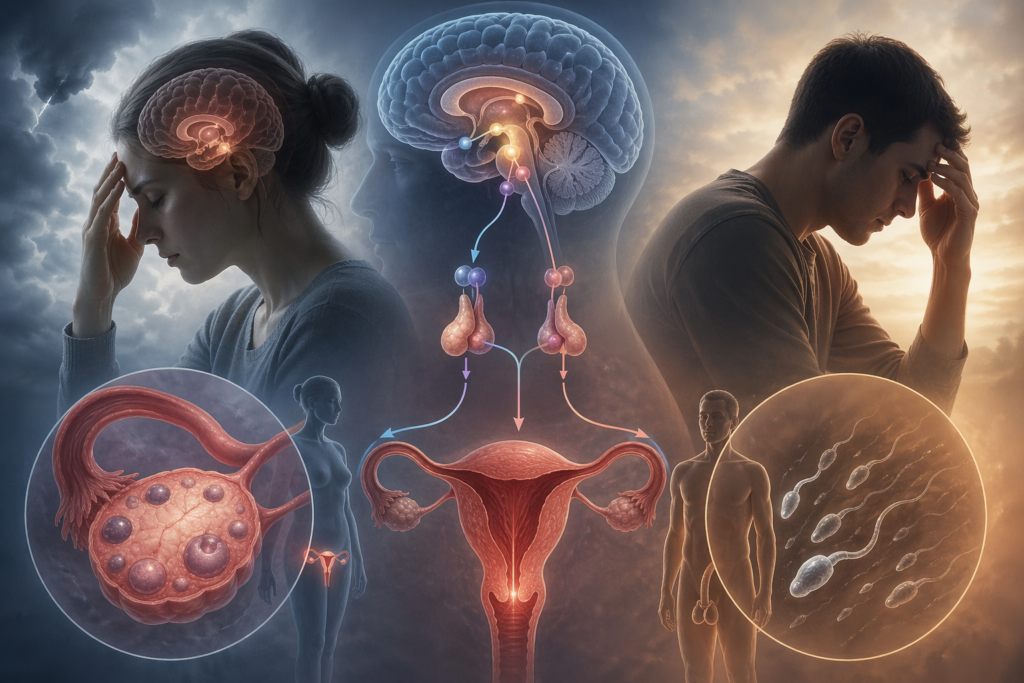
We often hear the frustratingly vague advice: “Just relax, and it will happen.” For those in the throes of infertility, this feels like an oversimplification. However, reproductive science suggests that this sentiment, while often delivered clumsily, is rooted in a physiological reality. Chronic stress and depression are not merely “feelings”; they are powerful biological signals that reconfigure the body’s priorities.
The HPA Axis: Survival Over Reproduction When the body perceives chronic stress or depression, it activates the Hypothalamic-Pituitary-Adrenal (HPA) axis. This is the body’s “emergency response” system, designed for survival, not reproduction. As cortisol levels rise, the body sends a clear signal to all non-essential systems: reproduction is not a priority right now.
Biologically, the human body is not designed for romance during a crisis. If the brain perceives the internal environment as “unsafe,” it will intentionally dial down reproductive function.
The Cascade of Reproductive Inhibition
- Disrupting Ovulation: The command chain for ovulation begins in the brain with GnRH (Gonadotropin-Releasing Hormone). Stress-induced cortisol can suppress this signal, leading to irregular cycles, delayed ovulation, or, in severe cases, anovulation. The reproductive system is essentially “downshifted” to a lower gear.
- Compromising Implantation: Even if an embryo is formed, the uterine environment is highly sensitive to systemic stress. Elevated cortisol and the resulting inflammation can decrease uterine blood flow and diminish endometrial receptivity, making it physically harder for an embryo to take root.
- Male Fertility: Men are equally susceptible. Stress lowers testosterone levels, impairs sperm count and motility, and can lead to a significant decline in overall reproductive capacity.
The Cycle of Dysfunction Depression and chronic stress do not act in isolation; they trigger a behavioral feedback loop. Disrupted sleep, reduced physical activity, and changes in nutrition—common side effects of depression—all serve to further destabilize hormonal rhythms. What begins as a state of mind quickly evolves into a state of physiological imbalance.
Reframing Infertility: A Multi-Variable Equation We must move away from the dangerous trap of believing that “removing stress will automatically result in pregnancy.” Fertility is a multi-variable equation; embryo quality, sperm health, uterine receptivity, and systemic hormonal balance must all cross specific “thresholds” to achieve a pregnancy. Depression acts as a weight that drags all these variables downward simultaneously.
A Call for Collective Care If you are struggling with the emotional toll of infertility, recognize that your mood is a physiological component of your treatment plan. Finding ways to mitigate chronic stress is not an act of “wishful thinking”; it is an act of biological optimization.
If the body treats stress as a “danger signal,” then the pursuit of psychological balance becomes a strategic move to signal “safety” back to the reproductive system. This is why joint efforts between couples are so vital—when both partners prioritize mental health and systemic stability, they aren’t just improving their mood; they are actively working to re-calibrate their reproductive potential.
Conclusion: Re-aligning the System Infertility is a complex biological puzzle. While you cannot always control the variables of egg quality or chromosomal normality, you can influence the internal “safety” of your system. Pregnancy is a systemic event, not a linear one. By tending to your emotional and physiological balance, you are creating an environment where the reproductive system feels safe enough to move from “survival mode” back into the possibility of creating life.
Sources: Guidelines from the European Society of Human Reproduction and Embryology (ESHRE) and the American Society for Reproductive Medicine (ASRM) regarding the impact of lifestyle and psychological stress on IVF outcomes.
Disclaimer: This report is for informational purposes. While psychological well-being is critical to systemic health, infertility often involves complex medical causes. Do not feel guilt if stress reduction does not yield immediate results; continue working with your fertility specialist to address the systemic factors of your specific case.