
Is an inability to conceive strictly a woman’s issue? The definitive answer is no.
For a long time, pregnancy has been culturally understood as an event that initiates exclusively within the female body. In fertility clinics, diagnostic evaluations have overwhelmingly centered around maternal age, ovarian reserve, and uterine receptivity; the global conversation inside consultation rooms naturally flowed in this direction. As long as the husband was not diagnosed with absolute azoospermia (무정자증), his reproductive health was largely deemed acceptable.
Today, that clinical paradigm has fundamentally shifted.
Contemporary breakthroughs in reproductive endocrinology are making one fact increasingly undeniable: pregnancy is a biological milestone that initiates simultaneously within two bodies, not one. Within this synchronized process, the critical factor that has been historically underestimated is the paternal sperm cell. A sperm cell is no longer viewed as a passive, simple delivery vehicle for DNA.
Recent longitudinal research reveals that sperm cells deliver far more than raw paternal genomic sequences; they actively transmit various RNA species, specific proteins, and complex epigenetic signals. These molecular signatures actively regulate initial embryonic development immediately following fertilization. Clinically, it has been repeatedly documented across numerous peer-reviewed studies that an elevated sperm DNA Fragmentation Index (DFI) directly correlates with decreased fertilization success, compromised embryo quality, and significantly lower implantation rates.
While these biological insights are firmly established facts, it is crucial to avoid exaggerated interpretations at this juncture.
Asserting that paternal sperm single-handedly “determines” the absolute fate of the embryo is scientifically inaccurate. The primary epicenter of early embryonic development remains heavily governed by the maternal oocyte. The cellular cytoplasm, the critical mitochondrial machinery, and the intricate biochemical mechanisms that regulate early cellular cleavage are predominantly provided by the egg.
Furthermore, the holistic uterine environment serves as a powerful variable that dictates reproductive outcomes long after implantation has concluded. The paternal genetic influence is undeniably present, but it functions as one vital axis within a highly complex, interconnected multi-organ system.
Why, then, is paternal sperm rightfully returning to the absolute center of clinical focus?
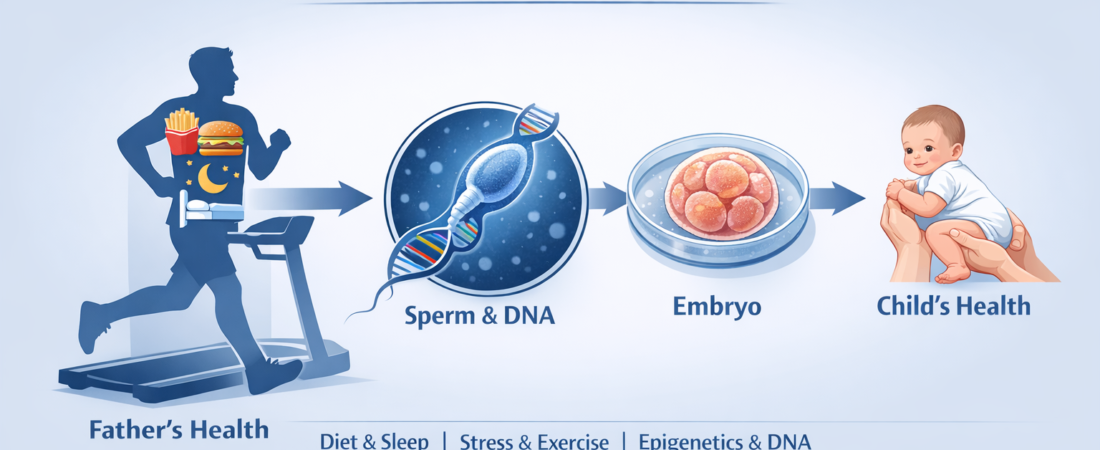
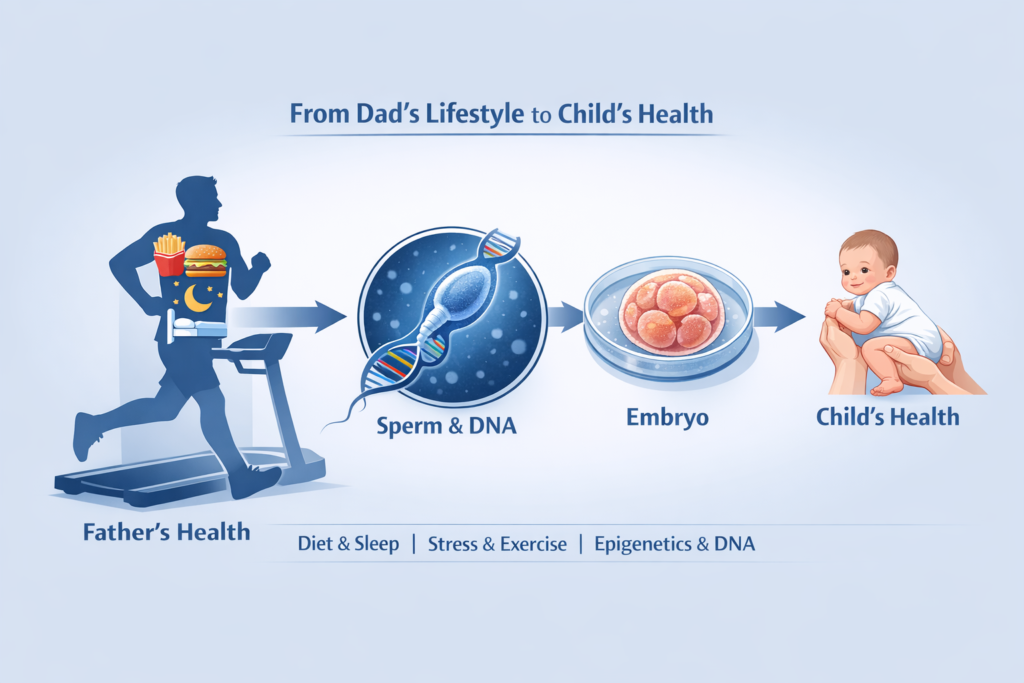
The explanation is remarkably simple: a sperm cell is an extraordinarily hyper-sensitive biological entity that reacts acutely to its surrounding micro-environment. Throughout its estimated 70-day manufacturing timeline (spermatogenesis), a man’s systemic metabolic profile, chronic low-grade inflammation levels, circadian sleep rhythms, psychological stress, and endocrine fluctuations are meticulously archived within the developing cells. These compounded variables directly alter the rate of paternal DNA damage, ultimately dictating the embryo’s developmental viability during its earliest cellular phases.
The clinical challenge arises when this complex biological reality is oversimplified into consumer marketing. The superficial question, “What specific superfood or supplement should I consume to immediately boost my sperm quality?” is continuously repeated by patients. However, the trajectory demonstrated by major clinical trials points in an entirely different direction. An isolated dietary choice lacks the power to radically transform gamete health; rather, it is the overarching, structural lifestyle architecture that drives the selection of that diet which fundamentally recalibrates sperm quality.
In short, the ultimate variable governing sperm health is not a single dietary ingredient. Ultra-processed foods (초가공식품) are less an isolated root cause and far more a downstream consequence of a fractured lifestyle architecture. Chronic sleep deprivation, physical inactivity, persistent psychological distress, and erratic nutritional timings all operate simultaneously to systematically degrade overall semen parameters.
Furthermore, emerging molecular research hints at the distinct possibility that an individual’s pre-conception paternal lifestyle can exert a lasting influence on the metabolic health profiles of future generations. However, this specific dimension must be interpreted with extreme clinical caution. Direct, unyielding causal relationships within human cohorts remain limited, as current data rests heavily on animal models or observational population registries. While the biological plausibility is firmly recognized, declaring this a definitively sealed scientific conclusion remains premature.
To summarize the clinical reality with absolute precision: a sperm cell does not single-handedly “determine” the ultimate outcome of a pregnancy. However, it undeniably exerts a powerful biological “influence” over the process. And that influence remains entirely malleable, continuously reshaped by the structural patterns of a man’s daily life.
📚 Medical References
- Zini A, Sigman M.
- “Are sperm DNA pathogenic parameters clinically useful? A systematic review.”
- Human Reproduction.
- Significance: Demonstrates that an escalation in sperm DNA fragmentation directly precipitates a reduction in fertilization success, compromised embryo morphology, and significantly lower baseline implantation rates.
- du Plessis SS, et al.
- “The effect of sedentary lifestyle and environmental factors on male factor infertility.”
- Asian Journal of Andrology.
- Significance: Establishes a direct correlation between systemic obesity, psychological stress, sleep deprivation, and lack of exercise with increased oxidative stress and elevated sperm DNA damage.
- Rando OJ, Simmons RA.
- “I’m eating for two: paternal dietary effects on next-generation metabolism.”
- Nature Reviews Genetics.
- Significance: Outlines how sperm cells deliver a complex payload of non-coding RNA and epigenetic data alongside paternal DNA, directly influencing early embryonic cleavage and potential long-term metabolic pathing.
Editor’s Note: This content is an analytical commentary prepared by a specialized fertility journalist through the collection and evaluation of domestic and international reproductive medicine research, clinical policies, and statistical data. The insights are further enriched by a comprehensive field analysis and direct correspondence with over 20 leading reproductive medical centers nationwide. All medical diagnoses and treatment decisions must exclusively be established through direct consultation with a qualified medical professional.
Image Source: AI-generated (ChatGPT, OpenAI) / Provided solely as a supplemental visual aid for conceptual understanding.