
The ‘First Meeting Place’ for Sperm and Egg: Secrets of the Fallopian Tubes
You ovulate well and your periods are regular. You’ve even been diagnosed with normal ovarian function. Yet, pregnancy rarely happens. One of the things these women hear most often in a fertility clinic is: “Let’s perform a fallopian tube test (HSG).”
Many people think of the fallopian tubes simply as a passage for the egg. However, reproductive medicine views them very differently. Experts state, “The fallopian tube is not just a pipe; it is the first stage where a new life begins.” In other words, it is the ‘meeting place’ where the sperm and egg first meet and choose each other.
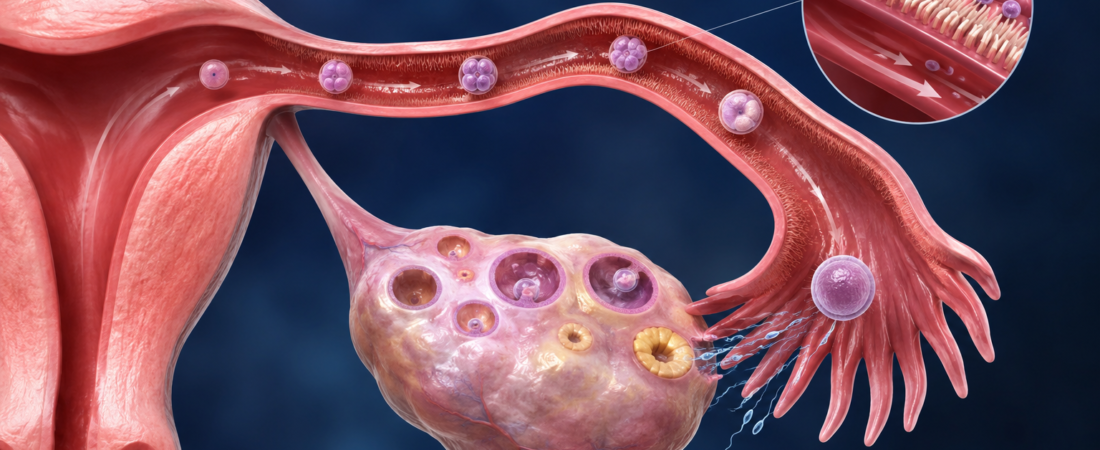
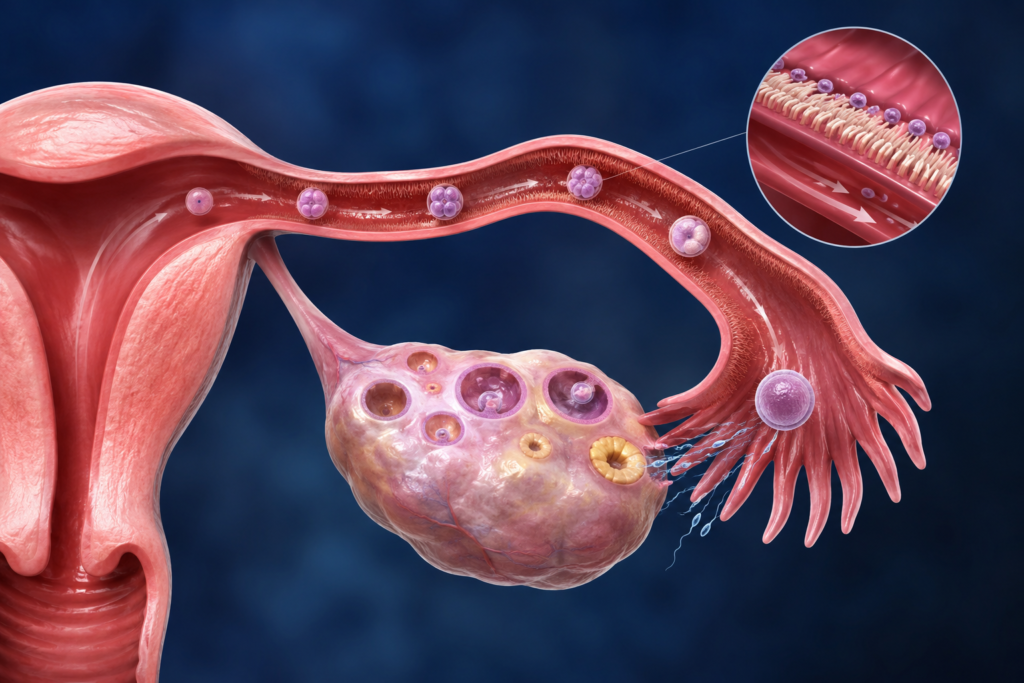
In reality, most natural pregnancies begin in the ampulla, the widest part of the fallopian tube. Some of the hundreds of millions of sperm reach this spot, and as the ovulated egg moves there, the two cells meet for the first time.
Fertilization takes place exactly at this ‘meeting place.’ Afterward, the fertilized egg travels slowly along the fallopian tube for several days, undergoing repeated cell division, before arriving at the uterus to implant.
It Is Not the Egg That Moves; It Is the ‘Fallopian Tube’
Many people think the egg moves toward the uterus on its own, but that is not the case.
The inside of the fallopian tube is densely packed with tiny hair-like structures called cilia. Like a wheat field swaying in the wind, these cilia constantly move in a uniform direction, pushing the fertilized egg toward the uterus. At the same time, the muscles of the fallopian tube rhythmically contract and relax to aid the movement of the fertilized egg.
In short, the fallopian tube is not a simple drainpipe, but a living organ that moves on its own.
The problem arises when inflammation, infection, or aging damages these cilia. Even if the fallopian tube is open, if the cilia do not move properly, the fertilized egg cannot reach the uterus in time. In this case, not only does natural pregnancy become difficult, but the risk of ectopic pregnancy also increases.
Why Do Fallopian Tubes Get Blocked?
The most common cause is pelvic inflammatory disease (PID).
Infections with few symptoms, such as Chlamydia or gonorrhea, are particularly problematic. If treatment is missed, scars form inside the fallopian tubes, eventually narrowing or completely blocking the path.
Endometriosis is also a major cause. Chronic inflammation causes adhesions where the fallopian tubes and ovaries stick to each other, preventing the egg from moving normally.
Adhesions occurring after abdominal surgeries—such as cesarean sections, ovarian cyst surgery, or appendectomies—are also cited as significant causes.
A More Fearsome Condition: ‘Hydrosalpinx’
A condition that has become increasingly important in recent reproductive medicine is hydrosalpinx, a condition where the end of the fallopian tube becomes blocked and fills with fluid. In the past, it was thought of as simply a blocked path, but recent research shows far more serious problems.
The fluid inside a hydrosalpinx can contain inflammatory substances and toxic components. If this fluid backflows into the uterus, it can hinder embryo implantation and potentially worsen the endometrial environment. Many studies and international clinical guidelines recommend that if hydrosalpinx is present, excising the damaged fallopian tube or blocking its connection to the uterus before IVF can improve pregnancy and birth rates.
“To Save or to Bypass?”
In the past, surgeries to reopen blocked fallopian tubes were actively performed. However, treatment strategies are changing.
Even if the fallopian tube is restored through microsurgery, the function of the cilia is often not recovered. If the internal function is already damaged, even if the path appears open on the outside, the success rate of natural pregnancy is not high, and the risk of ectopic pregnancy may actually increase.
For this reason, when both fallopian tubes are severely damaged or hydrosalpinx is present, the standard of care is increasingly shifting toward bypassing the damaged tubes and choosing In Vitro Fertilization (IVF) rather than trying to save the tubes at all costs. IVF allows sperm and eggs to meet and fertilize outside the body, after which the embryo is implanted directly into the uterus, effectively bypassing the damaged fallopian tubes.
The Fallopian Tube: The First Stage of Life, Not Just a ‘Road’
As fertility treatment advances, people tend to focus heavily on ovarian function and embryo quality. However, no matter how healthy the eggs and sperm are, if the place where they are meant to meet for the first time is not functioning properly, a natural pregnancy cannot begin.
The fallopian tube is not a simple passage. It is the first meeting place where sperm and egg encounter each other, the space where fertilization begins, and the setting for the first journey of life toward the uterus.
This is why fertility specialists emphasize that “fallopian tube issues are the most common reason for natural pregnancy failure.” A healthy pregnancy does not just begin with a good egg; it begins in the small space of the fallopian tube, where the sperm and egg first meet and form a bond. Therefore, doctors strongly recommend IVF—where fertilization occurs outside the body—when fallopian tubes are absent or blocked, as it is the only viable path to pregnancy.
※ This article was written based on the latest research published in international reproductive medicine journals, international infertility clinical guidelines (ESHRE/ASRM), and consultations with reproductive endocrinology specialists. It does not replace a specific individual’s diagnosis or treatment, and actual medical judgment must be made through consultation with a specialist.
※ Images: Created using generative AI (ChatGPT, OpenAI); depicts fictional individuals, not real people.