

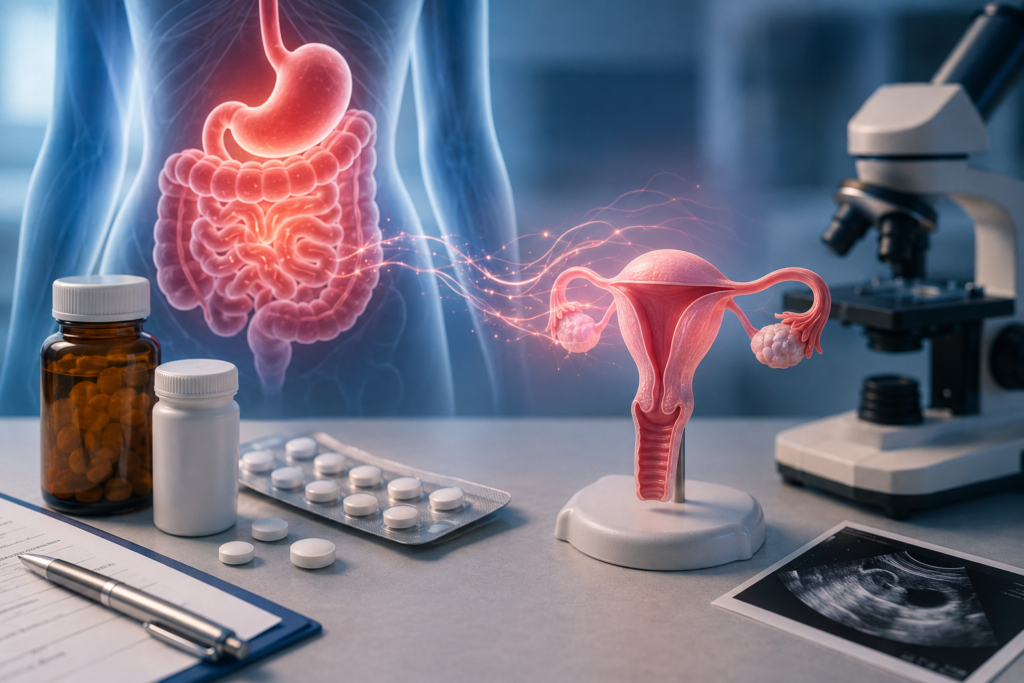
The Uncomfortable Truth About Stomach Medicine and Ovulation
The stomach and the ovaries seem unrelated. One is an organ for digesting food, while the other is the organ that creates life. Therefore, the fact that stomach medicine can affect ovulation is unfamiliar to most people.
However, the human body does not function in isolated segments. The stomach and the ovaries are closely connected within a single network of brain and hormones. Some stomach medications can alter the brain’s hormonal control system during the process of treating the digestive tract, and as a result, shake up the ovulation cycle. In fact, when evaluating unexplained menstrual irregularities or ovulation disorders, the medications currently being taken are often crucial clues.
Of course, not all stomach medicines are problematic. Most acid suppressants or over-the-counter antacids do not directly affect ovulation. However, it is a different story for some prokinetic agents (drugs that stimulate gastrointestinal motility).
Prokinetic agents help food move smoothly by stimulating the activity of the stomach and intestines. However, some of these inhibit the action of a neurotransmitter in the brain called dopamine.
Dopamine is not just a substance that regulates gastrointestinal motility. It also plays a vital role in the pituitary gland by inhibiting the excessive secretion of prolactin.
If dopamine’s action is weakened, prolactin levels rise easily. Prolactin is a hormone that helps secrete breast milk after childbirth, but in non-pregnant women, it actually acts to suppress reproductive function. The brain perceives the body as if it were already pregnant and reduces the secretion of GnRH (gonadotropin-releasing hormone) from the hypothalamus. Subsequently, the secretion of LH (luteinizing hormone) and FSH (follicle-stimulating hormone) decreases, which slows down follicle maturation and can delay or completely stop ovulation. This is why the menstrual cycle becomes prolonged or irregular, and in severe cases, it can lead to amenorrhea.
This phenomenon is well-known in fertility medicine as an ovulation disorder caused by hyperprolactinemia. Indeed, it has been reported that some prokinetic agents—such as metoclopramide, domperidone, and levosulpiride—can lead to increased prolactin levels, menstrual irregularities, galactorrhea (breast milk secretion), and ovulation disorders when taken long-term.
Ovulation Is Not Determined by the Ovaries Alone
While it does not happen to everyone, it can have a significant impact on women who are sensitive to hormonal changes.
For women preparing for pregnancy or undergoing fertility treatment, even small hormonal changes are never trivial. Even if ovulation is delayed by just a few days, pregnancy plans can be disrupted, and in assisted reproductive technology (ART), follicular growth and the timing of ovulation must be precisely matched. It is not rare for an ovulation disorder that had no clear cause to be traced back to the medication the patient is taking.
Drugs that suppress stomach acid need to be approached in a slightly different way. Proton pump inhibitors (PPIs) do not directly suppress ovulation. However, studies have reported that long-term use for several months to years can decrease the absorption of Vitamin B12, iron, and magnesium. These nutrients play important roles in cellular energy production and the egg maturation process. While a direct causal link cannot be determined, long-term nutrient deficiency may potentially create an unfavorable environment for ovarian function.
In some cases, the condition itself, rather than the medication, exerts an impact. People who take stomach medicine for a long time due to chronic gastritis, gastroesophageal reflux disease, or functional dyspepsia often suffer from persistent pain and stress. Chronic stress increases cortisol secretion, which in turn affects the reproductive hormone regulatory function of the hypothalamus and pituitary gland, potentially shaking ovulation. Ultimately, the medication, the disease, and stress are acting in a complex combination.
Therefore, if unexplained menstrual irregularities or ovulation disorders persist, you need to re-examine the medications you are currently taking. This is because not only stomach medicines, but also psychiatric drugs, some blood pressure medications, and hormone agents can affect reproductive hormones. If necessary, performing a prolactin test and checking the ingredients of the medications you are taking can be an important starting point for diagnosis.
You should not stop taking medications arbitrarily, but there are many cases where ovulation is restored to normal just by consulting with your doctor to change to a different drug or adjust the dosage.
Ovulation is not a phenomenon created by the ovaries alone. The brain, digestive tract, hormones, nutritional status, stress, and even the medications you take are all organically connected within a single reproductive system.
While many women meticulously take folic acid and vitamins while preparing for pregnancy, they often overlook the stomach medicine they take every day. However, the cause of infertility can sometimes be hidden in the most familiar medicine cabinet. This is because ovulation is not just a matter for the ovaries, but a signal of life created by the entire body working together.
※ This article was written based on clinical practice guidelines for infertility and reproductive endocrinology from the American Society for Reproductive Medicine (ASRM), European Society of Human Reproduction and Embryology (ESHRE), and American College of Obstetricians and Gynecologists (ACOG), as well as drug approval information, medication safety data, and research results published in international academic journals related to endocrinology and reproductive medicine. It does not replace specific individual diagnosis or treatment, and actual medical judgment must be made through consultation with a specialist.
※ The image used in this article is a visual aid created using generative AI (ChatGPT, OpenAI) and does not depict a real person.