
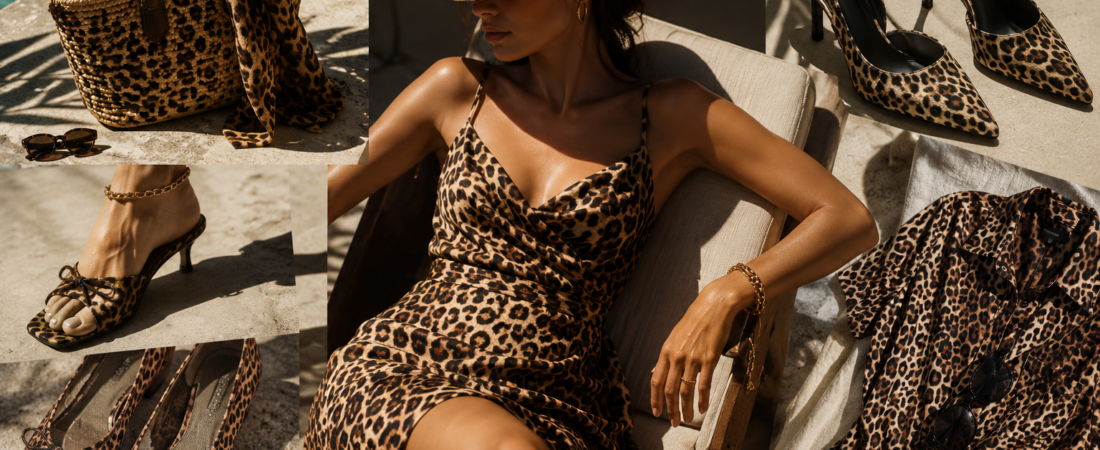

Leopard and tiger prints are everywhere. You see them on the runways, in department stores, and scrolling through social media feeds. Once derided as a symbol of kitschy, exaggerated taste, these animal prints have reclaimed their place at the center of sophisticated, powerful fashion.
This trend prompts a curious question: Why are we so drawn to the patterns of tigers and leopards?
It is a biological irony. Tigers and leopards are not the most prolific breeders in nature. They require vast territories, engage in fierce competition for prey, and face immense difficulty in raising their offspring to adulthood. Behind the glorious title of “apex predator” lies a lonely and precarious history of survival. In traditional Eastern divination, the “Tiger” energy was often even associated with a difficulty in bearing children. They were never the symbols of fertility.
Yet, we admire them. We admire their power, their independence, their authority—and at times, their solitude.
Contrast this with the rabbit or the mouse. These are the champions of nature’s reproductive race—animals that propagate rapidly and ensure the survival of their lineage with ease. If human society prioritized reproduction and survival above all else, the fashion world would be dominated by rabbit-fur patterns and rodent-inspired motifs.
In reality, the opposite is true. We are attracted to the rare, not the common. We gravitate toward what is difficult to attain, not what is plentiful. Human values have shifted from “quantity” to “scarcity.”
In the agrarian past, numbers were the ultimate source of power. A large family meant wealth; a massive workforce meant survival. Countries measured their greatness by population growth. But the paradigm has flipped. Today, the most valuable things are those that cannot be owned by everyone. Limited editions are the most coveted; unique works of art command the highest prices. Companies prioritize originality over scale. People no longer aspire to be part of a “crowd”; they aspire to be “extraordinary.”
Perhaps the leopard print trend is a reflection of this zeitgeist. It is symbolic that in a nation with the world’s lowest birth rate, the most popular fashion pattern belongs to an apex predator—an animal that is fundamentally difficult to breed. This is not to suggest a direct causal link between fashion and fertility trends, but rather to observe that a society’s aesthetic choices reveal its collective unconscious.
We no longer live in an era of “plenty.” We live in an era of “rarity.” In a world where differentiation is the only true competitive advantage, the tiger is more than just an animal. It is an icon representing the human desire to be distinct, independent, and rare.
When people wear these prints, they are not just choosing a pattern. They are “wearing” strength, freedom, and independence. They are cloaking themselves in the modern human desire to be unlike anyone else—to be an individual in an age that prizes uniqueness above all.
The popularity of animal prints is not merely a fashion cycle. It is a reflection of the values this era craves most: strength, freedom, independence, and above all, the instinctual human desire to exist as a singular, irreplaceable being.
Sources: Perspectives from the ‘Population Reader’ (人口讀本) column by Lee Seung-ju; cultural and sociological observations on modern aesthetic trends.
Disclaimer: This column is a sociological reflection on cultural trends and is intended for informational and analytical purposes.