
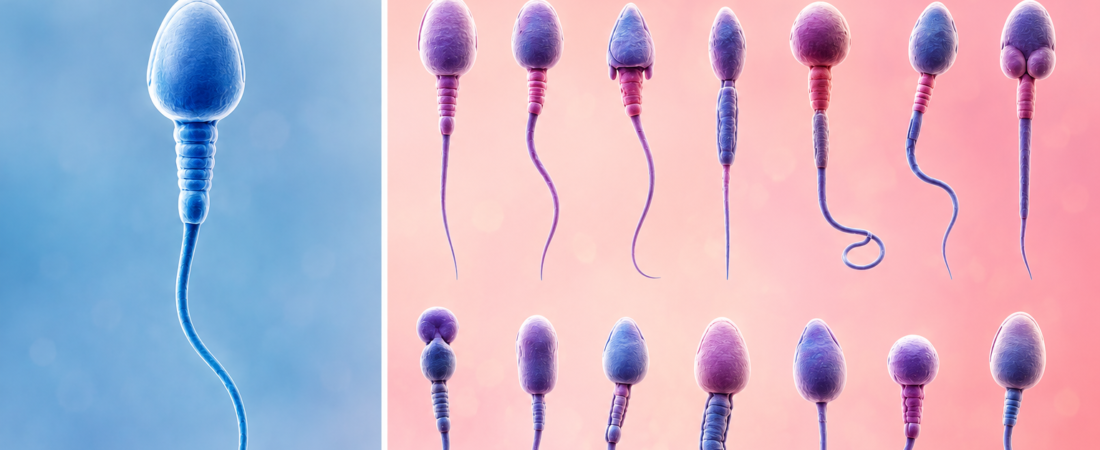
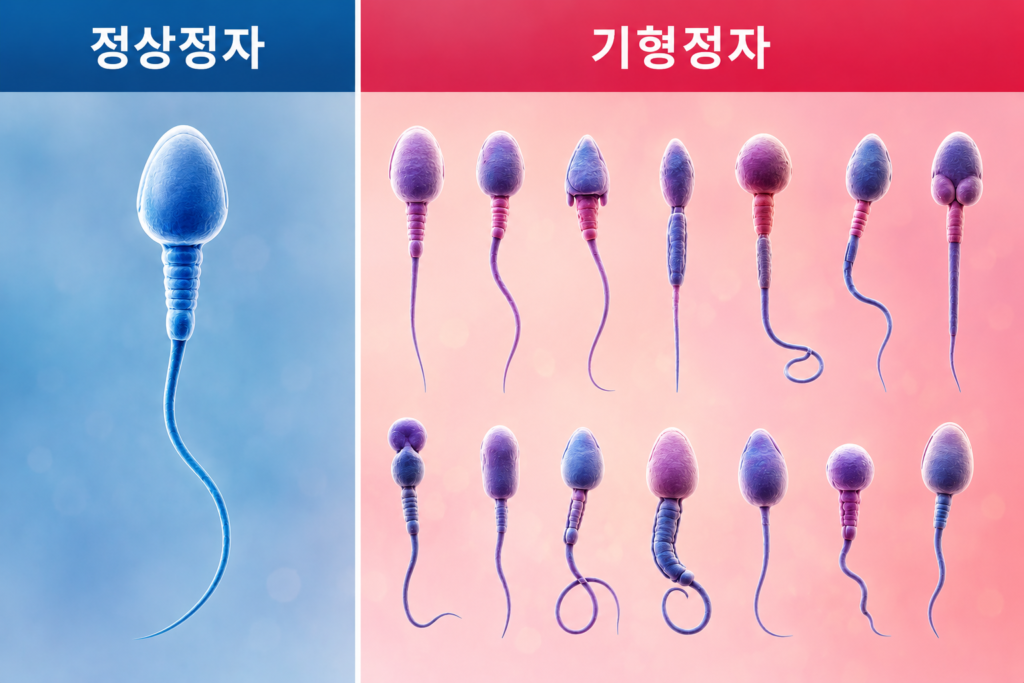
One of the most shocking numbers for men reviewing their semen analysis is the morphology score. When a report indicates that only 3%, 2%, or even 1% of sperm are “normal,” many men immediately conclude they are infertile. A common question in the clinic is, “Does this mean the remaining 99% are defective?”
To understand this, we must accept an uncomfortable truth: humans are naturally a species that produces a high percentage of morphologically abnormal sperm.
The WHO Standard: A High Bar for Perfection The World Health Organization (WHO) considers a normal morphology of 4% or higher to be within the normal range. To many, a “passing grade” of 4% seems absurdly low. However, this is because the criteria for a “normal” sperm are incredibly stringent.
Sperm are composed of a head, mid-piece, and tail. If the head is slightly too large or too small, it is classified as abnormal. If the tail is slightly bent or the mid-piece is misshapen, it is also classified as abnormal. Because the criteria are so rigorous, many sperm that are perfectly capable of fertilization are categorized as “abnormal”.
Evolutionary Strategy: Mass Production over Quality Control Why does the human body produce so many “imperfect” sperm?
- The testes are high-volume manufacturing plants, producing tens of millions of sperm daily.
- In this complex process of rapid cell division and DNA replication, a certain rate of error is biologically inevitable.
- Evolutionarily, this is an efficient strategy: rather than crafting a few “elite” sperm, the human system produces a vast quantity and lets natural competition filter out the anomalies, favoring a “volume-based” survival strategy.
Why Morphology Isn’t the Only Predictor A low morphology score does not mean pregnancy is impossible. In reality, fertility is a complex equation involving sperm count, motility, DNA integrity, the female partner’s age, ovulation status, and tubal health.
- Even with a 2% morphology rate, if the concentration is high (e.g., 100 million per mL), there are still 2 million “normal” sperm present—which is often sufficient for natural conception.
- Modern reproductive medicine is shifting its focus from morphology to DNA fragmentation, as sperm that appear structurally normal can still harbor damaged genetic information.
- In IVF, Intracytoplasmic Sperm Injection (ICSI) allows embryologists to manually select the healthiest-looking, most motile sperm and inject it directly into the egg, effectively bypassing structural limitations.
Conclusion: Your Lifestyle is Your Quality Control Sperm cells are not static; they are renewed every 70–80 days. This means your current lifestyle directly dictates the “face” of your sperm three months from now.
- Temperature Matters: The testes function best at 2–3°C below core body temperature. Avoiding saunas, hot tubs, prolonged sitting, and laptop use on your lap is essential.
- Lifestyle Optimization: Quitting smoking, managing weight, exercising, and getting adequate sleep can significantly improve sperm parameters within three months.
Do not be discouraged by a single number on a report. View it as a mirror of your current health and an opportunity to optimize your systemic well-being for the future.
Sources: WHO Laboratory Manual for the Examination and Processing of Human Semen (6th Ed.); Male Infertility (Campbell-Walsh-Wein Urology); Clinical guidelines from ASRM, ESHRE, and EAU.
Disclaimer: This report is for informational purposes. If you have concerns about your fertility, consult with a urologist or reproductive specialist for a personalized evaluation.