
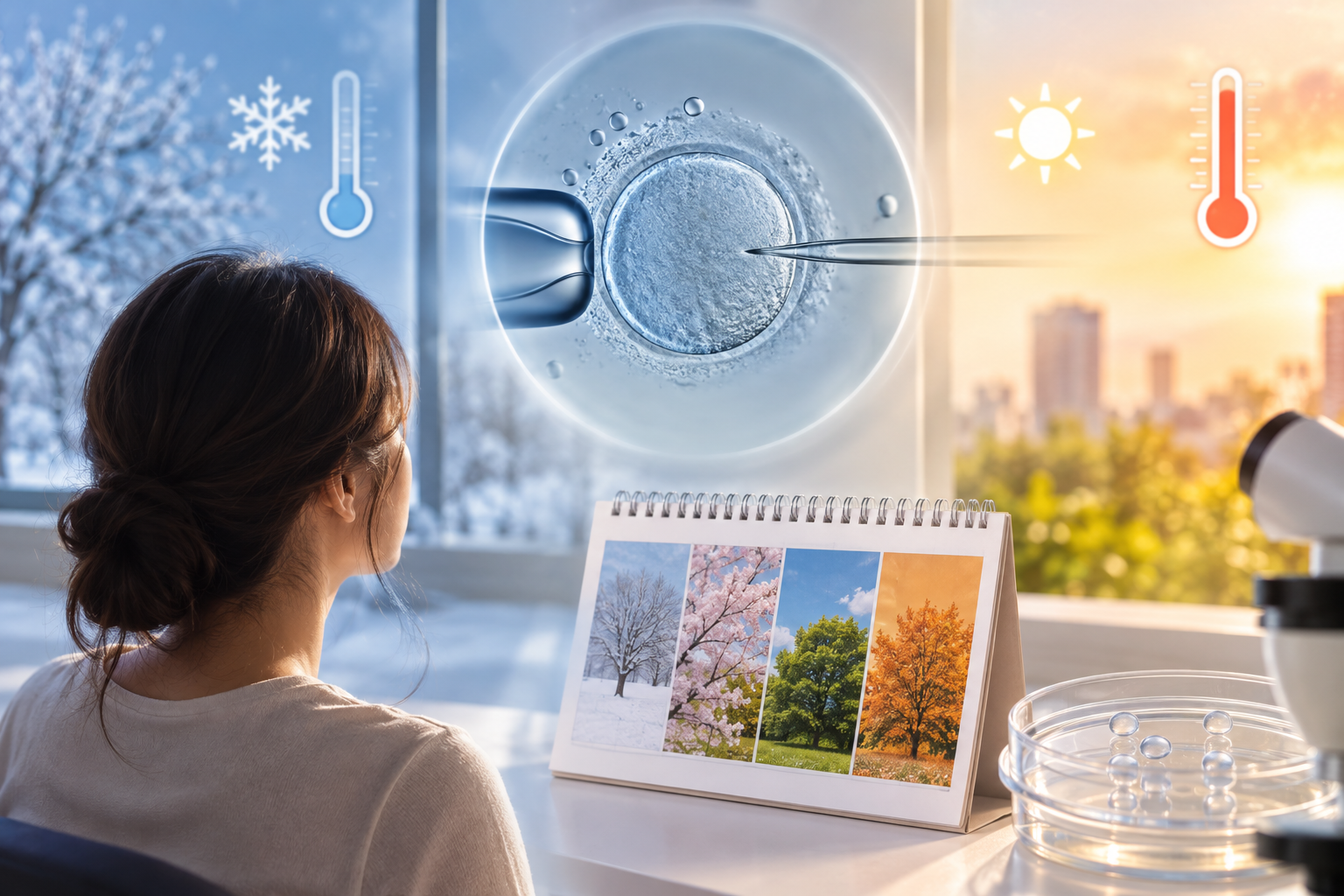
A study of 58,468 first IVF/ICSI treatments linked each 1°C rise in ambient temperature to 0.25% fewer retrieved eggs.
Fertilization and blastocyst formation rates did not show clear adverse associations, and seasonal treatment delays were not tested.
Higher outdoor temperatures before IVF egg retrieval were associated with slightly lower egg yield in a large Chinese study. The analysis also found small reductions in mature and normally fertilized egg numbers, with reproductive hormones potentially explaining part of the relationship.
Researchers including a team at Chongqing Medical University examined 58,468 women undergoing their first IVF or ICSI treatment.
Published online August 2 and in the October 2026 issue of Human Reproduction, the findings raise environmental research questions. They do not establish that waiting for winter improves the chance of a baby.
Small average differences per degree of temperature
The retrospective study covered January 2018 through May 2024. Researchers estimated outdoor temperature and apparent temperature, incorporating humidity, based on residential location before egg retrieval.
They assessed retrieved eggs, mature eggs and normally fertilized eggs, alongside fertilization and blastocyst formation rates.
Each 1°C increase in ambient temperature was associated with average reductions of 0.25% in retrieved eggs, 0.22% in mature eggs and 0.22% in normally fertilized eggs.
For apparent temperature, the corresponding reductions were 0.20%, 0.17% and 0.19% per degree.
These are average proportional changes across the population, not a fixed number of eggs lost by every individual. Age, ovarian reserve and stimulation approach also influence response.
Fertilization and blastocyst formation rates did not clearly decline
The results did not show statistically significant associations between temperature and normal fertilization or blastocyst formation rates.
For exposure windows of three weeks and 90 days, the proportion of mature eggs was slightly higher with warmer temperatures.
Thus, fewer retrieved eggs did not necessarily mean a lower fertilization or blastocyst formation rate among the available eggs.
IVF outcomes depend on maturity, fertilization, embryo development, chromosome status and the uterine environment as well as egg numbers.
The main outcomes here concerned retrieval and early fertilization, not pregnancy or live birth. The study cannot establish that hot-weather retrieval lowers embryo quality or pregnancy success.
Reproductive hormones may explain a small part
The researchers examined baseline luteinizing hormone (LH), follicle-stimulating hormone (FSH) and estradiol (E2), all relevant to follicle growth and maturation.
LH statistically mediated up to 5.23% of the association between temperature and reduced egg yield.
FSH and estradiol showed patterns that partly offset the negative association.
These analyses suggest possible hormonal pathways, but LH explained only a small proportion. Other mechanisms remain unresolved, and hormonal mediation itself requires further causal investigation.
Exposure before retrieval, not just the weather that day
Follicles develop over an extended period before stimulation supports their final growth. The study therefore examined several exposure windows, including three weeks and 90 days.
Some associations involved these longer periods, pointing beyond the weather on retrieval day.
However, residential outdoor estimates do not directly measure an individual's experience indoors and outdoors. Air conditioning and occupational heat exposure were not fully captured.
Should egg retrieval be postponed until a cooler season?
The evidence is insufficient to recommend avoiding summer or waiting until winter.
A 0.25% average change per degree is comparatively small. Statistical significance does not guarantee a clinically important difference for every patient.
Age and ovarian reserve are major considerations. Delaying treatment can be disadvantageous, particularly with older age or reduced reserve.
Previous findings are also inconsistent. A 2025 US egg-donation study found an uncertain negative association with egg yield but positive associations for some survival and fertilization measures.
No season can currently be identified as universally optimal from these data.
Environmental research is not proof of a lifestyle intervention
The study connects climate-related exposure with specific IVF measures and suggests that temperature might add information beyond age, AMH, antral follicle count and stimulation dose.
Baseline reproductive hormones may also merit investigation when assessing response under higher-temperature conditions.
It has not been demonstrated that stronger air conditioning or reducing outdoor activity increases egg yield. An exposure association is not proof that an intervention works.
The observational design cannot establish direct causation. Future research needs better personal exposure measurement and follow-up through pregnancy and birth.
For now, the research supports closer study of the treatment environment while age, reserve and individual clinical circumstances remain central to timing decisions.
Study source
Yi-Yan Zeng, Yu-Ling Hu, Rui-Ling Liu and colleagues: “Ambient temperature reduces oocyte yield in assisted reproductive technology via a partially sex hormone-mediated pathway.” Human Reproduction, 2026;41(10):1725–1740. Published online August 2, 2026. DOI: 10.1093/humrep/deag128. PMID: 42542932.
The illustration was generated using ChatGPT (OpenAI). Any people depicted are fictional.
Related reading
Low AMH and egg quality: why egg numbers and per-embryo outcomes differ
Copyright © 2026 THE FERTILITY NOTES. All rights reserved. Unauthorized reproduction, copying, redistribution, scraping, AI training, or data use of any content, including articles, photographs, and images, is strictly prohibited. Violations may result in legal liability.