

Steroids are sometimes prescribed to modify immune responses around embryo transfer, but a trial in 715 women with recurrent implantation failure found no live-birth benefit.
Suppressing immune activity does not necessarily improve pregnancy outcomes; the reason for each prescription matters.
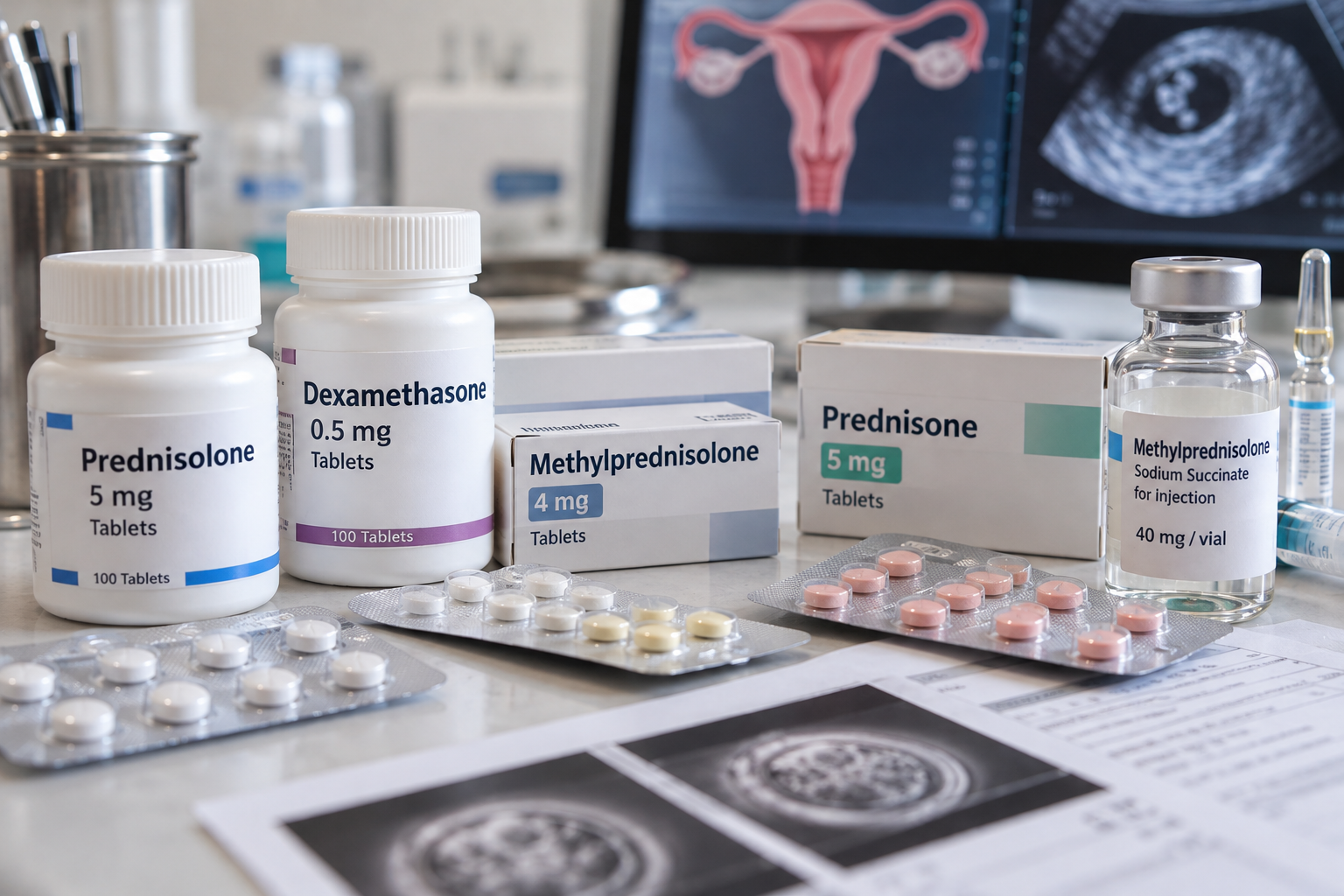
Some women undergoing IVF receive steroids before or after embryo transfer, intended to reduce inflammation and modify immune activity to support implantation. They are sometimes offered after repeated failed transfers.
Do they actually increase the chance of pregnancy?
The clinical evidence is less reassuring than the rationale might suggest. Although steroids suppress immune responses, evidence that this improves IVF pregnancy or live-birth rates is insufficient.
Why are steroids used around implantation?
Steroids used in IVF are generally glucocorticoids, including prednisone, prednisolone, methylprednisolone and dexamethasone.
They suppress inflammation and influence immune-cell activity. Fertility treatment has used these properties in an attempt to create a more favorable endometrial environment.
Embryos contain paternal as well as maternal genetic material. Interactions between the maternal immune system and the embryo are therefore important in establishing pregnancy.
The hypothesis that excessive immune activity might interfere with implantation led to the use of steroids to suppress it.
However, implantation also requires appropriate inflammatory signaling and immune-cell activity. Suppression does not automatically create favorable conditions.
A randomized trial in 715 women found no live-birth benefit
A major trial evaluating this question was published in JAMA in 2023.
Chinese researchers studied prednisone in 715 women with recurrent implantation failure.
The randomized, double-blind trial assigned 357 women to prednisone and 358 to placebo.
Live-birth rates were 37.8% and 38.8%, respectively, without a statistically significant difference.
Biochemical pregnancy loss and preterm birth were observed more often in the prednisone group. These findings do not mean that every steroid prescription carries identical risks.
They do support reconsideration of routine steroid use for recurrent implantation failure.
Do elevated immune-test results mean steroids are needed?
Some patients are offered steroids on the basis of natural killer (NK) cell activity or other immune tests.
It is unclear how accurately blood NK-cell measurements reflect the immune environment within the endometrium.
A high immune-test result alone cannot reliably establish an implantation problem or predict benefit from steroid treatment.
ESHRE’s recommendations also encourage caution with insufficiently supported immunological tests and treatments in recurrent implantation failure.
Not every steroid prescription is unnecessary
Insufficient evidence of improved IVF success does not mean that steroids have no legitimate use.
Patients with autoimmune diseases such as lupus, or certain endocrine disorders, may need them to control an underlying condition.
That indication must be distinguished from empirical prescribing intended to improve implantation.
Potential adverse effects include elevated blood glucose, insomnia, gastrointestinal symptoms, mood changes and increased infection risk. Drug choice, dose and duration need particular care in women with diabetes or hypertension.
Assessing causes is more useful than assuming immune suppression helps
Repeated failed transfers should not be attributed solely to immune abnormalities.
Age, embryo chromosome status and development, uterine-cavity abnormalities, endometrial condition and the transfer procedure all merit consideration.
For add-ons without established benefit, explaining the purpose, expected effects and adverse effects is especially important.
Adding medication does not necessarily improve IVF success. The relevant questions are whether a patient has a medical indication and whether evidence supports the expected benefit.
This article is based on “Prednisone vs Placebo and Live Birth in Patients With Recurrent Implantation Failure Undergoing In Vitro Fertilization: A Randomized Clinical Trial,” published in JAMA in May 2023 by investigators from eight Chinese fertility centers, including Shanghai Jiao Tong University School of Medicine, and ESHRE recommendations on recurrent implantation failure. DOI: 10.1001/jama.2023.5302. PMID: 37129654.
The need for steroids depends on their indication and underlying disease. Patients already taking them should not stop independently; they should discuss treatment with their fertility specialist.
The accompanying image was created using generative AI (ChatGPT, OpenAI).
Related reading: What an intralipid study can and cannot tell us about IVF add-ons
Copyright © 2026 Fertility Information TokTok Fertility News | THE FERTILITY NOTES. All rights reserved. Unauthorized reproduction, copying, redistribution, scraping, AI training, and other data use of any articles, photographs, images, or other content are strictly prohibited. Violations may result in legal liability.