
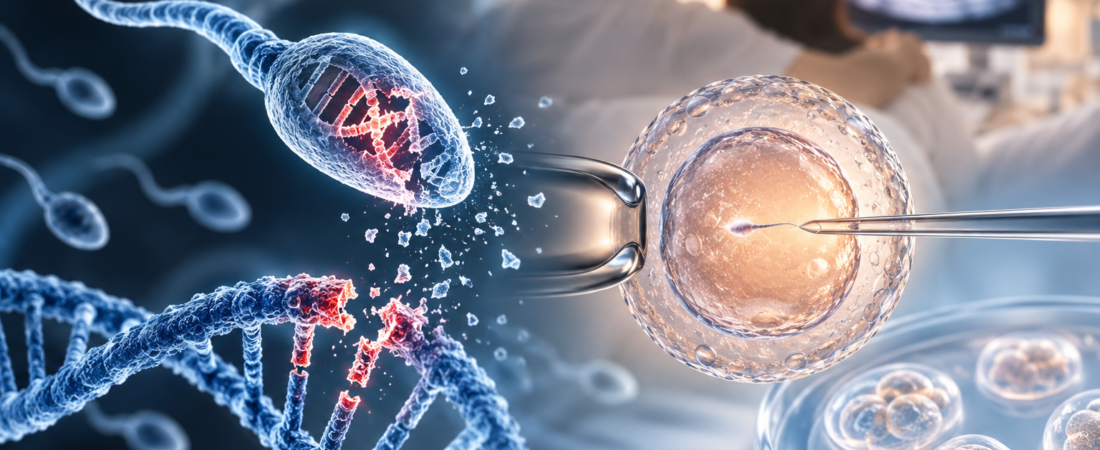
Does more sperm DNA damage necessarily mean a lower chance of IVF success? A study of 4,520 couples found poorer semen quality at higher DNA fragmentation levels, but no clear association with lower clinical pregnancy or live birth rates.
Higher DNA fragmentation was associated with lower sperm count, motility and normal morphology. Among men with higher body mass index, it was also associated with lower fertilization rates. Yet a single test result did not tell the whole story of pregnancy and birth.
Even when sperm count and movement appear normal, DNA damage can raise concerns about fertilization and embryo development. This is particularly relevant to couples who have experienced repeated implantation failure or miscarriage.
Researchers at Fujian Maternity and Child Health Hospital in China reviewed treatment records to examine sperm DNA fragmentation alongside fertilization, embryo development, pregnancy, miscarriage and live birth. The study was published in Andrology in October 2026.
Higher sperm DNA fragmentation was associated with poorer semen quality
The DNA fragmentation index, or DFI, measures damage to the genetic material inside sperm. Standard semen analysis evaluates sperm number, movement and shape; a fragmentation test examines damage to the DNA itself.
The researchers retrospectively analyzed records from 4,520 couples who underwent fresh embryo transfer following IVF or ICSI between June 2018 and January 2025.
They compared groups with DFI below 15% and DFI of 15% or higher, while also examining differences by the man's body mass index, or BMI.
Higher DFI was associated with lower sperm concentration, total sperm count, motility and the proportion of normally shaped sperm. These associations were more pronounced in men with higher BMI.
This suggests that sperm DNA damage may be related to broader semen quality, as well as to the integrity of the genetic material.
Fertilization findings differed by body mass index
One notable finding was that the relationship between DNA damage and fertilization differed according to BMI.
Among men with higher BMI, higher DFI was associated with a lower fertilization rate. Among men with lower BMI, however, an unexpected result emerged.
The high-DFI group had a higher proportion of good-quality embryos. The association remained in adjusted analyses, but the researchers cautioned that this subgroup was relatively small.
This does not mean DNA damage improves embryo quality. Rather, the findings suggest that associations may differ across groups and should be interpreted alongside physical characteristics such as BMI.
No clear difference in pregnancy or live birth
The analysis of pregnancy and birth outcomes was particularly important.
The researchers examined DFI in relation to blastocyst formation, clinical pregnancy, miscarriage, live birth, fetal aneuploidy—an abnormal number of chromosomes—and congenital defects.
Higher DFI was not significantly associated with lower clinical pregnancy or live birth rates. Associations with miscarriage, fetal aneuploidy and congenital defects were also not statistically significant.
Results were broadly consistent when DFI was analyzed as a continuous measure or when the threshold was changed to 20%. Analyses separating conventional IVF and ICSI showed similar patterns.
The findings suggest that DNA fragmentation can be related to semen quality and some stages of fertilization, while remaining insufficient on its own to predict pregnancy or birth.
However, the absence of a statistically significant association does not prove that sperm DNA damage has no effect on pregnancy outcomes. This retrospective observational study, based on past medical records, cannot establish causation.
A DNA fragmentation result should not determine prognosis alone
Sperm DNA fragmentation testing has attracted interest in unexplained male infertility and repeated treatment failure. A high result does not establish that fertilization will fail or that a pregnancy cannot continue.
IVF outcomes reflect many interacting factors, including sperm characteristics, the woman's age and egg quality, embryo chromosomal status and the endometrial environment.
The study underlines the importance of interpreting DNA damage measures alongside male BMI, semen analysis and the couple's clinical characteristics.
A high DFI alone should therefore not lead to an overly pessimistic view of pregnancy prospects or an assumption that a particular treatment is necessarily required.
Assessment needs to consider eggs, sperm, embryo development and the woman's reproductive environment together. DNA fragmentation testing may help characterize male reproductive health, but the study does not support using it as a decisive standalone predictor of birth.
Source: A retrospective cohort study in Andrology examining sperm DNA fragmentation index and outcomes after fresh embryo transfer. DOI: 10.1111/andr.70379.
Related reading
Korean male infertility recommendations: looking beyond sperm counts
The image was created using generative AI (ChatGPT, OpenAI). Any people depicted are fictional, not real individuals.
Copyright © 2026 Fertility Information TokTok | THE FERTILITY NOTES. All rights reserved. Unauthorized republication, reproduction, redistribution, scraping, AI training and data use of any content, including articles, photographs and images, are strictly prohibited. Violations may result in legal liability.