

- 561 Women Randomly Allocated Across 5 Belgian Fertility Centers: Clinical pregnancy rates show no major difference at 33.1% for natural cycles vs. 28.9% for hormone replacement cycles
- Natural cycle cancellation rate at 3.9%, lower than hormone replacement cycles at 9.4%… but requires more hospital visits
- Cesarean section rates stand at 20.2% vs. 42.7%… “Obstetric outcomes require further research”
Women preparing for a Frozen Embryo Transfer (FET) often face a difficult question:
“Should I wait until I ovulate naturally before transferring the embryo?”
“Or is it better to use estrogen and progesterone to prepare the uterine lining and schedule the transfer date?”
A randomized controlled trial conducted across 5 fertility centers in Belgium involving 561 women compared natural-cycle FET with hormone replacement cycle (artificial cycle) FET and found no significant difference in pregnancy success rates.
However, the natural cycle demonstrated a lower rate of cycle cancellation before transfer, and the proportion of Cesarean deliveries among women who gave birth was notably lower in the natural cycle group compared to the hormone replacement group.
Study Overview and Pregnancy Success Rates
This study was published in the August 2026 issue of the international journal Human Reproduction, following its online pre-release in June. The researchers randomly assigned 561 regularly ovulating women aged 18 to 45 into two cohorts: 284 in the natural cycle group and 277 in the hormone replacement cycle group.
The fundamental difference between the two protocols lies in how the endometrium is prepared for implantation:
- Natural Cycle: Relies on the body’s natural ovulation process. Follicular growth and hormonal shifts are tracked via ultrasound scans and blood tests, and the frozen embryo is thawed and transferred in alignment with ovulation.
- Hormone Replacement Cycle: Exogenous estrogen is administered to develop the endometrium, followed by progesterone supplementation to control the precise date of transfer.
In short, the natural cycle follows the body’s internal clock, while the hormone replacement cycle regulates the uterine schedule with medication.
The primary outcome—pregnancy rate—was comparable between both groups. The clinical pregnancy rate, confirmed by fetal cardiac activity on ultrasound, was 33.1% in the natural cycle group and 28.9% in the hormone replacement group. Although the natural cycle showed a roughly 4 percentage point higher raw rate, the difference was not statistically significant.
Based on this trial alone, it cannot be concluded that natural cycles lead to superior pregnancy rates compared to hormone replacement cycles.
Cancellation Rates and Clinic Visits
A clearer difference emerged in cycle cancellation rates. In the natural cycle group, 3.9% of cycles were canceled before reaching the transfer stage, compared to 9.4% in the hormone replacement group—representing a cancellation rate less than half that of the artificial cycle.
However, natural cycles are not without logistical demands. Accurately pinpointing the window of natural ovulation requires close, ongoing monitoring:
- Average monitoring visits: 3.0 visits for natural cycles vs. 2.4 visits for hormone replacement cycles.
For patients who face challenges visiting the clinic frequently due to work commitments or travel distance, hormone replacement cycles may offer greater scheduling convenience.
Delivery Methods: The Cesarean Disparity
An unexpected and noteworthy finding involved the mode of delivery. The Cesarean section rate was 20.2% in the natural cycle group, compared to 42.7% in the hormone replacement group—more than double. Pregnancies achieved through natural cycles resulted in significantly fewer Cesarean births.
In recent years, reproductive medicine has increasingly investigated whether the absence of a corpus luteum in anovulatory hormone replacement FET cycles impacts downstream obstetric outcomes. Because the corpus luteum secretes not only progesterone in early pregnancy but also vasoactive substances involved in vascular and blood pressure regulation, physiological differences between natural and artificial cycles may extend well beyond the day of embryo transfer.
Nonetheless, these findings should not be taken as definitive proof that “opting for a natural cycle will cut Cesarean risk in half.”
- The trial was not originally powered or designed to evaluate differences in obstetric complications such as Cesarean delivery or preeclampsia.
- The sample size was calculated to assess pregnancy rates rather than obstetric outcomes, meaning the cohort size may be insufficient for definitive obstetric conclusions.
While the disparity in Cesarean rates is an intriguing signal, it requires re-evaluation through larger randomized trials.
Decision Factors for Patients
The takeaway of this study is not that one protocol is universally superior to the other. For women who ovulate regularly, there was no clear evidence indicating that a hormone replacement cycle must be chosen simply to achieve higher pregnancy rates.
- Natural cycles reduce medication use and demonstrated lower cycle cancellation rates in this study, though they require more frequent clinic visits to monitor ovulation.
- Hormone replacement cycles require pharmacological support, but allow for predictable scheduling and fewer hospital visits.
When choosing a frozen embryo transfer protocol, the decision should balance multiple factors beyond just the expected pregnancy rate, including ovulatory regularity, accessibility to monitoring, tolerance for medication, scheduling preferences, and maternal-fetal obstetric safety.
※ This article was synthesized based on the results of a 561-patient randomized controlled trial (RCT) conducted across 5 fertility centers in Belgium and published in the August 2026 issue of the international journal Human Reproduction. It does not replace individual diagnosis or clinical care, and specific medical decisions must be made in consultation with a qualified physician.
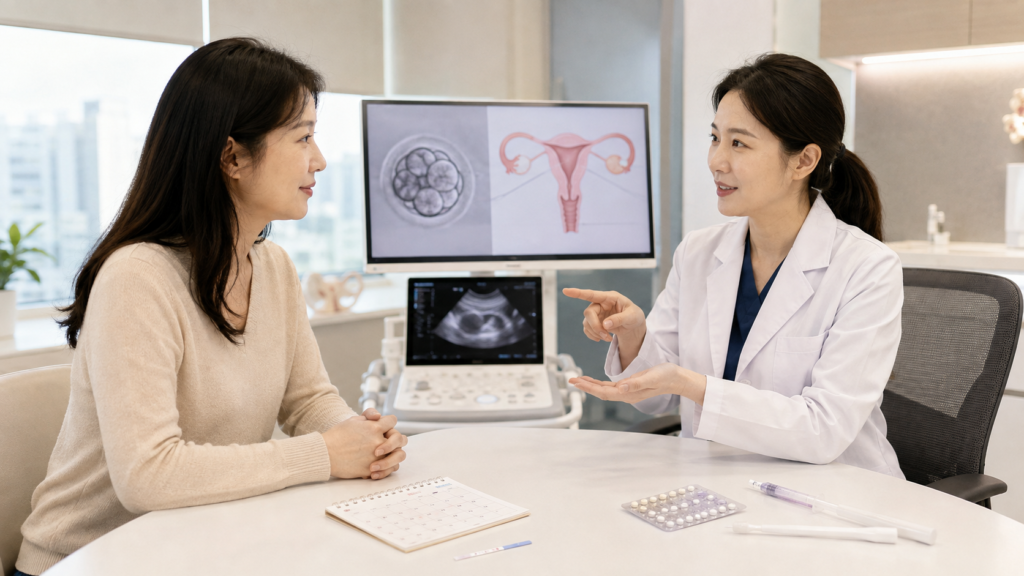
※ The images used in this article were generated using generative AI (ChatGPT, OpenAI) as visual references and do not depict real individuals.
Medical Reference (Source) Brecht Geysenbergh et al., “Natural cycle versus artificial cycle for endometrial preparation for frozen-thawed embryo transfer in ovulating women: a randomised controlled trial,” Human Reproduction, Vol. 41, Issue 8, August 2026, pp. 1420–1429. Published online June 19, 2026.