
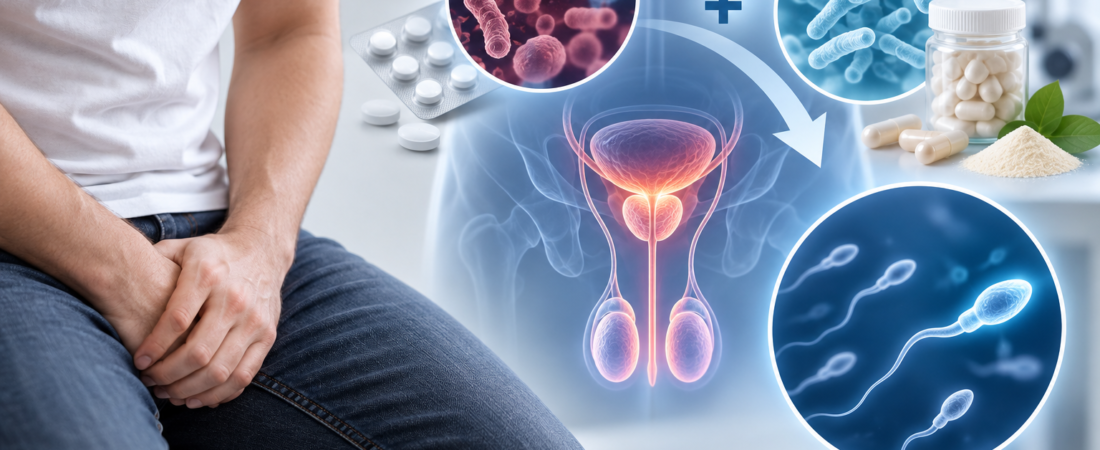
Adding probiotics and prebiotics to antibiotics was associated with higher bacterial clearance and improved sperm-count measures in a study of men with genital tract infections. Clearance was 92% with combined treatment versus 56% with antibiotics alone.
The findings do not prove a direct treatment effect of supplementation or establish improved pregnancy success. Further research is needed to determine whether the associations translate into fertility benefits.
Bacterial clearance reached 92% in the combined-treatment group
Researchers at the University of Padua and Padua University Hospital in Italy compared treatment outcomes in 100 infertile men with confirmed genital tract infections. The study appeared in Life on October 9, 2026.
Participants were aged 20–55, and the investigators retrospectively reviewed records from October 2023 to April 2026.
Fifty men had received antibiotics alone, and 50 had received antibiotics plus a multistrain probiotic/prebiotic supplement. Both groups used doxycycline; the combined group received additional support intended to modify the microbial environment.
Probiotics are live microorganisms that may provide beneficial effects, while prebiotics are ingredients supporting their growth or activity.
After treatment, bacteria were no longer detected in 92.0% of the combined group, or 46 men, versus 56.0%, or 28 men, in the antibiotic-only group. The difference was 36.0 percentage points.
The association suggests a possible role for adjunctive microbial approaches in managing these infections.
Sperm concentration increased in 94% versus 60%
Semen measures also differed between groups.
Sperm concentration increased from baseline in 94.0% of men receiving combined treatment and 60.0% receiving antibiotics alone. An increase of at least 50% occurred in 76.0% versus 36.0%, respectively.
Total sperm count increased in 96.0% of the combined group and 56.0% of the antibiotic-only group. Increases of at least 50% occurred in 68.0% and 36.0%, respectively.
Total and progressive motility did not differ significantly between groups. The findings should not be interpreted as improvement in every aspect of sperm function.
How infection can affect sperm quality
Infections of the male reproductive tract can contribute to poorer sperm quality. Inflammation can increase production of reactive oxygen species.
Excess reactive oxygen species may damage sperm membranes and DNA, a condition referred to as oxidative stress.
Because sperm are structurally vulnerable to oxidative injury, persistent inflammation can adversely affect movement and fertilization capacity.
Research is also examining the semen microbiome, the community of microorganisms found in semen.
Some studies suggest that imbalances in these communities may be associated with semen measures and genital tract inflammation.
This has prompted interest in how to manage microbial changes during treatment, alongside eliminating the infecting bacteria.
More sperm does not establish a higher chance of pregnancy
The study adds evidence on a possible adjunctive role for probiotics and prebiotics in infection management.
Its limitations are substantial: 100 participants, retrospective records and no random allocation of treatment.
The investigators did not directly measure changes in semen or gut microbial composition, inflammation or oxidative-stress markers. The biological mechanism behind the associations therefore remains unconfirmed.
Increased sperm concentration or total count does not necessarily mean a higher natural-conception rate or greater IVF success.
Pregnancy and live-birth outcomes were not systematically evaluated in this study.
The researchers emphasized that evidence remains insufficient to recommend supplementation as standard treatment. Larger randomized trials are needed to assess effectiveness and safety.
The findings encourage attention to the reproductive tract's microbial environment as well as infection eradication. They do not justify adding probiotics for every man with infertility; the infection and semen findings need individual clinical assessment.
Study source
This article is based on Giuseppe Grande, Andrea Graziani and colleagues at the University of Padua and Padua University Hospital: “Associations of Adjunctive Multistrain Probiotic/Prebiotic Supplementation with Microbiological Eradication and Semen Parameters in Infertile Men with Male Tract Infections: A Retrospective Cohort Study,” Life, October 9, 2026. DOI: 10.3390/life16101683.
Related reading
Korean Male Infertility Guidelines: Why Treatment Must Look Beyond Sperm Counts
The image was created using generative AI (ChatGPT, OpenAI); any people depicted are fictional.
Copyright © 2026 Fertility Information TokTok | THE FERTILITY NOTES. All rights reserved. Unauthorized republication, reproduction, redistribution, scraping, AI training and data use of any content, including articles, photographs and images, are strictly prohibited. Violations may result in legal liability.