
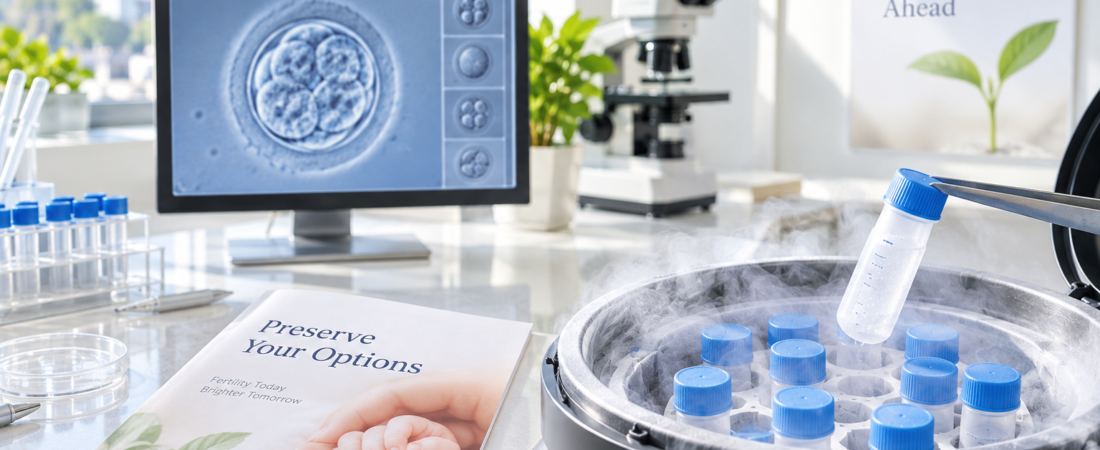
Planned egg freezing can preserve a future fertility option, but it does not guarantee a live birth. An Australian and New Zealand study covering 20,209 women found that only 27.9% of those followed for at least 10 years returned to thaw their eggs. Among women who actually used their frozen eggs and had at least two years of follow-up, 33.9% had at least one baby.
Those percentages answer different questions. Not using frozen eggs does not mean infertility or treatment failure, and the live birth figure does not apply to everyone who froze eggs. Age at freezing and the number of eggs thawed mattered more than how long the eggs had been stored.
More women are freezing eggs in anticipation of a future pregnancy. As marriage and parenthood are delayed, many hope that storing eggs when they are younger will keep the possibility of having a child open. Yet freezing eggs does not secure that outcome.
How many women eventually return to use them, and how many of those women have a baby?
A large study published in Human Reproduction on October 6, 2026, examined planned egg freezing in Australia and New Zealand from 2009 through 2023. Its long-term assessment of actual use and birth outcomes offers a useful view of what happens after eggs enter storage.
Egg freezing surged—but only about one in four returned after a decade
The number of women choosing egg freezing rose from 55 in 2009 to 4,919 in 2023, an average annual increase of approximately 35%.
Women were predominantly 34–38 years old, and 98.6% had not previously given birth. They generally stored 7–18 eggs, and about 68% completed freezing after one egg retrieval.
Actual use was much less common. Among 514 women who froze eggs in 2009–2013 and could be followed for at least 10 years, 27.9% returned to thaw them. Among 4,288 women with at least five years of follow-up, the proportion was 22.1%. The time between freezing and use was generally around five years.
Non-use is not the same as failure to conceive. Some women may have conceived naturally, changed their plans for parenthood, or simply not reached the point of using their stored eggs. The study could not fully establish the reasons for non-use.
A 33.9% live birth rate—among women who used their eggs
Researchers followed women who first thawed frozen eggs in 2009–2021 for at least two years. Of those women, 33.9% had at least one live birth. Among the more recent group who thawed eggs in 2019–2021, the figure was 37.8%.
The denominator is essential: 33.9% describes women who actually thawed and used their eggs, not all women who originally froze them. It should not be interpreted as a promise that one in three women choosing egg freezing will have a baby from those eggs.
Thawing does not immediately lead to pregnancy. Eggs must survive warming, fertilize with sperm and develop into embryos. An embryo must then be transferred, implant and sustain a pregnancy before a baby can be born.
Among women who thawed eggs in 2019–2021, approximately 86% obtained embryos that could be transferred or frozen again, and about 81% proceeded to embryo transfer. The eventual live birth rate was 37.8%. Having eggs in storage and having a baby are separated by several clinical steps.
Age at freezing mattered more than storage duration
One notable finding concerned how long eggs remained frozen. Storage duration did not have a statistically significant association with live birth in this study. By contrast, the woman's age when the eggs were frozen and the number of eggs thawed were associated with the chance of a birth.
For example, eggs frozen at 33 and used at 40 broadly retain the reproductive characteristics of eggs retrieved at 33. Time in frozen storage does not mean that the eggs themselves age in step with the woman's current age.
Pregnancy at 40 still involves separate age-related obstetric considerations, including gestational diabetes and high blood pressure.
The number of eggs also matters. One egg does not equal one embryo or one live birth. Some eggs will not survive warming; others may not fertilize, or the resulting embryos may stop developing.
Citing existing prediction models, the researchers noted that a 33-year-old woman might need more than 20 eggs to achieve a high predicted chance of a live birth. That is a statistical estimate, not a guarantee that freezing 20 eggs will produce a baby.
A future option, rather than a birth insurance policy
The findings illustrate a substantial gap between expectations and the eventual use of frozen eggs. Egg freezing is an important fertility preservation technique that can retain a possibility of future pregnancy. It may be an option for women who are not ready for parenthood but are concerned about age-related changes in egg quality.
It does not completely stop the reproductive clock. The chance of a birth still depends on age at freezing, the number of eggs available, fertilization and embryo development after warming. Many women who choose freezing never return to use those eggs during the observed follow-up.
The study also has limitations. Women who froze eggs more recently have had less time to return, so their use rates may rise with longer follow-up. In some early records, it was difficult to fully distinguish eggs frozen for medical reasons from planned egg freezing.
The practical message is that egg freezing preserves an option; it does not guarantee parenthood. Before deciding, women should discuss age-specific estimates of live birth, the number of eggs that may be needed, the possibility of additional retrievals, and the IVF steps required later.
Understanding the likelihood of eventually having a baby with stored eggs matters more than focusing only on how long they can remain in storage.
Study source
This article is based on the Australian and New Zealand analysis of 15 years of planned egg freezing and birth outcomes published in Human Reproduction on October 6, 2026. The study covered 20,209 women who froze eggs in 2009–2023. DOI: 10.1093/humrep/deag155. The original article is available through Oxford Academic.
Related reading
Egg freezing success and age at storage
The illustration was generated using ChatGPT (OpenAI). It is not a clinical photograph and does not depict actual patients.
Copyright © 2026 THE FERTILITY NOTES. All rights reserved. Unauthorized republication, reproduction, redistribution, scraping, AI training and data use of any content, including articles, photographs and images, are strictly prohibited. Violations may result in legal liability.