
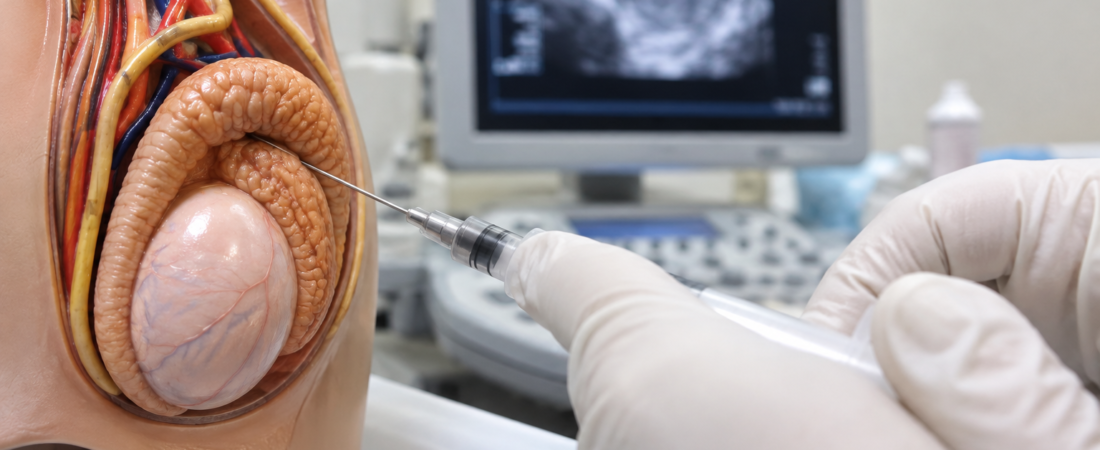
For men with obstructive azoospermia, does retrieving sperm from the epididymis rather than the testis improve ICSI outcomes? A study of 1,368 cycles found higher normal fertilization and usable-embryo rates with percutaneous epididymal sperm aspiration (PESA) than with testicular sperm aspiration (TESA). Clinical pregnancy, miscarriage and live birth, however, did not differ significantly in the transfer analysis.
Obstructive azoospermia means sperm are produced in the testes but cannot reach the ejaculate because the reproductive tract is blocked. Sperm can be retrieved directly from the epididymis or testis and used for intracytoplasmic sperm injection, or ICSI. The question is whether the retrieval site changes what happens after fertilization.
Comparing epididymal PESA with testicular TESA
Sperm develop in the testes and then mature as they pass through the epididymis. With an obstruction, production can continue even though no sperm appear in the ejaculate.
PESA uses a fine needle to aspirate sperm from the epididymis. TESA retrieves sperm directly from testicular tissue. The sperm obtained are generally used for ICSI.
In a study published online in Andrology in September 2026, investigators reviewed 1,368 ICSI cycles in men with obstructive azoospermia between 2015 and 2022. PESA was used in 516 cycles and TESA in 852.
PESA had higher normal fertilization and usable-embryo rates
Differences emerged during fertilization and early development. After adjustment for potential influences, the TESA group had a lower rate of normal two-pronuclear, or 2PN, fertilization than the PESA group. The proportion yielding embryos usable for transfer or freezing was also lower with TESA.
In other words, epididymal sperm were associated with a higher proportion of normal fertilization and usable embryos.
Sperm do not move directly from production to ejaculation: maturation in the epididymis contributes to motility and fertilizing capacity. The findings raise the possibility that this process also influences fertilization and early embryo development after ICSI. They do not establish that epididymal sperm are universally of better quality.
No significant difference in pregnancy, miscarriage or live birth
The investigators separately analyzed 869 fresh day 3 embryo transfers: 399 following PESA and 470 following TESA. Clinical pregnancy, miscarriage and live birth per transfer showed no significant between-group differences.
The advantage in fertilization and usable embryos therefore did not translate into a demonstrated advantage in the chance of pregnancy or birth in this analysis. That is not proof of exact equivalence, but it does mean the study should not be read as a rule that all men with obstructive azoospermia must use epididymal sperm.
A birthweight difference needs cautious interpretation
The study also examined 262 singleton babies born after fresh day 3 transfer. Average birthweight was approximately 209 g lower in the TESA group.
Gestational duration, preterm birth and the proportion small for gestational age did not differ significantly. The single-center population and limited newborn sample are insufficient to conclude that using testicular sperm causes lower birthweight.
The study was retrospective, and retrieval methods were not randomly assigned. Patient characteristics, causes of obstruction and other incompletely controlled factors could have influenced the findings.
Where sperm are found may matter—but treatment remains individual
The study is interesting because it looks beyond whether sperm can be found to whether the retrieval site may affect early embryo outcomes.
In practice, neither PESA nor TESA can be declared best for every patient. Decisions depend on the site and cause of obstruction, whether epididymal sperm can be obtained, prior surgery or retrieval experience, the amount of sperm needed and future freezing plans.
The key finding is not blanket superiority of epididymal sperm. Some early outcomes favored PESA in this cohort, while a difference in pregnancy and live birth was not demonstrated.
Study source
This article is based on research from Peking University Third Hospital, China, comparing embryological, clinical and neonatal outcomes after ICSI with epididymal versus testicular sperm in obstructive azoospermia. It was published online in Andrology on September 10, 2026. DOI: 10.1111/andr.70388. PMID: 42717709.
Related reading
The illustration was created with generative AI (ChatGPT, OpenAI). Any people depicted are fictional.
Copyright © 2026 THE FERTILITY NOTES. All rights reserved. Unauthorized reproduction, copying, redistribution, scraping, AI training, or data use of any content, including articles, photographs, and images, is strictly prohibited. Violations may result in legal liability.