
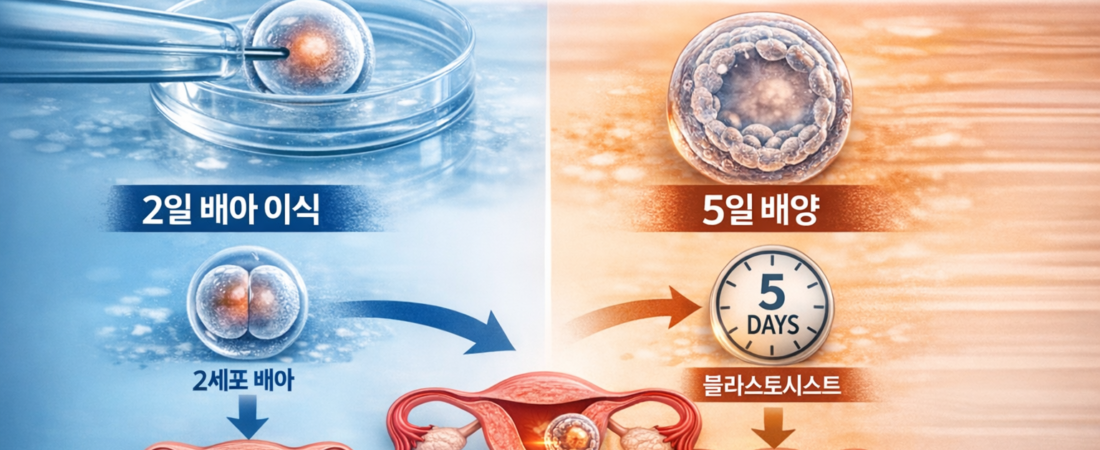
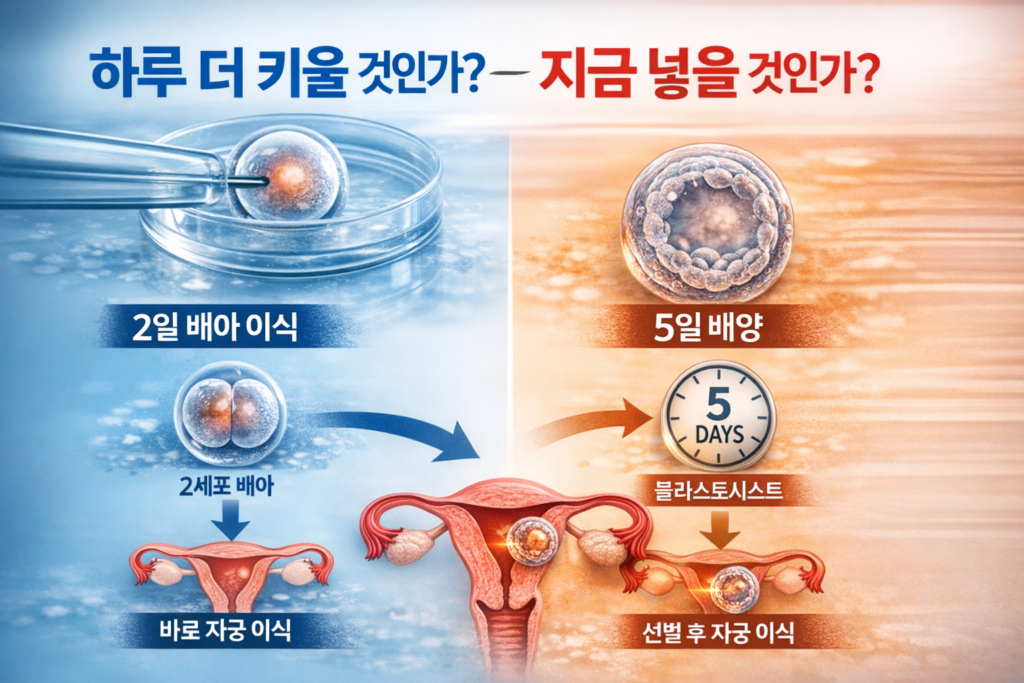
A single embryo, two distinct destinies. Should you transfer on Day 2, or extend the culture further?
The most critical decision in an In Vitro Fertilization (IVF) cycle often disguises itself as a deceptively simple question: Should we culture the embryo for another day, or transfer it into the uterus right now?
The exact moment a patient with diminished ovarian reserve yields only one solitary oocyte, this question ceases to be a mere technical choice and transforms into a profound clinical philosophy.
For decades, reproductive medicine has relied heavily on a singular principle: extend the laboratory culture to the blastocyst stage (Day 5) to systematically select and transfer only the highest-quality embryo. Embryos that successfully reach the Day 5 blastocyst stage boast significantly higher implantation rates, a clinical fact robustly backed by vast longitudinal data.
The core essence of this screening strategy is transparent: retain only the absolute best and filter out the rest.
The fundamental challenge, however, is that this screening principle only operates effectively when there is a baseline “cushion” of multiple embryos. If a patient has several embryos, filtering them is entirely rational; an attrition in the lab is not an absolute loss.
But when a patient possesses only one solitary embryo, the biological narrative shifts completely. At this juncture, a developmental arrest in the laboratory cleanroom is not a routine filtering process—it represents the immediate, catastrophic termination of the entire IVF cycle. Consequently, the clinical strategy must invert from selection to absolute preservation.
This is where a widespread misconception frequently arises. Many view an embryo’s developmental arrest during extended culture as a tragic, unnecessary loss that could have been avoided.
In biological reality, this is inaccurate. An embryo that lacks the metabolic power to survive the laboratory incubator would almost certainly have failed to sustain development within the uterine cavity. Extended Day 5 culture is not an artificial hurdle; it is a rigorous biological validation process. It remains an absolute fact that only embryos capable of weathering this timeline possess superior implantation competency.
Conversely, does an early cleavage-stage transfer emerge as the superior strategic path?
Transferring an embryo after a brief 2-day or 3-day culture is a well-established clinical strategy. Because oocytes retrieved from diminished ovarian reserves are extraordinarily vulnerable to micro-environmental shifts, minimizing laboratory culture stress and returning the embryo earlier to the physiological sanctuary of the uterus can be highly advantageous. No matter how advanced or precisely calibrated an incubator space may be, the definitive womb remains the natural environment designed to nurture life.
Yet, this preservation strategy demands its own clinical compromise.
Placing an early-stage embryo into the uterine cavity means transferring cells that have not yet undergone rigorous biological validation. This can naturally result in a higher baseline implantation failure rate. Most importantly, it introduces a highly volatile clinical variable: the precise synchronization of the uterus, scientifically known as the window of implantation.
The window of implantation refers to the strictly limited, highly sensitive chronological period during which the endometrial lining becomes biochemically receptive to an incoming embryo. On average, this receptive phase spans between Day 5 and Day 7 post-ovulation, lasting roughly 4 to 5 days following the onset of progesterone secretion.
When an embryologist transfers a Day 2 embryo, that embryo must comfortably reside and continue its cellular cleavage within the uterine fluid for an additional 2 to 3 days before it is biologically ready to initiate attachment.
The critical unknown is whether this early entry into the uterine cavity works to the embryo’s advantage or detriment—a variable uniquely dictated by each patient’s individual biological profile. For certain women experiencing severe diminished ovarian reserve, the window of implantation may open prematurely and close rapidly; in such specific profiles, a Day 2 embryo transfer can actually yield a superior clinical outcome.
However, if the diminished ovarian reserve is accompanied by a characteristically short menstrual cycle, the follicular phase (the timeline leading up to ovulation) becomes abnormally accelerated, and the subsequent luteal phase becomes highly unstable. Under these compromised conditions, forcing a fresh transfer is biologically counterproductive. The optimal strategic move is to pivot to cryopreservation, committing to a frozen embryo transfer (FET) cycle. This allows clinicians to meticulously prepare and prime the endometrial lining utilizing targeted hormonal supplementation before introducing the thawed embryo.
Ultimately, successful implantation demands absolute, flawless synchronization between the specific developmental stage of the embryo and the molecular receptivity of the endometrium. During a fresh cycle, if the uterine lining is not precisely primed, a transferred embryo will fail to secure a foothold, regardless of its intrinsic potential.
In essence, the ultimate clinical choice distills into a clear paradigm: Do you extend laboratory culture to filter out viability risks, or do you transfer early and accept the risk of failure within the uterus?
When a couple is faced with only one or two viable embryos, extending the laboratory timeline offers zero selection utility because there are no alternative embryos to choose from. Instead, the risk of exposing that solitary life to prolonged in vitro stress scales disproportionately.
A Day 5 blastocyst strategy is designed to comfortably absorb laboratory dropouts in exchange for securing a highly competent embryo. Conversely, a Day 2 or Day 3 transfer strategy is designed to absorb potential uterine failures in order to aggressively safeguard every single mathematical opportunity for life.
Neither path can be universally labeled as superior. The fundamental difference lies not in the probability of failure itself, but in the exact location where that failure is allowed to occur.
Therefore, the moment you are confronted with one solitary embryo in the shadow of diminished ovarian reserve, the decision completely transcends standardized textbook guidelines. It cannot be resolved through raw statistical charts alone, nor through emotional preference. A patient’s chronological age, real-time embryo morphology, historical tracking of past cycle failures, and the immediate biochemical readiness of the endometrium must all be synchronized simultaneously.
The absolute safest course of action is to entrust this delicate choice to the compiled judgment of a highly experienced physician and a master embryologist.
📚 Medical References
- Window of Implantation
- European Society of Human Reproduction and Embryology (ESHRE) Clinical Practice Guidelines.
- American Society for Reproductive Medicine (ASRM) Practice Committee Opinions.
- Significance: Establishes the definitive diagnostic criteria for endometrial receptivity and defines the narrow chronological window required for successful embryo attachment.
- Embryo-Endometrial Synchronization
- Comprehensive Review Papers published in Human Reproduction Update.
- Clinical Cohort Analyses from Fertility and Sterility.
- Significance: Outlines the critical necessity of aligning the precise biological clock of the dividing embryo with the hormonal priming of the maternal uterine lining to optimize live birth rates.
Editor’s Note: This content is an analytical commentary prepared by a specialized fertility journalist through the collection and evaluation of domestic and international reproductive medicine research, clinical policies, and statistical data. All medical diagnoses and treatment decisions must exclusively be established through direct consultation with a qualified medical professional.
Image Source: AI-generated (ChatGPT, OpenAI) / Provided solely as a supplemental visual aid for conceptual understanding.