
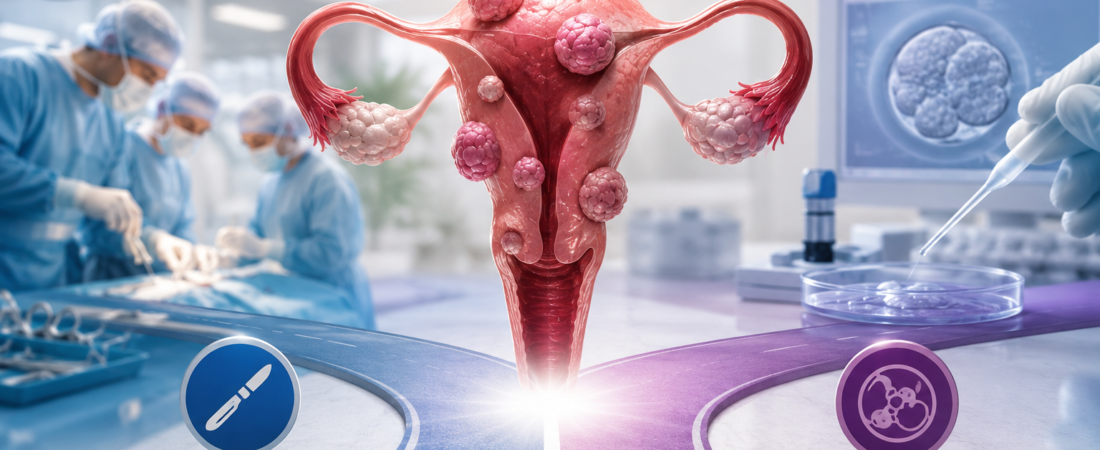
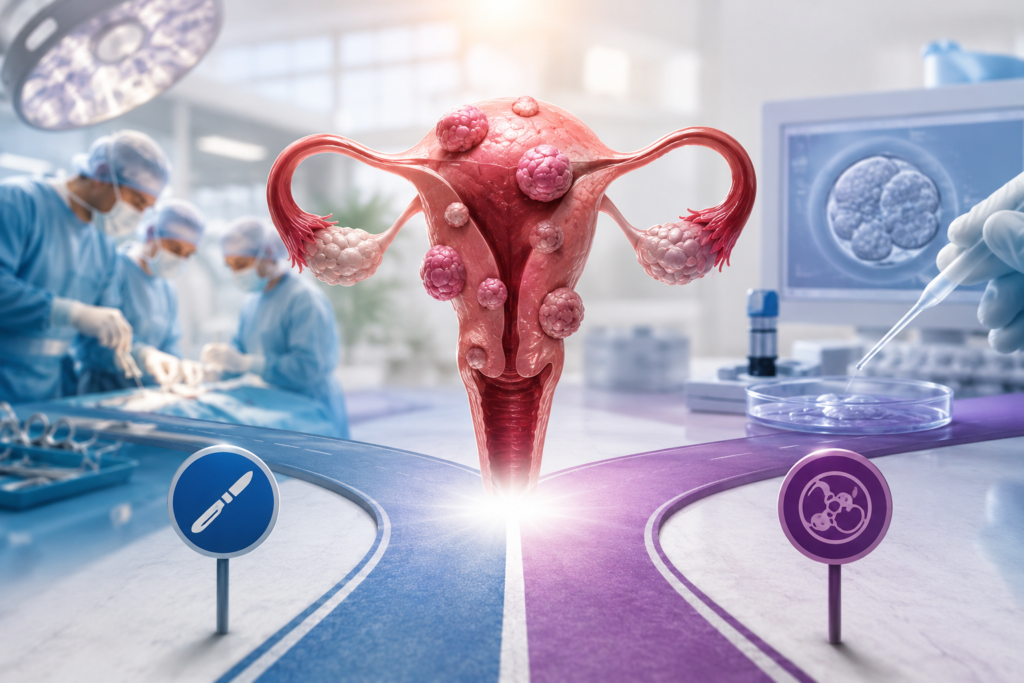
“Let’s Operate First” vs. “Let’s Transfer Immediately”… The Choice That Determines a Patient’s Fate
Women diagnosed with multiple uterine fibroids (myomas) usually hear the same thing first: “Because you have so many fibroids, pregnancy won’t be easy.”
However, in actual fertility treatment settings, completely different results often emerge. There are cases where a patient is advised to have surgery at one hospital, yet another hospital proceeds directly with In Vitro Fertilization (IVF) and, surprisingly, succeeds in pregnancy.
Why do the judgments differ even when looking at the same MRI and ultrasound images?
Multiple uterine fibroids are one of the most misunderstood and controversial conditions in infertility treatment. Senior fertility specialists commonly point out that in this field, the experience and judgment of the doctor interpreting the fibroids affect pregnancy success rates far more than the number of fibroids themselves.
Uterine fibroids are benign tumors that occur in the uterine muscle layer. They are so common that their prevalence increases with age, being found in over half of women around the age of 40. The problem is that many patients fear the mere fact that they “have fibroids.” However, from the perspective of reproductive medicine, what matters is not the existence of fibroids, but their location and influence.
Submucosal fibroids, which grow toward the inside of the uterus, can interfere with implantation even when small, whereas subserosal fibroids, which grow toward the outside, often do not affect pregnancy even when they are quite large.
More Important Than Dozens of Fibroids Is the Doctor’s Eye
Ultimately, the important question is not how many fibroids there are, but whether they are invading the space where the embryo must implant.
This is where the difficulty of multiple uterine fibroids begins. If there is only one fibroid, judgment is relatively easy. But if several fibroids exist simultaneously, the story changes. One must comprehensively evaluate whether several fibroids are pressing slightly on the inside of the uterus, whether the uterine cavity is deformed, whether endometrial blood flow is maintained, and whether the environment can sustain a future pregnancy.
In fact, analyzing patients with recurrent implantation failure reveals that the cause is often the uterine environment rather than the quality of the embryo. Conversely, there are cases where women successfully achieve a normal pregnancy and childbirth even with dozens of fibroids. In the end, one cannot find the answer through numbers alone.
A bigger problem is that two extremes coexist in reality.
One is the approach of unconditionally recommending surgery as soon as fibroids are visible. To an infertile woman waiting for pregnancy, this sounds like active and responsible treatment. However, surgery for multiple fibroids is never simple. During the process of removing several fibroids, normal uterine muscle can be damaged, and adhesions or a weakened uterine wall may occur after surgery. For infertility patients, especially those over 38, the months spent on surgery and recovery can be a fatal loss. The ovaries do not stop their clock.
Remove Aggressively If It Hinders Pregnancy
The opposite extreme also exists: the approach of simply proceeding with IVF because fibroids are common. This, too, can be dangerous. Submucosal fibroids that deform the uterine cavity or certain intramural fibroids can be significant causes of recurrent implantation failure. In this case, the patient fails repeatedly while undergoing multiple embryo transfers, losing both time and money. Ultimately, “surgery-is-everything” is a problem, and “unconditional neglect” is also a problem.
Doctors with extensive IVF experience view fibroids differently. Their concern is not the count of fibroids, but distinguishing which fibroids interfere with implantation and which ones do not need to be touched. Medical teams that treat many high-difficulty infertility patients focus on finding the “true cause” hindering pregnancy by comprehensively combining MRIs, 3D ultrasounds, and hysteroscopy.
There are cases where IVF proceeds with ten fibroids still present, while in other cases, surgery is decided upon because of a single small fibroid. What matters is not size or count, but location and functional impact.
The goal of infertility treatment is not to remove fibroids cleanly. It is pregnancy and childbirth. However, in reality, treatment goals are often swapped. Patients focus on removing fibroids and lose the most precious time. Especially for women around 40, time is not just a date on a calendar; it is reproductive capacity itself, which determines the quality and quantity of eggs. While recovering from a myomectomy, the ovaries age another year.
The direction emphasized by recent international reproductive medicine guidelines is the same: do not evaluate the existence of fibroids, but evaluate their impact on pregnancy. In other words, do not treat all fibroids, but selectively treat only those that hinder pregnancy.
Ultimately, the IVF success rate for patients with multiple uterine fibroids is not determined by the number of fibroids. Looking at the same uterus, one doctor may judge that surgery is necessary, while another may judge that pregnancy can be attempted immediately. And it is not rare for the accuracy of that judgment to determine the success of the pregnancy.
The essence of treating infertility caused by multiple uterine fibroids is not a war against the fibroids. It is the process of identifying exactly which fibroid among many is blocking the path to pregnancy.
In the end, the person the patient needs to meet is not the doctor who has removed the most fibroids, but the doctor who knows what to remove and what to leave behind, having experienced countless IVF successes and failures due to fibroids. The true variable in multiple uterine fibroids may not be the number of fibroids, but the doctor’s eye that can read the possibility of pregnancy within that number.