
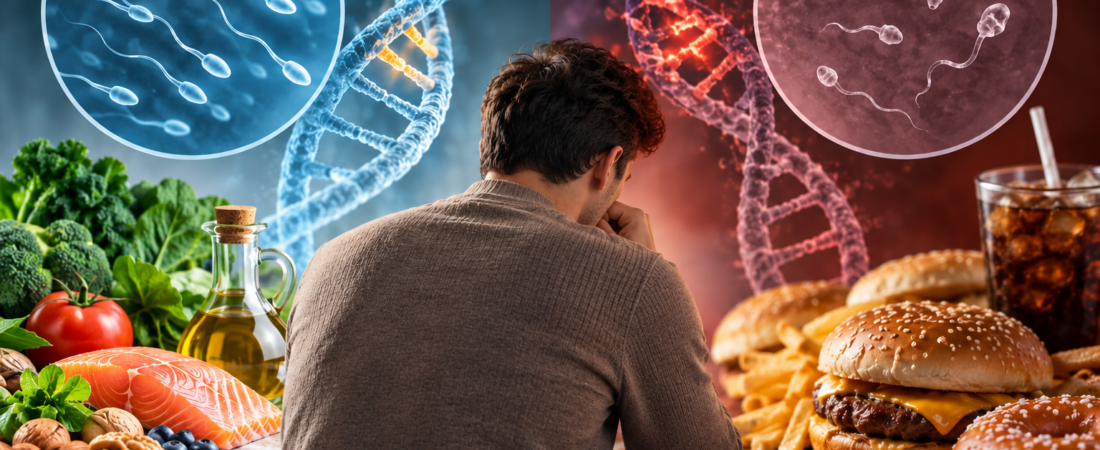
A high-fat, high-sugar diet combined with an infertility-related gene defect worsened sperm movement and shape.
University of Melbourne researchers found an interaction between genetic and environmental factors in an animal experiment, opening questions for future male-infertility research.
If male infertility has a genetic cause, can lifestyle still matter?
A genetic defect cannot be changed simply by changing habits, but research suggests that its effects on reproductive function may vary with diet.
Even when the same infertility-related gene is affected, some men have severely reduced sperm counts while others have azoospermia, with no sperm detected. The reasons for these differences have not been fully explained.
A study from the University of Melbourne, published in Human Reproduction, offers a possible clue: adding a high-fat, high-sugar diet to a genetic defect can further impair sperm quality and reproduction.
A gene defect and Western-style diet together
The researchers focused on M1AP, a gene involved in sperm production. Disruption of its function can impair sperm development.
They compared mice lacking M1ap with mice carrying a normal gene, feeding them either a standard diet or a Western-style diet high in fat and sugar. They assessed sperm count, movement and shape, germ-cell condition and reproductive outcomes.
The gene defect and Western-style diet each impaired reproductive function independently. Outcomes worsened further when both factors were present.
Mice with the gene defect that received the Western-style diet had more abnormal germ cells, poorer sperm movement and shape than other experimental groups, and fewer offspring per litter.
The findings suggest that environmental factors such as diet can intensify a vulnerability associated with an infertility-related gene.
Why can the same genetic problem have different effects?
M1AP abnormalities are also recognized as a genetic cause of male infertility in humans, but affected men do not all have the same presentation.
Some have severe oligozoospermia, with very few sperm, while others have azoospermia.
The researchers considered whether diet and environmental conditions might contribute to differences beyond the gene itself.
Study leader Dr Jessica Dunleavy explained that genetics may establish an underlying reproductive vulnerability, while lifestyle could influence how severely infertility is expressed.
This interpretation goes beyond separating infertility into genetic and acquired causes. Additional environmental burdens may compound a genetic problem.
However, this was not a clinical comparison of men with the same variant. It was an experiment in mice with the gene’s function removed, limiting direct application to people.
Genes and modifiable risks are different questions
The study raises the importance of considering modifiable risks even when a genetic cause of male infertility has been identified.
A genetic finding can lead patients to assume that there is little prospect of treatment. But the presence of a genetic defect and the claim that lifestyle can have no relevance are separate issues.
The researchers suggest that improving environmental factors, including diet, might have a favorable effect in genetically vulnerable men.
This does not mean that changing diet cures inherited infertility. The experiment did not directly test whether improving the diet restored sperm quality, nor whether it increased natural pregnancy or IVF success in humans.
Where an M1AP abnormality severely disrupts sperm production, there is insufficient evidence to expect diet alone to restore normal production.
An accurate diagnosis and assessment of modifiable habits are therefore complementary. Dietary management cannot replace genetic evaluation or specialist infertility care.
Assessment before IVF should look beyond a genetic result
The findings support examining genetic and lifestyle factors together in male-infertility research and care.
Semen analysis assesses sperm count, movement and shape. Depending on the clinical situation, severe sperm-production problems can lead to genetic testing.
Even after an abnormal genetic result, it remains important to understand residual reproductive function and other contributing risks.
For couples preparing for IVF or ICSI, a clear assessment of sperm characteristics can help inform treatment planning.
The researchers hope the findings will support studies of tailored lifestyle interventions in men with genetic susceptibility.
The present results cannot establish that any particular diet improves pregnancy success in men with infertility. Clinical studies are needed to identify effects and who, if anyone, benefits.
The central message is that reproductive conditions are not determined by a gene alone, even when the genetic defect itself cannot be changed.
Understanding how genetic vulnerability interacts with environmental factors is an important challenge for more precise infertility care.
Related reading: Another genetic clue in male infertility: WFS1.
Source: “A Western-style diet exacerbates male infertility in M1ap knockout mice,” published online in Human Reproduction on August 31, 2026, and in volume 41, issue 10, pages 1633–1642 in October 2026. The University of Melbourne and University of Münster team included Brendan J. Houston, Joseph Nguyen, Moira K. O’Bryan and Jessica E. M. Dunleavy. It compared sperm development and reproductive outcomes under different diets in M1ap-knockout and normal mice. DOI: 10.1093/humrep/deag130. PMID: 42671480.
The illustration was created using generative AI (ChatGPT, OpenAI). Any people depicted are fictional.
Copyright © 2026 Fertility Information TokTok Fertility News | THE FERTILITY NOTES. All rights reserved. Unauthorized reproduction, copying, redistribution, scraping, AI training, and other data use of any articles, photographs, images, or other content are strictly prohibited. Violations may result in legal liability.