
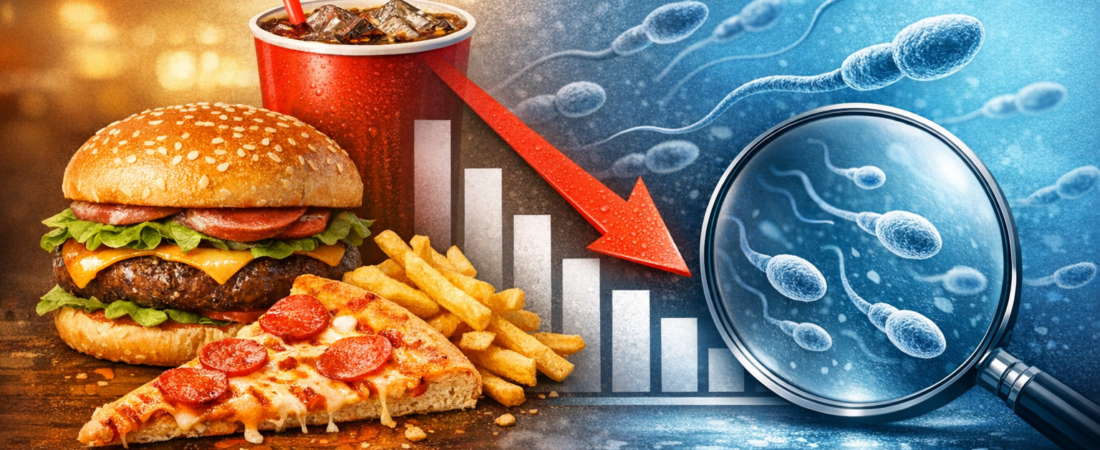
Junk food is a collective term for fast foods and instant products that are high in calories but low in nutritional value. For the sake of a healthy pregnancy, items like pizza, fried chicken, and donuts should be strictly avoided for the time being.
The claim that consuming junk food depletes your sperm count has become a fairly familiar sentence. It is a narrative that repeatedly surfaces in health articles and broadcast segments, accepted almost as common sense among men preparing for conception.
But to what extent is this statement biologically true? Does eating a single hamburger genuinely diminish your sperm supply, or have we mistakenly interpreted a mere correlation as a definitive cause?
A prominent study evaluating 3,000 young Danish men revealed that those who habitually consumed a diet rich in pizza, fried foods, and refined sugars exhibited a sperm count approximately 25% lower than those who adhered to a diet centered around fresh vegetables, fruits, and fish. Looking purely at the raw statistics, the conclusion seems clear-cut: junk food reduces sperm counts. However, it is vital to pause and critically evaluate this finding. Did this study truly establish a direct cause, or did it simply highlight a lifestyle pattern?
When you look a layer deeper, it becomes clear that these findings do not reflect the consequence of eating an isolated type of food, but rather mirror a person’s entire lifestyle architecture.
Statistically, individuals who frequently consume junk food also tend to present with highly irregular sleep schedules, a severe lack of physical activity, elevated baseline stress levels, and poor weight management. In other words, the core issue may not be the hamburger itself, but rather the structural lifestyle patterns that drive a person to choose that hamburger in the first place.
Why, then, do we observe a measurable drop in sperm counts within this demographic? To understand this, the primary focus should be directed away from the testes and toward the brain.
While sperm cells are physically manufactured within the testes, their actual production rate is strictly governed by the hypothalamus and the pituitary gland—collectively known as the hypothalamic-pituitary-gonadal (HPG) axis. This master control system holistically evaluates the body’s internal environment to determine whether the organism is currently in a suitable state for reproduction before releasing the necessary hormonal signals.
A diet dominated by junk food inevitably creates profound micronutrient deficiencies, fosters insulin resistance, and induces chronic systemic inflammation. These cascading metabolic disruptions are ultimately relayed to the brain, where they are interpreted as a biological signal: “The body is currently under too much stress to safely reproduce.” Consequently, the brain downregulates the hormonal cascade, resulting in a decline in sperm production.
Therefore, absorbing this research simply as a warning that “junk food kills sperm” is only half-accurate.
It is far more scientifically precise to view modern, uncoordinated lifestyles as a comprehensive hostile force acting against male reproductive fitness. Dietary choices are merely a visible marker of this deeper reality; what truly drives the biological outcome is the overall rhythm of daily life and the baseline metabolic state of the body.
Ultimately, the core question steers back to its origin. It is not simply a matter of what we are putting on our plates, but how we are choosing to live.
Sperm cells are not manufactured overnight. They undergo a complex, highly regulated development cycle that spans approximately 70 to 90 days—a cellular journey that is continuously shaped by your current dietary habits, sleep architecture, stress levels, and physical activity. Achieving a successful pregnancy may seem like a biological event that begins inside a fertility clinic, but in reality, its direction is already being quietly determined much earlier through the microscopic choices of your daily life.