
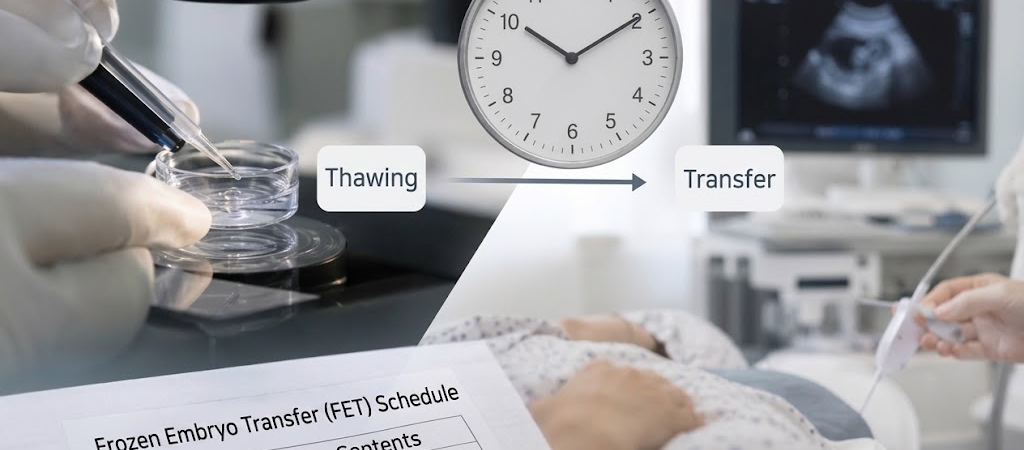
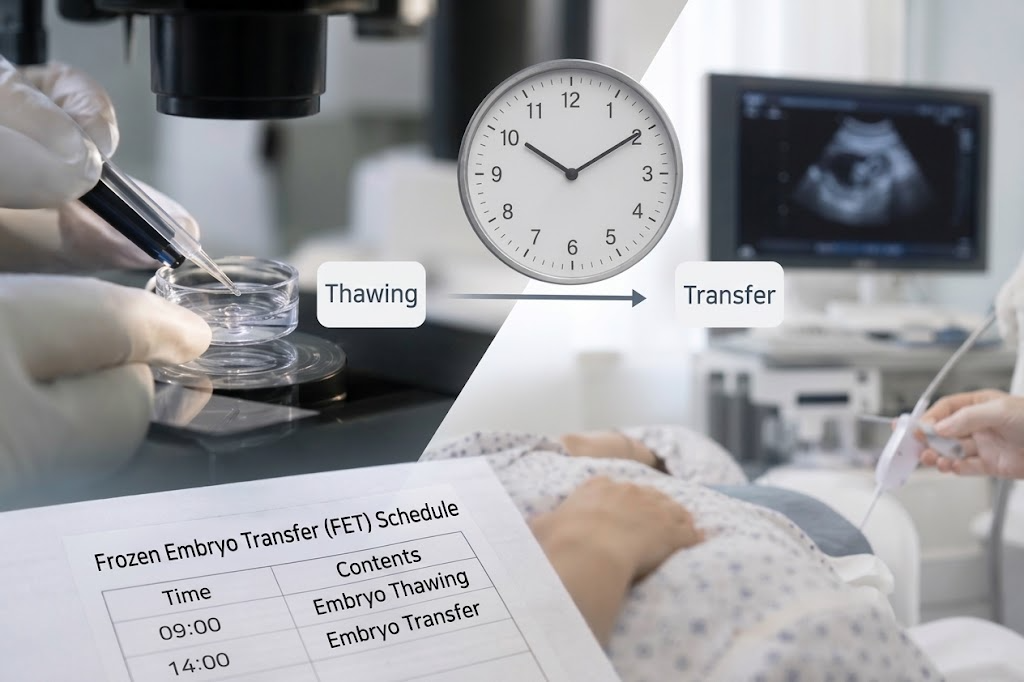
- Analyzing up to 5 hours from frozen blastocyst thaw to transfer: No significant difference in pregnancy outcomes
- Analysis of 6,034 PGT-tested single blastocysts: Embryo developmental day and morphological grade mattered far more than timing
- Little evidence supporting “transfer immediately after warming”… No need for undue anxiety over a few hours’ difference due to laboratory schedules
Hearing the clinic say, “We will thaw your embryo in the morning and perform the transfer in the afternoon” ahead of a frozen embryo transfer can be quietly unsettling. Once a frozen embryo is warmed, wouldn’t it be better to place it back into the uterus as quickly as possible? Could the embryo weaken while spending two or three hours in the embryology lab after warming?
A recent study compared those “few hours inside the lab”—a window rarely visible to patients—against actual pregnancy outcomes. To cut straight to the conclusion: within routine clinical practice, the time interval between thawing a blastocyst and its transfer does not appear to significantly sway the likelihood of pregnancy.
Frozen Embryos Aren’t Transferred Immediately After Warming
Blastocysts used in frozen embryo transfers are stored in cryogenic tanks before undergoing a “warming” process on transfer day—what patients colloquially describe as “thawing the embryo.”
The question lies in what happens next. While some clinics transfer warmed embryos into the uterus almost immediately, others allow them to recover in culture medium for a set period, monitoring their condition before transfer. This timeframe often shifts depending on embryology laboratory workflows and daily transfer schedules.
In practice, one patient might have their embryo thawed in the morning and transferred an hour or two later, while another has it thawed in the morning only to be transferred in the afternoon. Could this gap of a few hours alter the chances of implantation?
To answer this question, researchers presenting at the 2026 Annual Meeting of the European Society of Human Reproduction and Embryology (ESHRE) analyzed 6,034 frozen blastocyst transfer cycles performed between 2021 and 2026. The study was restricted to single embryo transfers (SET) using PGT-tested blastocysts with morphological grades of “good” or “fair.”
Even Spanning from 0 to 300 Minutes, the Difference in Pregnancy Probability Was Just ~3%
The researchers evaluated the precise time elapsed from blastocyst warming to intrauterine transfer.
The analysis found no clear decline in pregnancy rates as the interval from warming to transfer lengthened.
Overall, the clinical pregnancy rate was approximately 73%, and the implantation rate was about 58%. Even after adjusting for maternal age, stage of embryonic development, morphological grade, warming protocol, and the use of transfer medium, the thaw-to-transfer time interval showed no statistically significant association with clinical pregnancy or implantation rates.
In particular, when the researchers modeled pregnancy probability across intervals ranging from immediately post-thaw up to roughly 300 minutes—five full hours—the predicted variation in pregnancy rate was only around 3%. The authors concluded that this could hardly be considered a clinically meaningful difference.
In simple terms, there was no evidence that whether an embryo warmed at 9:00 AM was transferred at 10:00 AM or after lunch in the afternoon served as a decisive factor in treatment success.
What Mattered Far More Than a Few Hours Was the ‘Embryo Itself’
Instead, what exerted a far more distinct impact on outcomes was embryonic developmental speed and morphological quality.
Embryos that reached the blastocyst stage by Day 5 achieved higher pregnancy rates than Day 6 blastocysts, and high-grade embryos similarly outperformed fair-grade ones. Rather than how many hours elapsed after warming, the primary predictors remained which day the embryo reached the blastocyst stage and its baseline morphological score.
Prior literature aligns with these findings. In a study analyzing 11,520 single frozen embryo transfers, researchers categorized thaw-to-transfer intervals from under 1 hour up to 7–8 hours, yet observed no statistically significant differences in live birth rates or miscarriage rates. Furthermore, metabolic profiling tracking embryos for up to 10 hours found no evidence of deleterious metabolic deterioration over that incubation window.
This Does Not Mean ‘Any Time Will Do’
These findings should not be oversimplified to mean that “embryos can simply be transferred whenever.”
This was a retrospective cohort study rather than a randomized controlled trial. Moreover, the study cohort was limited to single transfers of relatively good-quality, PGT-tested blastocysts; Day 7 blastocysts and untested embryos were excluded. Therefore, these conclusions cannot be applied uncritically to every frozen embryo transfer patient. The investigators themselves noted that unmeasured clinical or laboratory variables could have influenced the findings.
Additionally, how effectively an embryo recovers and re-expands post-thaw remains a distinct biological consideration. The pace and degree to which a vitrified, collapsed blastocyst re-expands upon warming continues to be actively studied as a functional biomarker of embryonic viability. Thus, one must distinguish between the sheer “number of hours elapsed” and “the physiological state of the embryo during that window.”
The takeaway for patients is surprisingly straightforward: there is little reason to fuel anxiety with worries like, “Was my embryo thawed too early?” or “Why isn’t the transfer happening immediately after warming?”
The success of a frozen embryo transfer is dictated not by a tick-tock difference of one or two hours post-thaw, but by an interplay of factors: the embryo’s developmental pace and quality, endometrial receptivity, and the transfer procedure itself. Within standard embryology lab workflows, what time the embryo was warmed does not appear to be the decisive variable that determines pregnancy—that is what this analysis of 6,034 transfer cycles shows.
※ This article was written based on the study “Association between blastocyst thaw to transfer time intervals and pregnancy outcomes in frozen embryo transfer cycles” by researchers from Kindbody IVF Lab, published in Human Reproduction, Volume 41, Supplement 1, on July 8, 2026. The study evaluated 6,034 single frozen blastocyst transfers of PGT-tested embryos performed between 2021 and 2026 (Presentation: L26/P-901, Abstract: deag083.1225, DOI: 10.1093/humrep/deag083.1225). It does not replace individualized clinical diagnosis or medical care, and specific protocols and schedules for warming, incubation, and transfer must be determined by the attending clinical team and embryology laboratory based on individual embryo status and clinical conditions.
※ The images associated with this article were generated using generative AI (ChatGPT, OpenAI) as illustrative visual references and do not depict real individuals.
※ Copyright © 2026 THE FERTILITY NOTES. All rights reserved. Unauthorized reproduction, duplication, distribution, scraping, AI training, or data utilization of all content, including articles, photos, and images, is strictly prohibited and may result in legal liability.