


When ‘Good Bacteria’ Leave, Vaginitis Follows
Vacation season is here. The beaches, valleys, water parks, and swimming pools are bustling with people. Enjoying the cool water to escape the heat is one of summer’s greatest gifts. However, after the fun of water play ends, another summer guest sometimes visits women: vaginitis.
During the summer, the number of women visiting OB/GYN clinics complaining of vaginitis increases significantly. High temperatures, humidity, sweat, wet swimwear, and clothing that does not allow for ventilation create an environment where bacteria and fungi thrive. If these are combined with fatigue from travel, lack of sleep, and irregular eating habits, our body’s immune balance can easily be shaken.
Many women think of vaginitis as a single disease. However, vaginitis is not one illness like the common cold. It is an entirely different set of conditions depending on the cause, and the treatments vary accordingly. Not all cases with increased discharge are the same, and not all itching should be treated with the same medication.
In fact, a healthy vagina is not ‘sterile.’ It is a small ecosystem where numerous microorganisms coexist in balance. At its center is a type of probiotic called Lactobacillus. These beneficial bacteria produce lactic acid to keep the vagina mildly acidic and defend against the overgrowth of external bacteria and fungi. A healthy vagina is not healthy because it is ‘clean’ (in a sterile sense), but because ‘good bacteria’ are thriving within it.
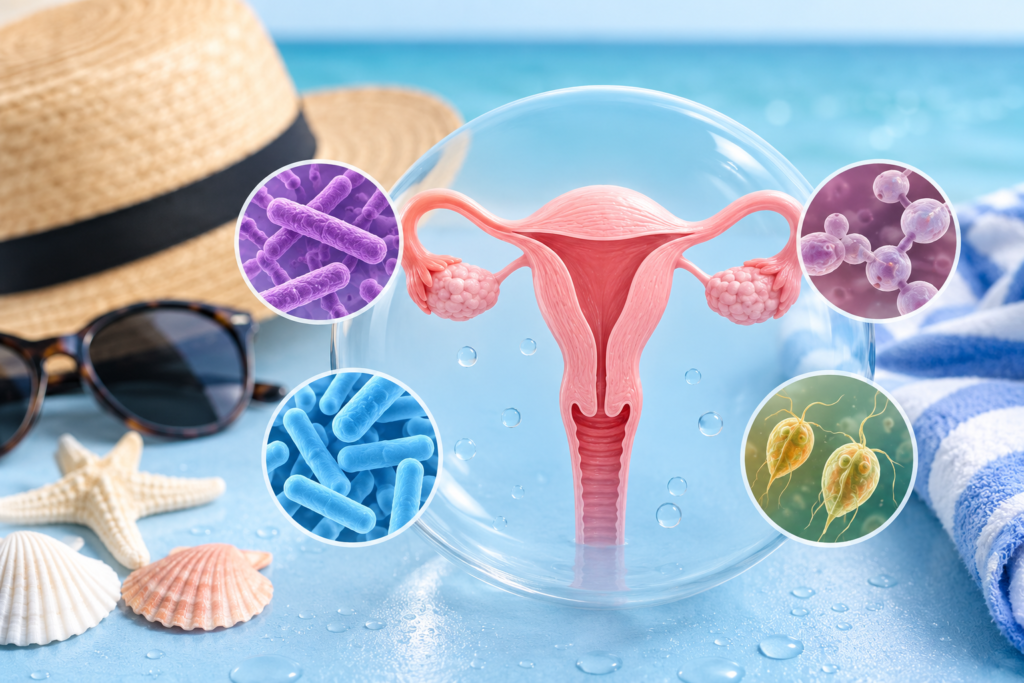
There Is a Forest in the Vagina
The first condition that appears when that balance collapses is vaginitis.
Bacterial Vaginosis (BV) is the most common form. It occurs when Lactobacillus in the vagina decreases and various anaerobic bacteria increase. It is characterized by thin, gray or white discharge and a fishy odor. The smell often intensifies after sexual intercourse, and surprisingly, itching is often not severe.
Candidal Vaginitis (Yeast Infection) is caused by the overgrowth of Candida, a type of fungus. The most prominent symptom is intense, unbearable itching, often accompanied by white, clumpy discharge that looks like tofu or cottage cheese. It occurs frequently after taking antibiotics, in patients with diabetes, during pregnancy, or when immunity is weakened. Staying in wet swimwear for too long in the summer is also a risk factor.
Trichomoniasis is caused not by bacteria or fungus, but by a protozoan. It can present with yellow-green, frothy discharge and a strong odor, and can be accompanied by itching, stinging, or pain during urination. Because it can be transmitted through sexual contact, both the patient and their sexual partner must be treated simultaneously to reduce the risk of reinfection.
Atrophic Vaginitis, common in postmenopausal women, is slightly different. It is caused by a decrease in female hormones rather than an infection. As the vaginal mucosa thins and becomes dry, it may feel stinging or burning, and even minor irritation can cause wounds or bleeding. Although it shares the name ‘vaginitis,’ the treatment approach is different from the others.
When vaginitis occurs, many women search the internet and use over-the-counter vaginal suppositories or ointments first. However, this can actually become a cause for recurring vaginitis. If you use a fungal treatment for bacterial vaginosis, or antibiotics for a yeast infection, the balance of microorganisms in the vagina can be further disrupted.
Recently, research viewing vaginitis not just as an infection, but as a problem of the vaginal microbiome (the vaginal microbial ecosystem), has become active. Multiple studies confirm that a healthy vagina usually maintains an environment where Lactobacillus is dominant, and the more this balance is broken, the higher the likelihood of recurring vaginitis. In particular, in the field of reproductive medicine, research is actively underway on whether the vaginal microbial environment can also affect pregnancy and implantation.
To prevent vaginitis, the basics are more important than any special secret. After water play, do not stay in wet swimwear for long, and wear well-ventilated underwear. It is also advisable to avoid the excessive use of highly scented feminine cleansers. Because the vagina is an organ that maintains its own balance, excessive washing can actually reduce the beneficial bacteria. Sufficient sleep, a balanced diet, and stress management also help maintain vaginal health.
Enjoy your water play this summer to your heart’s content, but do not miss the small signals your body sends. If the color of your discharge changes, if there is an odor different from usual, or if itching and pain persist, it is better not to dismiss it as a simple summer inconvenience.
Vaginitis is a common disease that can happen to anyone, but knowing the exact cause and receiving the correct treatment can reduce recurrences and protect women’s health.
※ This article was written based on domestic and international OB/GYN and reproductive medicine research and the latest medical journals. It does not replace a specific individual’s diagnosis or treatment, and actual medical judgment must be made through consultation with a specialist.
※ The images used in this article were created using generative AI (ChatGPT, OpenAI) and depict fictional individuals, not real people.