

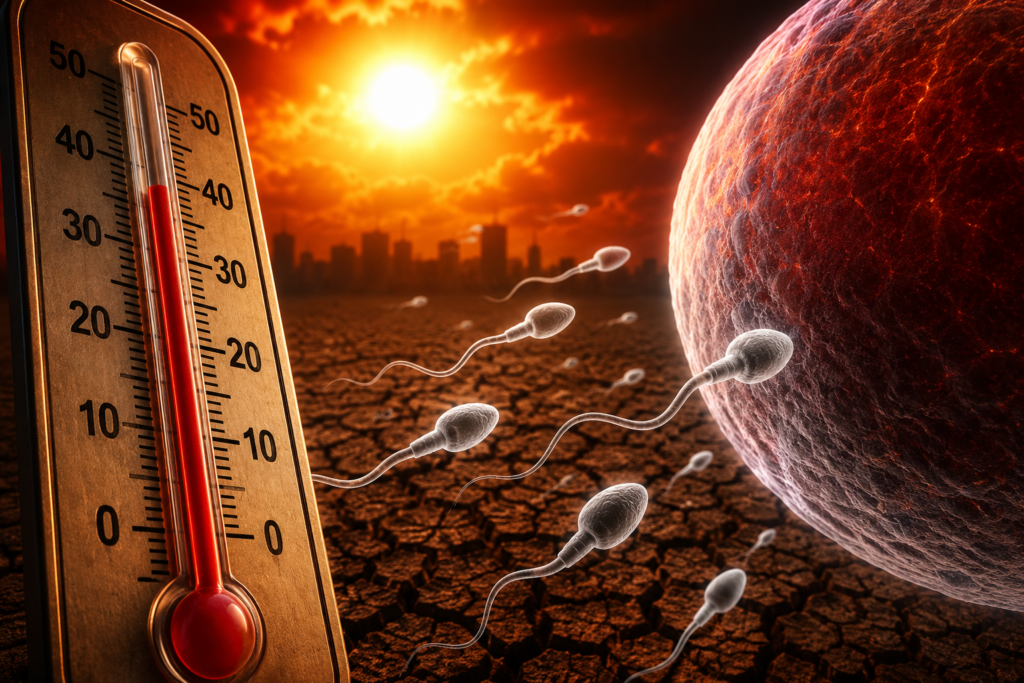
A Heating Earth, Cooling Fertility
Heatwaves have reached a level that now threatens human life. While people worry about heatstroke, dehydration, and cardiovascular diseases, reproductive medicine specialists have issued another warning: ‘Fertility.’
As climate change makes summers longer and heatwaves a daily reality, global research into how extreme heat stress affects sperm, eggs, and the potential for pregnancy is becoming increasingly active. While not all mechanisms have been fully identified, one fact is clear: reproductive cells are among the most heat-sensitive cells in our body.
First, let’s look at the male body. The reason the testicles are located outside the abdominal cavity in the scrotum is precisely to keep them in an environment cooler than the core body temperature. Normal sperm production requires a temperature about 2–4°C lower than the body temperature. Research consistently reports that even a 1–2°C increase in testicular temperature can decrease sperm count, reduce motility, and increase the rate of DNA damage and abnormal sperm.
A recent international study confirmed a correlation between higher ambient temperatures and an increased risk of male infertility. Researchers analyzed that continuous exposure to heatwaves increases testicular heat stress and induces oxidative stress, which may impair spermatogenesis. An Argentine study also reported a decrease in motile sperm in men who experienced heatwaves.
Fertility specialists explain, “Sperm are not made today; they are created over a period of about 70–80 days. Therefore, excessive heat exposure in mid-summer can affect semen analysis results several months later.” For men planning a pregnancy, managing body temperature during the summer is considered an essential part of health care.
Research on female fertility is also increasing. While eggs are not exposed to external heat as directly as sperm, the possibility that oxidative stress and cellular damage caused by high-temperature environments affect egg function is being raised. In particular, mitochondria, which serve as the egg’s energy factories, are known to be sensitive to heat and oxidative stress. Reproductive medicine experts explain that if mitochondrial function declines, it can affect the embryo’s developmental capacity after fertilization.
In the field of In Vitro Fertilization (IVF), heatwaves are emerging as a new research topic. Although evidence from human studies remains limited, animal experiments and cellular research consistently report that heat stress can have a negative impact on egg maturation and embryo development. Experts predict that while it is difficult to conclude that heatwaves directly lower IVF success rates, the long-term impact of climate change on reproductive health will become an increasingly important field of research.
Daily heat exposure cannot be ignored. Habits such as long sessions in saunas or jjimjilbangs (Korean steam rooms), staying in hot tubs for too long, using laptops on your lap, wearing tight underwear, or driving for long periods—all environments where the temperature around the testicles stays elevated—are known to be disadvantageous for sperm production. In urology clinics, men preparing for pregnancy are often advised to reduce these habits.

Interestingly, not all studies reach the same conclusion. Some recent studies have reported higher sperm motility in the summer. Researchers have suggested that various seasonal factors, such as Vitamin D production from sunlight exposure, increased physical activity, and lifestyle changes, may be acting together. This shows that fertility is not determined by temperature alone but is influenced by a complex combination of health status, lifestyle, and environment.
Nevertheless, the advice from experts is relatively consistent. Couples preparing for pregnancy should not take heatwaves lightly. Consuming enough fluids, proper cooling, and lifestyle habits that avoid long-term exposure to high-temperature environments can help manage not only summer health but also reproductive health.
In the past, heatwaves were the season of heatstroke and cardiovascular disease. Now, it has become an era where reproductive health must also be managed.
The following lifestyle habits are recommended to protect male fertility during the summer:
- Choose loose-fitting clothing made of cotton or materials that allow good ventilation, rather than tight underwear or pants.
- Avoid a sedentary lifestyle. Staying seated for long periods accumulates heat between the thighs and scrotum, so it is helpful to stand up, walk, or stretch once every hour.
- Reduce the use of saunas, steam rooms, and hot tubs. Men preparing for pregnancy should especially avoid habits that involve repeated exposure to high-temperature environments.
- Improve the habit of using laptops on your lap. Heat generated from the laptop can raise testicular temperature, so using it on a desk is recommended.
- Pay attention to body temperature management by drinking plenty of water during the summer and changing out of sweat-soaked clothes immediately.
Urologists specializing in male infertility unanimously advise, “The key to testicular health is not to make it excessively cold, but to avoid letting it become excessively hot.” They add, “Extreme cooling methods like ice packs are not recommended.”
※ This article was written based on reproductive medicine and environmental health research published in international academic journals, as well as the opinions of domestic and international experts. It does not replace a specific individual’s diagnosis or treatment, and actual medical judgment must be made through consultation with a specialist.
※ Image: Created using generative AI (ChatGPT, OpenAI); depicts fictional individuals, not real people.