
Among 2,102 women with a low prognosis, adjusted cumulative live-birth rates were 46.7% with a fresh-transfer strategy and 40.0% with freeze-all.
Researchers at Wenzhou Medical University question a uniform freeze-all approach and emphasize choosing transfer strategies according to patients’ circumstances.

As freezing all embryos becomes more common in IVF, patients face a familiar question: is it better to transfer an embryo straight away or freeze all available embryos for later transfer?
The freeze-all strategy is widely used, but a recent study suggests that it may not benefit every patient.
Researchers from Wenzhou Medical University and its First Affiliated Hospital in China analyzed IVF outcomes in 2,102 women with a relatively low expected chance of treatment success. Cumulative live birth was higher among those whose strategy included fresh transfer than among those who froze all embryos.
The study was published in Reproductive BioMedicine Online in September 2026.
Cumulative live birth: 40.0% with freeze-all versus 46.7% with a fresh-transfer strategy
The analysis compared 2,102 women with a low prognosis. Of these, 912 underwent a freeze-all strategy and 1,190 a strategy that included fresh embryo transfer.
After statistical adjustment for patient characteristics, cumulative live-birth rates were 40.0% and 46.7%, respectively—a difference of 6.7 percentage points.
Cumulative live birth measures whether embryos obtained from one egg retrieval ultimately result in a birth. It considers the overall outcome from that retrieval, rather than only pregnancy after the first transfer.
The results indicate that freezing all embryos does not necessarily lead to a higher cumulative birth rate in women with a low prognosis.
However, the study analyzed observational data. It did not prove that fresh transfer itself caused the higher rate.
Why freezing all embryos may not always be advantageous
Freeze-all is an important tool in fertility treatment. When hormone levels rise substantially during ovarian stimulation, postponing transfer can allow a different endometrial environment. It can also help reduce the risk of ovarian hyperstimulation syndrome (OHSS).
The balance may differ for women with a low ovarian response. When few eggs and embryos are available, potential losses during freezing and thawing and delays in treatment also need consideration.
Freezing every embryo despite conditions suitable for fresh transfer adds treatment steps and time. Survival after thawing must also be assessed.
Modern vitrification achieves high survival rates, and frozen embryo transfer is an established treatment. This study does not demonstrate that frozen transfer itself is ineffective.
The important point is to choose a strategy that takes account of ovarian response, hormone levels, the endometrium, and embryo number and quality.
Individual assessment for women with a low prognosis
A low prognosis refers to a lower expected treatment outcome based on factors such as ovarian reserve, response to stimulation, age and previous IVF results.
How available embryos are used is particularly important for these patients. A strategy suitable for someone with several good-quality embryos may not be equally suitable for someone with only one or two.
Where fresh transfer is feasible, clinicians can assess endometrial thickness and condition, progesterone and OHSS risk together before deciding whether to proceed.
Conversely, freeze-all may be more appropriate with an unfavorable endometrial environment or high OHSS risk. Embryos may also need freezing while awaiting preimplantation genetic testing results.
Neither fresh nor frozen transfer can be assumed superior for all women. The appropriate strategy depends on the clinical circumstances.
What the 2,102-patient analysis can establish
The study is informative because it analyzed a relatively large patient group and assessed births rather than pregnancy alone.
Its limitation is that it used observational data rather than a randomized clinical trial. Statistical adjustment cannot remove every possible difference between the groups or all confounding factors.
The findings therefore cannot establish a universal rule that women with a low prognosis should receive fresh transfer first. Further randomized trials are needed.
They nevertheless raise an important question: adopting a newer technology does not always ensure the best outcome for every patient.
The decision to freeze all embryos or include fresh transfer should be based on medical circumstances rather than a general ranking of the techniques. Patients likely to have few embryos should discuss the advantages and disadvantages of both strategies with their clinical team.
This article is based on “Freeze-all versus fresh embryo transfer strategies in low-prognosis women: an emulated target trial study,” by researchers at Wenzhou Medical University and its First Affiliated Hospital, China, first published online in Reproductive BioMedicine Online on September 3, 2026. DOI: 10.1016/j.rbmo.2026.105957. PMID: 42771977. Transfer decisions require an assessment of ovarian response, hormone levels, endometrial condition and embryo characteristics with a fertility specialist.
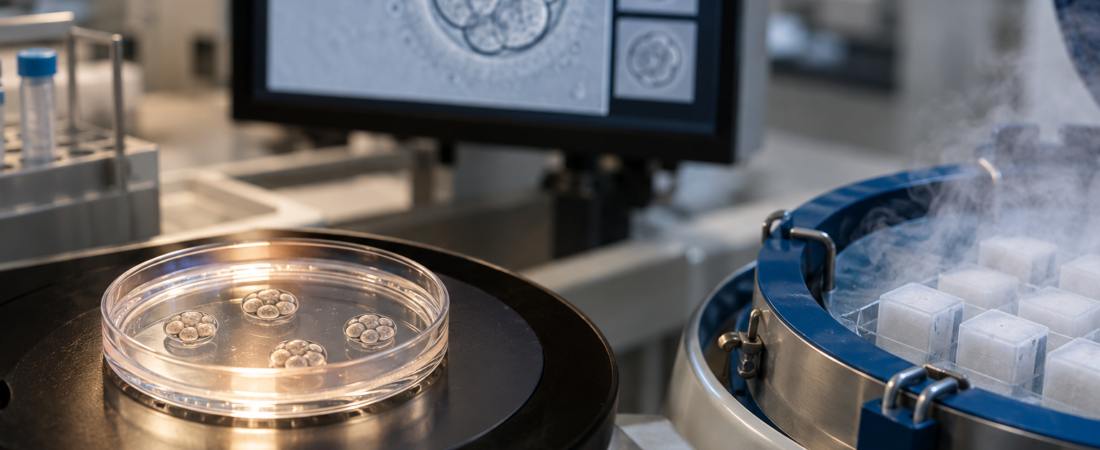
The accompanying image was created using generative AI (ChatGPT, OpenAI); any people depicted are fictional.
Related guide: Understanding implantation failure after euploid embryo transfer
Copyright © 2026 Fertility Information TokTok Fertility News | THE FERTILITY NOTES. All rights reserved. Unauthorized reproduction, copying, redistribution, scraping, AI training, and other data use of any articles, photographs, images, or other content are strictly prohibited. Violations may result in legal liability.