
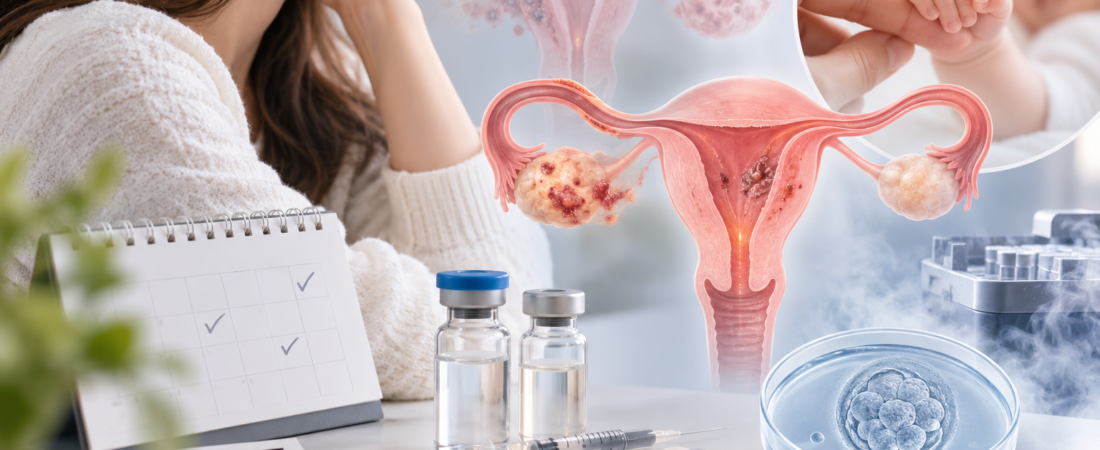
FET pretreatment for endometriosis and adenomyosis was associated with higher live birth odds in a small study of women with at least one previous failed frozen embryo transfer. The study analyzed 51 women and 217 transfers. It offers an early signal for a combined hormonal approach, not proof that pretreatment causes better outcomes or should be used for everyone.
The protocol suppressed estrogen before transfer using a GnRH agonist and an aromatase inhibitor over approximately two months. The researchers called for prospective confirmation.
Women with endometriosis or adenomyosis may have difficulty becoming pregnant or experience repeated pregnancy loss even after transfer of good embryos. Could outcomes change if the hormonal environment sustaining these conditions is suppressed before an embryo is transferred?
A study published online on September 21, 2026, in Reproductive BioMedicine Online examined that question. It found a marked association between pretreatment using a gonadotropin-releasing hormone (GnRH) agonist plus an aromatase inhibitor and improved live birth outcomes after previous conventional FET failure.
The endpoint was not simply a positive pregnancy test. The researchers evaluated whether a baby was actually born: live birth.
Why might endometriosis and adenomyosis affect embryo transfer?
Endometriosis and adenomyosis are related but distinct conditions. In endometriosis, tissue resembling the uterine lining grows outside the uterus, including in the ovaries or pelvis. In adenomyosis, similar tissue is present within the uterine muscle.
Both conditions respond to estrogen. Aromatase, an enzyme involved in estrogen production, can be more active in adenomyosis tissue. An estrogen-dependent environment may involve inflammation, abnormal uterine contractions and reduced responsiveness to progesterone, all of which have been proposed as factors that could make implantation less favorable.
This is why fertility care has long explored the idea of temporarily suppressing disease activity before transfer—sometimes described to patients as letting the uterus “rest.” The question is about the uterine environment, which involves more than endometrial thickness alone.
How did the two-drug pretreatment work?
Rather than proceeding directly to transfer, the researchers used approximately two months of hormonal suppression before endometrial preparation.
The first component was a GnRH agonist. The brain normally sends signals that stimulate the ovaries to develop follicles and make reproductive hormones. With sustained GnRH agonist treatment, these signals are suppressed and ovarian estrogen secretion falls markedly. In simple terms, ovarian activity is temporarily placed into something resembling a resting state.
The second component was an aromatase inhibitor, which acts on an enzyme directly involved in making estrogen. Whereas the GnRH agonist reduces hormonal signaling to the ovaries, the aromatase inhibitor limits another route of estrogen production.
The protocol therefore targeted estrogen from two directions. The paper describes aromatase inhibitor treatment given either at the same time as, or after, GnRH agonist treatment; it was not an identical simultaneous schedule for every patient.
The rationale for this combined suppression was the estrogen dependence of both endometriosis and adenomyosis.
What happened across 217 transfers in 51 women?
The researchers reviewed treatment records from 2018–2024 at Northwestern University in the United States, the University Fertility Clinic in Skive, Denmark, and IVI Rome in Italy.
The 51 women had endometriosis, adenomyosis or both, and had experienced at least one failed conventional frozen embryo transfer. Together, they contributed 217 FET cycles.
The analysis compared conventional FET cycles with transfers after GnRH agonist–aromatase inhibitor pretreatment. These were not two groups created through random assignment. Some women contributed multiple cycles, which the statistical models took into account.
The cycle-specific results showed substantial differences:
| Transfer attempt | After pretreatment | Conventional FET |
|---|---|---|
| Second | 11 of 21 women, about 52% | 0 of 30 women, 0% |
| Third | 45% | 7.7% |
| Fourth | 57% | 8.7% |
| Fifth | 75% | 21% |
Statistical analyses accounting for repeated transfers within the same patients and other factors also linked pretreatment to higher odds of live birth. These percentages describe the women receiving each approach at each attempt, not a promise that the next transfer will have that success rate.
Why “26.7” is not a 26.7-fold personal chance of a baby
The most striking model result was an odds ratio of 26.7 for live birth after pretreatment compared with conventional FET.
It should not be translated into “these drugs make your chance of having a baby 26.7 times higher.” An odds ratio compares odds, not probabilities, and the estimate came from a small observational study with repeated cycles rather than a randomized trial.
The strongest direct observation is that more live births occurred after hormonal pretreatment in this selected study population. The size of any true treatment benefit needs to be tested in more patients. Large relative estimates from small samples can be particularly uncertain.
Should everyone with endometriosis or adenomyosis have pretreatment?
No. The study collected and compared past treatment outcomes in 51 women. It did not begin by randomly assigning patients to receive the drugs or no pretreatment. It therefore cannot establish that the drugs caused the higher birth rate.
Previous studies of hormonal suppression before transfer have also produced mixed findings. Some suggested benefits for pregnancy and birth outcomes; others found little difference.
This study tested a particular approach. Earlier work often focused on GnRH agonists to reduce ovarian estrogen production. Here, an aromatase inhibitor was also used to reduce estrogen production through an additional mechanism.
In practical terms, transfer was postponed while two kinds of medication suppressed the estrogen environment supporting endometriosis and adenomyosis over roughly two months.
The researchers’ question was whether preparing the uterus in this way could change the likelihood of reaching live birth. The observations support investigating that possibility, but the sample is too small to settle it.
Who might be relevant to future trials, and what are the tradeoffs?
The population of interest is not every person receiving IVF. It is women with endometriosis or adenomyosis who have already had at least one failed conventional FET.
When good embryos repeatedly fail to lead to pregnancy, clinicians may reconsider the environment into which the embryos are transferred as well as the embryos themselves. Suppressing disease activity before transfer could conceivably help some patients, but identifying those patients remains an open question.
There are also costs to treatment. Prolonged estrogen suppression with a GnRH agonist can cause menopausal-type symptoms, including hot flushes, headaches, mood changes and vaginal dryness. Transfer is also delayed for the duration of pretreatment.
“More medication means better implantation” is therefore not a sound interpretation.
Future research needs to ask more specific questions: Does benefit differ between endometriosis and adenomyosis? Does it depend on whether adenomyosis is focal or diffuse, how much of the uterine muscle is involved, or the number of previous failed transfers?
Most importantly, randomized controlled trials need to compare treated and untreated patients directly.
This study does not provide a final answer. It offers a clue that, for selected women with endometriosis or adenomyosis, preparing the uterine environment before transfer is an important research question alongside embryo quality. Separate evidence about pregnancy outcomes after IVF in women with these conditions also shows why implantation alone is not the endpoint.
Study source
This article is based on “GnRH Agonist-Aromatase Inhibitor Pretreatment Before Frozen Embryo Transfer in Patients with Endometriosis, Adenomyosis or Both,” published online on September 21, 2026, in Reproductive BioMedicine Online. Researchers from Northwestern University Feinberg School of Medicine and centers in the United States, Denmark and Italy conducted a multicenter retrospective cohort study of 217 FET cycles in 51 women treated during 2018–2024. DOI: 10.1016/j.rbmo.2026.105982.
Image disclosure: The image used in this article was created using generative artificial intelligence (ChatGPT, OpenAI). Any people depicted are fictional, not real individuals.
Copyright © 2026 Fertility Information TokTok · Fertility News | THE FERTILITY NOTES. All rights reserved. Unauthorized republication, reproduction, redistribution, scraping, AI training, and data use of any content, including articles, photographs, and images, are strictly prohibited. Violations may result in legal liability.