
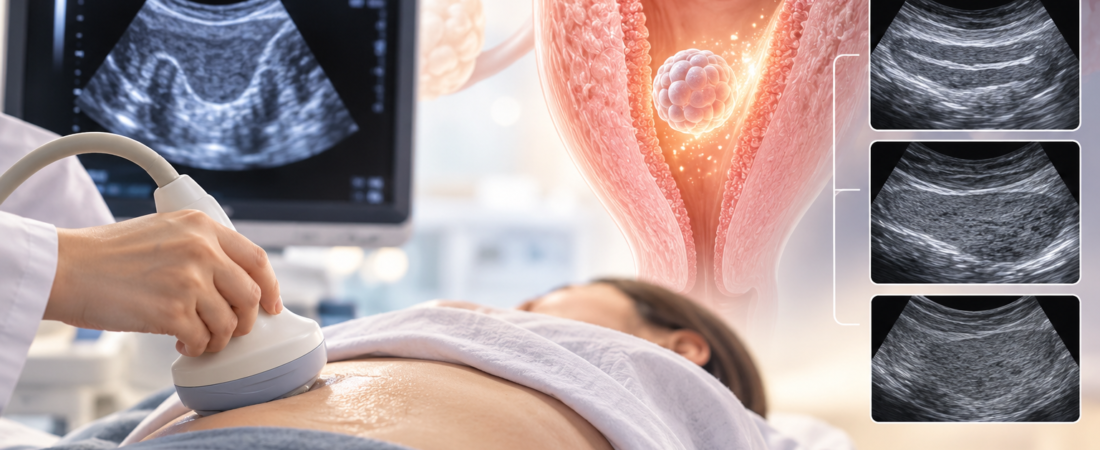
A study of 45,729 embryo-transfer cycles found different live-birth rates at similar endometrial thicknesses, depending on the lining’s ultrasound pattern.
The predictive value of a triple-line pattern was particularly apparent in thin and intermediate-thickness linings.
Endometrial thickness concerns not only women undergoing IVF but also people hoping for implantation. An embryo must implant in the uterine lining, making its thickness an important consideration.
Hearing “7 mm” during an ultrasound may bring relief, while “only 6 mm” can raise fears that embryo transfer should be postponed. Thickness has long been treated as an important indicator of the chances of a successful transfer.
But is a thicker lining always better? Can pregnancy and birth outcomes differ even at the same 7 mm measurement?
A large study offers a useful perspective: assessing the ultrasound pattern alongside thickness may help predict live birth more accurately.
Published in Fertility and Sterility in October 2026, the study analyzed 45,729 fresh and frozen embryo-transfer cycles. Live-birth rates varied by ultrasound pattern even when thickness was the same or similar, particularly in thin or intermediate-thickness linings.
45,729 cycles: is thicker always better?
Researchers analyzed 16,566 fresh and 29,163 frozen-thawed embryo-transfer cycles to examine associations between endometrial thickness, pattern and live birth. Their outcome was an actual birth, rather than simply a positive pregnancy test.
Live-birth rates tended to rise with increasing thickness, but the increase did not continue indefinitely.
The association began to level off at approximately 11–12 mm in fresh transfers and 9–10 mm in frozen transfers.
Once the lining reaches a certain thickness, additional millimeters may contribute less predictive information. This suggests that adequate thickness and the overall condition of the lining should be assessed together, rather than pursuing thickness alone.
The same 7 mm can look different
The ultrasound appearance of the endometrium was a central finding.
The lining changes appearance with hormonal changes. A triple-line pattern, resembling three distinct lines, was classified as type A. Patterns without a clear triple line, or with a more homogeneous appearance, were classified as B or C.
In fresh transfers, types B and C had lower live-birth rates than type A within the 7.0–7.9 mm and 8.0–8.9 mm ranges.
In frozen transfers, the difference extended across a broader range: below 10 mm, type A had higher live-birth rates than types B and C.
After adjustment for several factors, the relative likelihood of live birth with types B and C was approximately 12% lower in fresh transfers and 10.8% lower in frozen transfers than with type A.
In some frozen-transfer thickness ranges, a slightly thinner lining with a triple-line pattern had a higher live-birth rate than a thicker lining with another pattern. Thickness alone could not explain the results.
What lies behind the 16.7% and 44.7% figures?
Differences were especially apparent when thickness and pattern were considered together.
Among frozen transfers, the live-birth rate was 16.7% for linings below 7 mm with a B or C pattern, compared with 44.7% for linings at least 14 mm thick with a type A pattern—a difference of 28 percentage points.
That difference cannot be attributed solely to thickness and pattern. Age, embryo characteristics and treatment-related factors could also have contributed.
The more informative observation was that live-birth rates differed by pattern even at similar thicknesses.
Researchers considered pattern information particularly useful for predicting live birth when the lining was thin or of intermediate thickness.
Seven millimeters is not an absolute rule
A 7 mm endometrial thickness has long been used as an important reference in IVF. Yet pregnancy and birth can occur below 7 mm, and implantation can fail despite a sufficiently thick lining.
This study helps explain some of that variation. Two linings of the same thickness may not have the same outlook if one has a clear triple-line pattern and the other does not.
It does not mean that a triple-line pattern guarantees pregnancy, or that transfer should be cancelled whenever that pattern is absent.
Ultrasound appearance varies with hormonal conditions, examination timing and the method of endometrial preparation. This retrospective observational study also cannot show that treatment designed to produce a triple-line pattern would increase live-birth rates.
Transfer decisions therefore require consideration of embryo development, uterine disease, hormonal conditions and previous treatment outcomes, alongside thickness and pattern.
Ask about the lining as well as its measurement
Patients often focus on making the endometrium even one millimeter thicker. This study suggests that ultrasound appearance can provide additional information at the same thickness.
Thickness still matters, particularly because very thin linings were associated with lower live-birth rates. It simply does not describe every aspect of endometrial condition.
Before feeling reassured or discouraged by a 7 mm measurement, it is useful to understand what pattern was seen and how the lining changed during preparation for transfer.
Endometrial assessment is moving beyond a single measurement. The task is to understand the characteristics behind that number.
Related reading: Related reporting on endometrial thickness and ultrasound pattern.
Source: “Joint associations of endometrial thickness and pattern with live birth after fresh and frozen-thawed embryo transfer: a retrospective cohort study of 45,729 cycles,” published in Fertility and Sterility on October 14, 2026. The researchers analyzed 16,566 fresh and 29,163 frozen-thawed transfer cycles to evaluate joint associations with live birth. DOI: 10.1016/j.fertnstert.2026.10.008.
The illustration was created using generative AI (ChatGPT, OpenAI). Any people depicted are fictional.
Copyright © 2026 Fertility Information TokTok Fertility News | THE FERTILITY NOTES. All rights reserved. Unauthorized reproduction, copying, redistribution, scraping, AI training, and other data use of any articles, photographs, images, or other content are strictly prohibited. Violations may result in legal liability.