
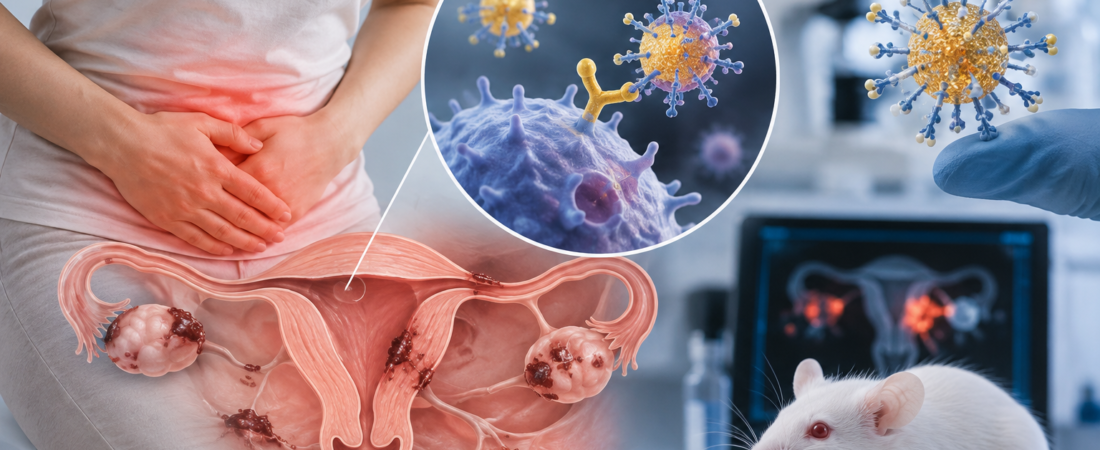
A targeted form of niclosamide, an established antiparasitic drug, has reduced endometriosis lesions and pain responses in mice. The approach delivers medication to immune cells involved in the disease, offering a possible alternative research direction to surgery or hormone suppression.
Researchers at the University of Michigan and Washington State University developed the candidate using nanotechnology to modify how niclosamide reaches endometriosis lesions.
The study appeared in Advanced Healthcare Materials and was highlighted by Nature on October 1, 2026.
Why current treatment still leaves gaps
Endometriosis occurs when tissue resembling the uterine lining grows outside the uterus, including on the ovaries or peritoneum, causing chronic inflammation and pain. It is estimated to affect about 10% of reproductive-age women and can cause severe period pain, chronic pelvic pain, painful sex and infertility.
Current care relies largely on hormonal treatment and surgery. Hormonal approaches can reduce lesion activity by suppressing estrogen-related effects, but some suppress ovulation and limit use while trying to conceive. Depending on the treatment, longer-term adverse effects can include hot flushes and reduced bone density.
Surgery is not a permanent solution for everyone. Lesions can recur, and surgery for ovarian endometriomas can sometimes reduce ovarian reserve.
The researchers therefore explored targeting disease-associated immune cells instead of suppressing hormones or directly removing lesions.
Delivering a drug to selected macrophages
Macrophages normally help clear pathogens and damaged cells. In endometriosis, some contribute to persistent inflammation, lesion growth, and formation of nerves and blood vessels.
The team focused on macrophages expressing folate receptor beta, or FRβ, and designed a way to deliver medication selectively to them.
Niclosamide has long been used against parasitic infections. Earlier work suggested anti-inflammatory and antiproliferative potential, but poor water solubility limits its absorption.
The researchers linked niclosamide to a dendrimer, a nanoscale branching molecular structure, and added targeting features intended to concentrate delivery in disease-associated macrophages.
The aim was selective delivery to cells involved in progression, rather than broad drug exposure throughout the body.
One injection reduced lesions and pain responses in mice
The candidate, FA-2DG-D-Niclo, was given once by intraperitoneal injection in a mouse model of endometriosis.
At doses equivalent to 25 or 50 mg of niclosamide per kilogram, both groups showed significantly fewer and smaller lesions when assessed two weeks later.
FRβ-positive macrophages within lesions decreased, and heightened responses to painful stimuli, known as hyperalgesia, were reduced.
The delivery system accumulated preferentially in lesions, with relatively lower distribution to other organs.
These findings support further investigation of a strategy that might address lesion growth and pain together.
Why a nonhormonal approach matters for fertility
The approach is of interest in reproductive medicine because it does not directly suppress reproductive hormones.
People with endometriosis who want to conceive face the challenge of controlling pain while preserving opportunities for pregnancy. Ovulation-suppressing treatment can help symptoms but creates constraints during attempts at conception or fertility treatment.
A therapy targeting disease-associated immune cells could potentially offer another way to manage endometriosis without hormonal suppression.
However, “nonhormonal” does not automatically mean safe for ovarian function or pregnancy. Effects on eggs and embryos, reproductive toxicity and longer-term safety require separate evaluation.
Early promise is not proof of benefit in patients
Nature's October 1 coverage highlighted the possibility of a nonsurgical, nonhormonal approach.
Human effectiveness has not yet been demonstrated. Reduced lesions and pain responses in mice do not establish the same effects in patients. Long-term prevention of recurrence and safety remain open questions.
The study assessed lesions and pain, not whether treatment improves pregnancy or live-birth rates.
Its significance is the possibility of modifying the immune environment around lesions, broadening research beyond approaches centered on hormones.
It offers a lead for developing additional treatments where options beyond surgery and hormonal therapy remain limited.
Study sources
The source article draws on Anubhav Dhull, Mingxin Shi, Madeleine E. Harvey and colleagues at the University of Michigan and Washington State University: “2-Deoxyglucose Dendrimer-Enabled Niclosamide Delivery to FRβ-Expressing Macrophages Alleviates Endometriosis Progression and Associated Hyperalgesia,” Advanced Healthcare Materials, 2026. DOI: 10.1002/adhm.71661. PMID: 42670248.
It also references Nature's October 1, 2026 report, “The ‘missed disease’ that affects 190 million: endometriosis drug shows early promise.” DOI: 10.1038/d41586-026-03042-x.
Related reading
Endometriosis and Adenomyosis: Longer Periods, but Not Necessarily More Pain
The image was created using generative AI (ChatGPT, OpenAI); any people depicted are fictional.
Copyright © 2026 Fertility Information TokTok | THE FERTILITY NOTES. All rights reserved. Unauthorized republication, reproduction, redistribution, scraping, AI training and data use of any content, including articles, photographs and images, are strictly prohibited. Violations may result in legal liability.