
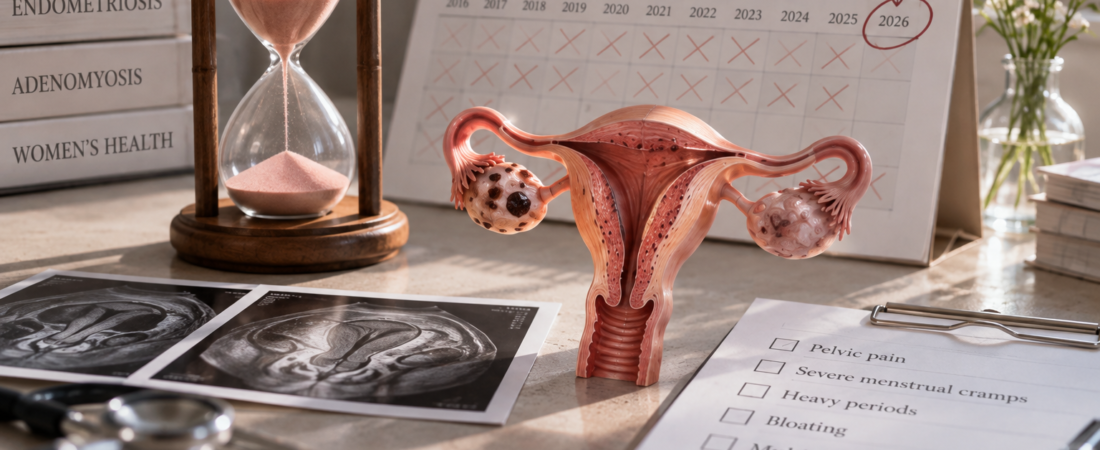
What if severe period pain lasted a decade before it had a name? A French study of 6,949 women reported an average endometriosis diagnostic delay of 10 years, and 11 years for adenomyosis. More severe or complex symptoms were associated with longer delays, not necessarily quicker answers.
For many women, repeated visits for recurring pain do not immediately lead to a clear explanation. This study describes that diagnostic experience in a large patient cohort.
Researchers including teams at INSERM and Université Paris-Saclay published the findings in the February 2026 issue of the Journal of Women's Health.
Ten years for endometriosis, eleven for adenomyosis
The investigators analyzed data from 6,949 women in the French online ComPaRe-Endometriosis cohort who reported a diagnosis of endometriosis or adenomyosis.
Endometriosis is a chronic inflammatory condition involving tissue resembling the uterine lining outside the uterus, such as on the ovaries or peritoneum. Adenomyosis involves similar tissue within the uterine muscle and can cause painful periods, heavy bleeding and chronic pelvic pain.
Both can affect quality of life and are associated with infertility in some patients.
The average delays from first symptoms to diagnosis were 10 years for endometriosis and 11 for adenomyosis, longer than the approximately seven years commonly cited for endometriosis.
The adenomyosis finding is particularly notable because large-scale data on its diagnostic delay have been relatively limited.
More severe period pain was associated with a longer wait
Severe menstrual pain before diagnosis was associated with an average delay 0.8 years longer than in women without that feature.
Women whose first consultation involved multiple symptoms had delays averaging 1.6 years longer. Seeing more clinicians before diagnosis was also associated with a longer interval.
Severe or complicated symptoms therefore did not necessarily lead to earlier recognition.
Alongside menstrual pain, these conditions can cause painful bowel movements, painful sex, chronic pelvic pain and abnormal uterine bleeding. Symptoms can overlap with other gynecological, digestive or urinary conditions.
Moving among specialties may form part of a prolonged diagnostic journey. However, this observational study cannot establish that consulting more clinicians itself causes the delay.
Financial circumstances and family history were also associated
The associations extended beyond symptoms to socioeconomic factors.
After adjustment for age, education, body mass index, comorbidities and other factors, unemployment was associated with a delay 0.7 years longer. Women who described their finances as comfortable had a delay 1.4 years shorter.
A family history of endometriosis or chronic pelvic pain was associated with a delay 1.1 years longer. More comorbid conditions were also associated with longer delays.
The family-history result runs against the expectation that familiarity might speed recognition. The analysis does not explain why that association occurred.
The findings suggest that access to care and complex health needs deserve consideration alongside symptoms and clinical judgment.
Conditions that can be missed before fertility assessment
Endometriosis and adenomyosis are important in fertility care.
Endometriosis can affect reproduction through pelvic inflammation, adhesions and changes in ovarian function. Adenomyosis can be associated with changes in uterine structure, function and the endometrial environment.
Neither diagnosis means that everyone will experience infertility. Effects vary with location, severity, age and other conditions.
Some women live with severe period pain for years before an underlying condition is recognized during a fertility evaluation.
Recurring pain, chronic pelvic pain or heavy bleeding should not simply be dismissed as an inevitable part of menstruation; professional assessment can help clarify the cause.
Evaluation uses symptoms, history, examination and imaging such as ultrasound or MRI. An apparently normal scan does not exclude every form of endometriosis.
Reducing the wait requires more than better imaging
The study illustrates why diagnostic delay is not solely a technical problem.
Symptoms vary and overlap with other conditions, while financial circumstances and pathways through healthcare may also be associated with the time to diagnosis.
Participants had already reported receiving a diagnosis. The findings should not be generalized as the average delay for all French women or for women in Korea. Recalling the timing of symptom onset and diagnosis can also introduce error.
The researchers suggested that identifying characteristics associated with longer delays may help clinicians and patients.
Severe period pain is not something women should be expected simply to endure. Repeated pain that disrupts daily life deserves investigation.
The broader message is the need for earlier symptom recognition and appropriate care pathways, so that naming a condition does not take more than a decade.
Study sources
This article is based on “Endometriosis Diagnostic Delay and Its Correlates: Results from the ComPaRe-Endometriosis Cohort,” by Zélia Breton, Solène Gouesbet, Marina Kvaskoff and colleagues, including researchers at INSERM and Université Paris-Saclay. Journal of Women's Health, volume 35, issue 2, February 2026; first published online September 26, 2025. DOI: 10.1177/15409996251380129. PMID: 40999898.
The Korean source also consulted Contemporary OB/GYN's February 16, 2026 discussion of the research.
Related reading
Endometriosis and Adenomyosis: Longer Periods, but Not Necessarily More Pain
The image was created using generative AI (ChatGPT, OpenAI); any people depicted are fictional.
Copyright © 2026 Fertility Information TokTok | THE FERTILITY NOTES. All rights reserved. Unauthorized republication, reproduction, redistribution, scraping, AI training and data use of any content, including articles, photographs and images, are strictly prohibited. Violations may result in legal liability.