
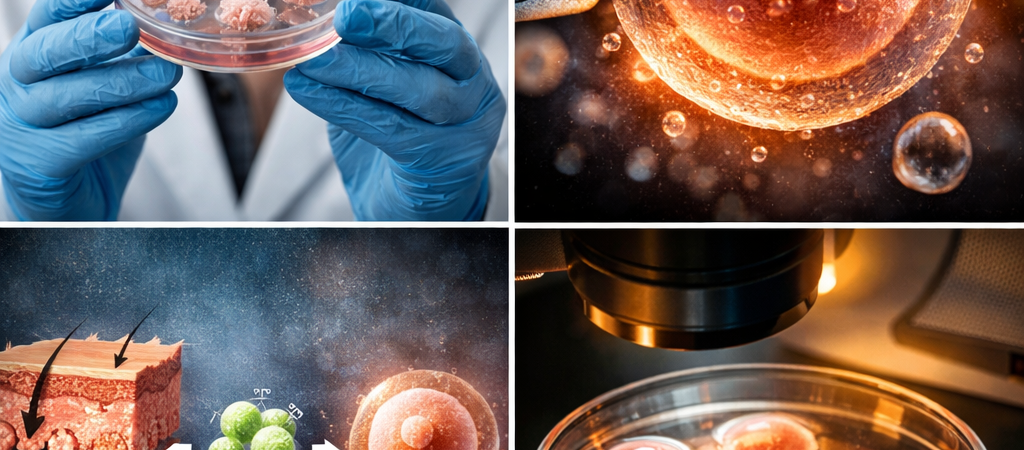
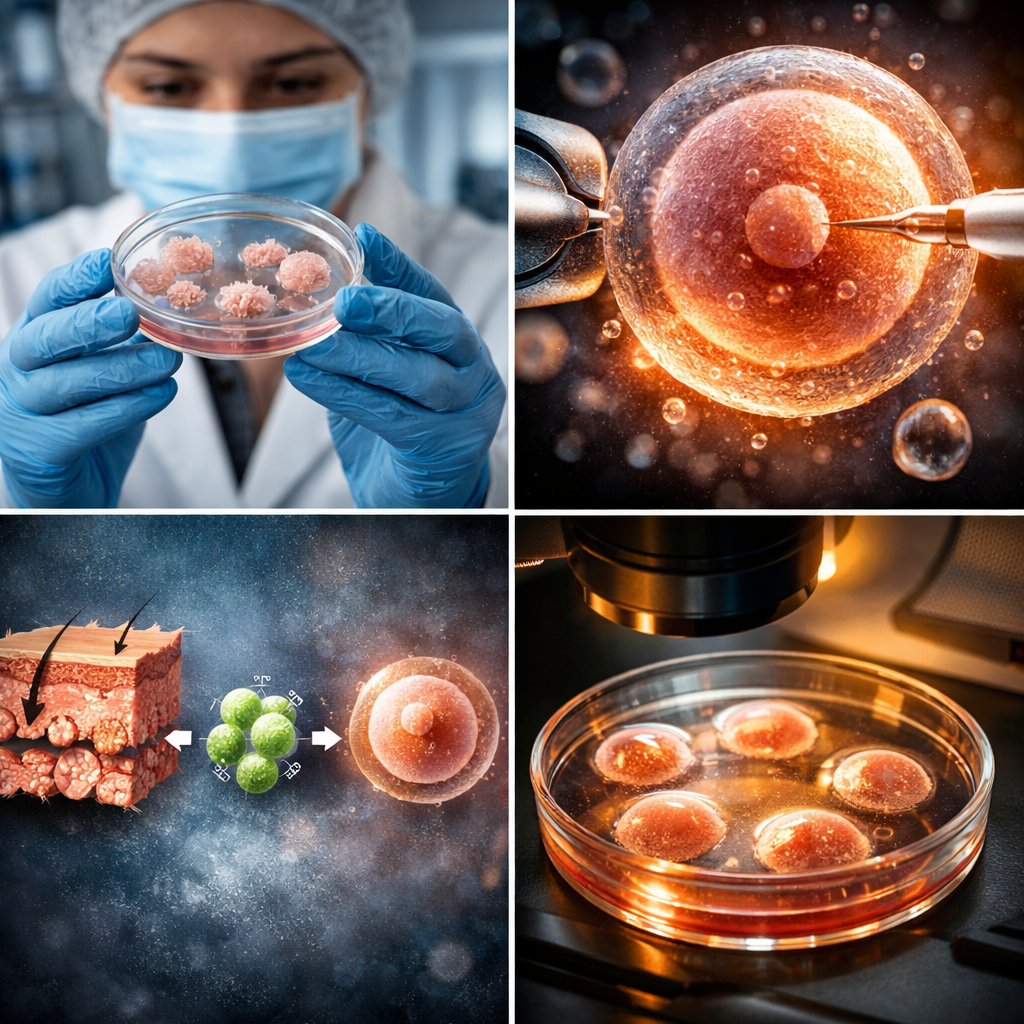
We are approaching an era where life could begin from a simple fragment of skin. Recent breakthroughs in reproductive medicine have brought us to a point where skin cells can be reprogrammed and converted into oocytes (eggs). While full clinical application in humans remains on the horizon, significant results have already been documented in animal models.
The core of this revolution lies in the realization that “a cell’s destiny is not fixed.” By reprogramming somatic cells—such as skin cells—into induced pluripotent stem cells (iPSCs) and subsequently differentiating them into oocytes, scientists are effectively resetting cells that have already fulfilled their specialized roles, turning them back into primordial reproductive cells.
If this technology becomes a clinical reality, its significance will extend far beyond the treatment of infertility. Until now, the human egg has been viewed as a “finite resource,” predetermined at birth and destined to deplete over time. However, if eggs can be synthesized from skin cells, reproduction is no longer bound by these biological constraints.
This is particularly transformative for women who have lost ovarian function, patients who have lost their fertility following cancer treatments, or even women of advanced maternal age. Theoretically, they could regain the ability to produce eggs carrying their own genetic material—an approach that operates on an entirely different dimension from traditional egg freezing or donor programs.
The Hurdles Ahead: Safety and Ethics
The technical and ethical barriers, however, remain formidable. We lack sufficient verification on whether these artificially derived oocytes can consistently lead to normal fertilization, healthy embryonic development, and successful live births. Genetic stability, the risk of mutations, and long-term health outcomes for offspring are critical issues that remain unresolved.
Above all, this technology forces us to confront a fundamental question: “What is reproduction?”
Is a life conceived from a lab-grown egg, rather than one produced naturally, fundamentally identical to our current concept of life? How far should we redefine the definition of “parents”? To what extent should we allow the boundaries of biological reproduction to be pushed?
Until now, the goal of reproductive medicine has been to answer: “How can we facilitate a more successful pregnancy?” This technology flips the script entirely, shifting the inquiry to: “Who, how, and with what will we define reproduction?”
This is not merely a medical intervention; it is a technology that proposes to redesign the entire system of human reproduction. If IVF was a technology that “assisted” nature, this technology possesses the potential to “replace” it.
The current reality, however, remains sobering. We are still in the experimental phase, and clinical application in humans is likely at least a decade away. During that time, the challenges we must resolve will be far more daunting than the science itself: we must prepare our ethics, our legal frameworks, and our society to absorb a change that is nothing short of revolutionary.
Disclaimer: This content is provided for informational purposes, based on reporting on infertility and various public data. Medical judgments and treatment decisions must always be made in consultation with professional medical personnel. Image: AI-generated (ChatGPT, OpenAI) / Visual reference for illustrative purposes only.