
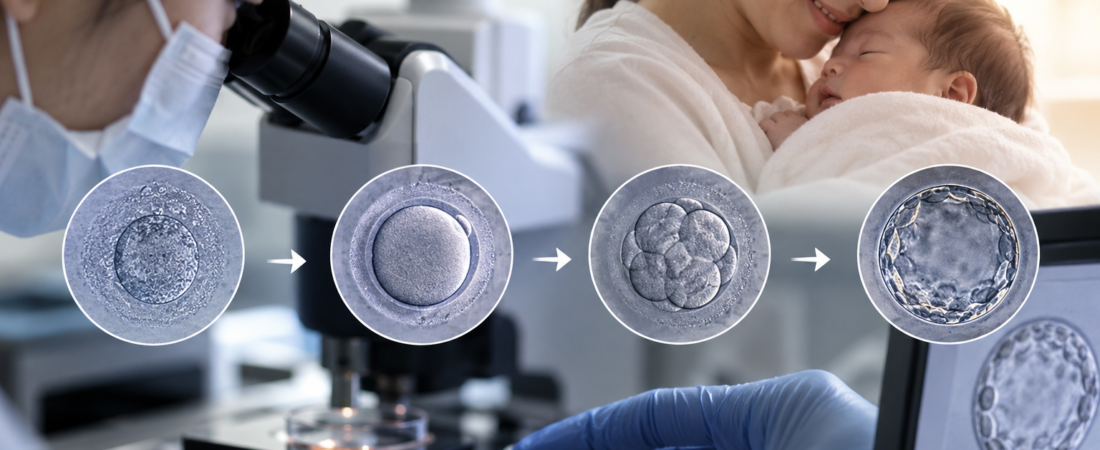
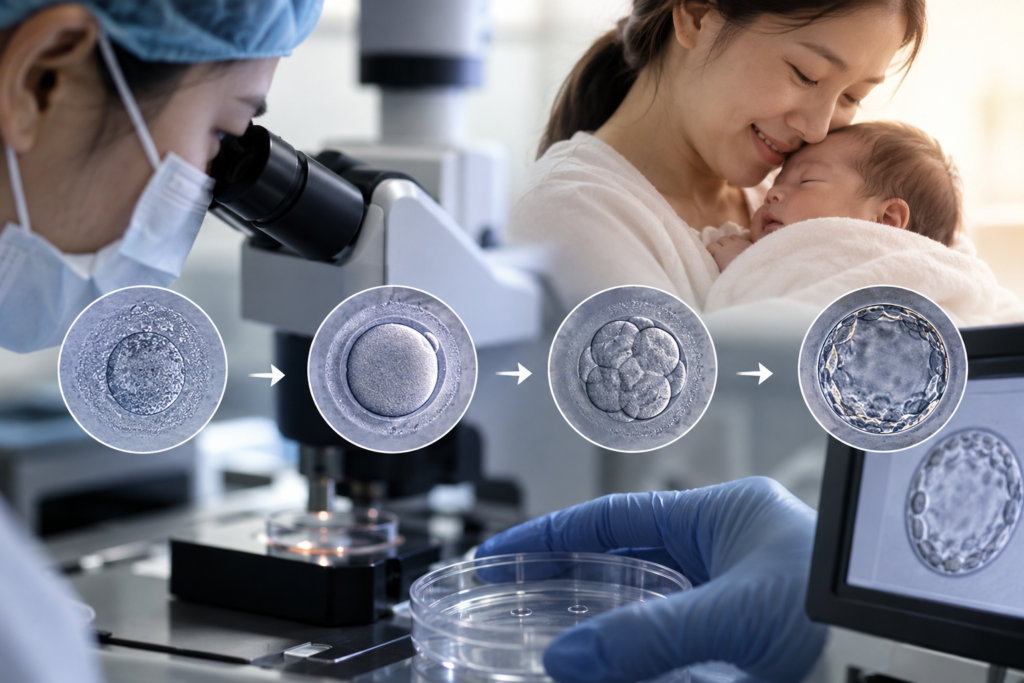
“Don’t Discard Them Just Because They’re Immature”… Cultured One More Night, They Became ‘Euploid Embryos’
- 266 immature oocytes at the germinal vesicle (GV) stage at retrieval cultured further: Nearly half converted into mature (MII) oocytes
- 11 out of 47 patients secured at least one additional euploid embryo: Meaningful salvage in patients with unexpectedly poor maturation
- Relative 20% increase in the number of patients achieving live birth: Demonstrating the clinical value of rescuing discarded gametes
After undergoing egg retrieval, some fertility patients are met with discouraging news: “We retrieved several eggs, but very few of them were mature.”
Not every egg collected during a retrieval cycle is ready for fertilization. In particular, oocytes at the germinal vesicle (GV) stage—where the nuclear envelope remains intact because meiotic progression has not yet occurred—are immature gametes that have historically been considered unusable in standard In Vitro Fertilization (IVF) and routinely discarded.
However, a study published in the international journal Human Reproduction reveals that instead of giving up on these immature eggs immediately, culturing them for an additional day in the embryology laboratory can provide select patients with new embryos and a renewed chance at live birth.
The research team analyzed 47 women under the age of 39 who underwent Intracytoplasmic Sperm Injection (ICSI) and Preimplantation Genetic Testing for Aneuploidy (PGT-A) between 2017 and 2024 and obtained fewer mature eggs than anticipated.
The study cohort specifically included patients who had 6 or fewer mature (MII) oocytes on the day of retrieval despite a low overall maturation rate, alongside 4 or more immature GV-stage oocytes.
127 of 266 GV Oocytes Became Mature Eggs
In this protocol, oocytes that were already mature (MII) at the time of retrieval were injected via standard ICSI on the day of retrieval. Meanwhile, immature oocytes arrested at the germinal vesicle (GV) stage were cultured in a time-lapse incubator for up to an additional 24 hours.
This technique of culturing eggs that were immature at collection to allow in vitro maturation is known as “rescue in vitro maturation” (rescue IVM).
Across the 47 patients, a total of 266 GV oocytes were identified. Among them, 127 successfully matured within 24 hours to the Metaphase II (MII) stage—the developmental point where fertilization becomes biologically possible. The maturation rate calculated across all GV oocytes was 47.7%.
On a per-patient average, the number of mature (MII) eggs secured on the day of retrieval was 4.4. However, with the addition of an average of 2.7 mature eggs rescued via IVM, the total number of oocytes available for ICSI increased to an average of 7.1.
For patients who started with few mature eggs, this is by no means an insignificant number.
For a patient who routinely yields 10 or 15 eggs, two or three additional oocytes may not feel like a major shift. But for a woman whose retrievals consistently stall at 2 to 4 mature eggs, the value of a single egg changes completely. Whether that single egg fertilizes, becomes a blastocyst, and ultimately yields a euploid embryo can decide whether she must endure an entire additional stimulation and retrieval cycle.
Blastocyst Conversion Was Lower, but Euploidy Rates Were Comparable
However, oocytes matured through rescue IVM did not display identical developmental competence to those that were mature in vivo from the start.
While the fertilization rate of rescue IVM oocytes did not differ significantly from baseline MII oocytes, their rate of progression to the blastocyst stage was relatively lower.
In other words: culturing immature eggs allows a substantial portion to achieve nuclear maturation, but not all of those rescued eggs will develop into viable embryos.
Yet, once an embryo successfully cleared the hurdle of reaching the blastocyst stage, the clinical picture changed.
The morphological quality of blastocysts derived from rescue IVM oocytes, as well as the proportion of euploid (chromosomally normal) embryos confirmed via PGT-A, showed no statistically significant difference compared to blastocysts originating from in vivo mature oocytes.
Ultimately, the primary biological barrier was simply whether the rescued egg could reach the blastocyst stage.
11 Out of 47 Patients Secured an Additional ‘Euploid Embryo’
The most striking finding was the actual acquisition of transferable euploid embryos.
Among the 47 patients evaluated, 11 women secured at least one additional euploid embryo originating from an oocyte matured via rescue IVM.
Gametes that would have been labeled immature and discarded on the day of retrieval successfully traversed extended culture, microinjection, embryonic cleavage, blastocyst biopsy, and PGT-A to become transferable, chromosomally sound embryos.
From a patient’s standpoint, this represents far more than just “saving one more immature egg.”
In cycles utilizing PGT-A, an egg must mature, fertilize, cleave, reach the blastocyst stage, and test normal on chromosomal screening before it can ever be transferred. Because numbers drop at each step of this developmental funnel, securing one or two additional eggs at the starting line can dramatically alter the final outcome.
Relative 20% Increase in Patients Achieving Live Birth
In the authors’ statistical model, rescue IVM meaningfully increased the total number of patients who successfully secured euploid embryos.
Compared to a hypothetical control scenario where GV oocytes were discarded, the proportion of patients securing at least one euploid embryo increased by a relative 8%.
Furthermore, the total number of patients who ultimately achieved a live birth increased by a relative 20%.
However, this figure must not be misinterpreted as a 20 percentage point jump in overall birth rates. It does not mean the clinical success rate jumped from 30% to 50%; rather, it signifies that because additional viable embryos were generated through rescue IVM, the total number of patients who successfully took home a baby grew by roughly 20% relative to the baseline cohort.
This Does Not Mean Every Immature Egg Can Be Saved
The investigators were careful to establish boundaries around interpreting these results.
This was a single-center retrospective study involving a modest sample size of 47 women. Crucially, the protocol was not applied indiscriminately to all IVF patients, but to a carefully defined subpopulation: women under 39 who experienced unexpectedly poor oocyte maturation and had four or more GV oocytes available.
Consequently, it is difficult to generalize these findings to claim that rescue IVM will universally raise pregnancy or birth rates for every IVF cycle.
Furthermore, the lower blastocyst conversion rate observed in in vitro matured eggs remains an acknowledged biological limitation.
Nevertheless, the central takeaway of this study is unmistakable: a diagnosis of “immature” on the day of retrieval does not mean the egg’s biological potential ends there.
For patients with diminished ovarian reserve or those who struggle to obtain mature eggs across repeated cycles, every single oocyte carries immense value. Selectively culturing previously discarded GV oocytes for one additional day in appropriate candidates offers a viable clinical strategy to minimize the loss of precious gametes.
Moving forward, reproductive medicine will need refined predictive models to determine which patients’ GV oocytes are most likely to mature and which eggs carry the genuine potential to become euploid embryos and healthy live births.
“Should we discard immature eggs, or wait one more day?” For fertility patients facing a scarcity of eggs, a single extra day in the embryology incubator may be more than passive waiting—it could be the window that creates a euploid embryo and another opportunity to hold a child.
Medical Source & Study Reference
- Journal: Human Reproduction (Official Journal of the European Society of Human Reproduction and Embryology, ESHRE), Vol. 41, Issue 9, pp. 1507–1521 (September 2026).
- Study Title: Germinal vesicle oocytes’ rescue: a worthless treatment or a patient-centred approach? Eight years of clinical experience in poor prognosis patients
- Lead Authors: Danilo Cimadomo et al.
- DOI: 10.1093/humrep/deag115 | Article ID: deag115
※ This article was synthesized based on the 8-year clinical study published in Human Reproduction (September 2026). It does not replace individualized clinical diagnosis or medical care, and specific embryological decisions should always be made in consultation with a qualified reproductive endocrinologist and clinical embryologist.
※ The images associated with this article were generated using generative AI (ChatGPT, OpenAI) as illustrative visual references and do not depict real individuals.