
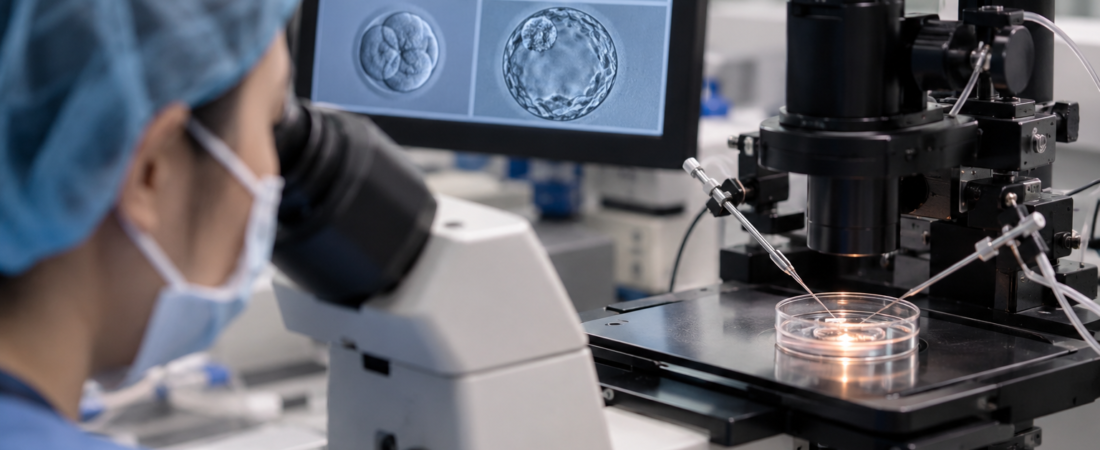
Do embryos develop better when cultured with other cells?
Conventional culture uses nutrient medium; co-culture adds living cells alongside the embryo.

The biological environment may improve, but benefits for pregnancy and live birth remain uncertain.
Fertilization does not ensure pregnancy in IVF. The fertilized egg must develop and implant, and its environment during the first three to five days is an important part of treatment.
Could growing an embryo with other cells be better than growing it without them?
That question underlies co-culture. Conventional culture supplies a medium containing the nutrients embryos need; co-culture places them alongside other living cells.
As an analogy, conventional culture provides a nutritious meal, while co-culture also provides cells that might support development.
Additional biological support does not necessarily translate into a higher pregnancy rate.
Conventional culture provides controlled nutrients and conditions
The most commonly used IVF approach places fertilized eggs in specialized medium while carefully controlling temperature, oxygen, carbon dioxide and pH.
The medium contains energy sources, amino acids, salts and other components needed for development. Laboratories manage conditions to reproduce aspects of the fallopian-tube and uterine environments.
A key advantage is the relative ease of maintaining consistent, standardized conditions, with systematic control of medium composition and incubator settings.
Even good media cannot fully recreate the complex interactions between cells in the reproductive tract.
Co-culture was investigated as a way to address this limitation.
Co-culture adds supporting cells
Co-culture grows embryos alongside other types of living cells.
Endometrial cells, fallopian-tube epithelial cells and cumulus cells have been studied. They may release growth factors and other active substances or change the surrounding environment in ways that affect development.
Some research suggests they may supply beneficial signals and reduce the effects of oxidative stress or harmful metabolic products.
Embryos also interact with surrounding tissues as they travel through the fallopian tube toward the uterus in the body.
Co-culture attempts to reproduce part of that biological environment in the laboratory.
Results depend on cell type, preparation, medium and culture conditions. Different co-culture methods should not be treated as a single uniform intervention.
Better development does not necessarily mean more births
The possibility of improving the developmental environment explains much of the interest.
Some studies have observed improved cell division or morphological quality. Researchers have explored whether it could help patients with repeated developmental arrest or few embryos reaching the blastocyst stage.
However, embryo development and successful pregnancy are different outcomes.
Higher cleavage or blastocyst-development rates do not necessarily imply improved implantation, clinical pregnancy or live birth.
Existing studies differ in cells, conditions, sample size and patient characteristics, making uniform comparisons difficult.
Sufficiently consistent clinical evidence has not established that co-culture increases live birth compared with conventional culture.
Which patients might discuss co-culture?
It may be considered after repeatedly poor embryo development or difficulty obtaining blastocysts in previous IVF cycles.
That does not establish that it will be effective for such patients.
Age, egg maturity and quality, sperm factors, chromosome abnormalities, stimulation and laboratory conditions all affect development.
If the underlying issue is an egg chromosome abnormality or a sperm genetic problem, changing the culture environment alone may not resolve it.
Preparing and maintaining living cells also makes the process more complex. Cell quality, microbial contamination risks and consistency require strict management.
Offering co-culture alone is therefore not evidence that a laboratory is better or that pregnancy is more likely.
Stable laboratory conditions remain fundamental
Reproductive medicine increasingly emphasizes how consistently the environment is maintained, rather than the name of a particular culture technique.
ESHRE’s 2026 IVF laboratory recommendations address control of temperature, pH, osmolality and gas concentrations during culture.
They emphasize avoiding unnecessary environmental changes and maintaining consistent quality-management systems.
Stable conditions are fundamental whether conventional culture or co-culture is used.
Co-culture aims to modify the biological environment, but cannot replace basic laboratory quality control or overcome every biological limitation of an embryo.
Choosing a method should reflect the patient and laboratory
Co-culture may sound more specialized or advanced to patients.
The appropriate choice depends on egg and sperm characteristics, previous development and the laboratory’s capabilities, rather than complexity alone.
It is not a standard intervention for every patient. Its potential to improve development in selected cases needs to be distinguished from uncertain effects on pregnancy and birth.
Patients considering it can ask what cells the center uses, which patients are offered it and what evidence supports a live-birth benefit.
The central issue is how reliably the laboratory provides a suitable developmental environment, rather than simply whether other cells are present.
Co-culture is one approach being explored, not a technique that guarantees better outcomes for everyone.
This article draws on “ESHRE recommendations on Good Practice in the IVF laboratory,” published in Human Reproduction in 2026 (DOI: 10.1093/humrep/deag096), and existing clinical studies and reproductive-medicine literature on embryo co-culture. Developmental improvements and live-birth benefits must be interpreted separately. Decisions should consider clinical characteristics and the laboratory system in consultation with a specialist.
The accompanying image was created using generative AI (ChatGPT, OpenAI); any people depicted are fictional.
Related reading: How an endometrial laboratory model helps researchers study embryos
Copyright © 2026 Fertility Information TokTok Fertility News | THE FERTILITY NOTES. All rights reserved. Unauthorized reproduction, copying, redistribution, scraping, AI training, and other data use of any articles, photographs, images, or other content are strictly prohibited. Violations may result in legal liability.