
Chronic endometritis is associated with lower clinical pregnancy rates and higher miscarriage rates after IVF or embryo transfer, according to a review of 39 studies. A separate small study found CD138-positive plasma cells in 40.63% of women with unexplained infertility. Neither finding proves that inflammation caused their infertility or supports testing every IVF patient.
The meta-analysis reported clinical pregnancy rates of 54.3% versus 60.1% and miscarriage rates of 16.4% versus 11.9%. The separate prospective study adds interest in a condition that may cause few symptoms, while the evidence for universal screening remains insufficient.
When embryo grades look reassuring and endometrial thickness seems unremarkable, repeated failure to conceive can leave patients wondering what else deserves attention. One area attracting renewed interest is chronic endometritis (CE): persistent inflammation within the uterine lining that can occur with few obvious symptoms.
A recent systematic review and meta-analysis found lower clinical pregnancy odds and higher miscarriage odds in women with CE than in those without it. A separate 2026 prospective study identified plasma-cell infiltration suggesting CE in more than 40% of the women studied with unexplained infertility.
Taken together, these findings encourage investigation of the subtle inflammatory environment in the endometrium, where an embryo must implant, alongside research focused on the embryo itself.
Clinical pregnancy: 60.1% versus 54.3%; miscarriage: 11.9% versus 16.4%
The review, published in September 2026 in the European Journal of Obstetrics & Gynecology and Reproductive Biology, searched databases from inception through February 2026 and included 39 studies.
Clinical pregnancy occurred in 60.1% of women without CE and 54.3% of women with CE. The pooled odds ratio was 0.55 (95% confidence interval [CI] 0.42–0.74), indicating lower clinical pregnancy odds with CE.
Miscarriage rates were 11.9% without CE and 16.4% with CE. The pooled odds ratio for miscarriage was 1.43 (95% CI 1.13–1.82).
For the particularly important outcome of live birth or ongoing pregnancy, rates were 44.0% in the CE group and 50.6% in the comparison group. The pooled difference was not statistically conclusive: OR 0.77, 95% CI 0.53–1.11.
The evidence therefore supports an association between CE and lower pregnancy rates or higher miscarriage risk. It does not, by itself, establish that CE directly causes pregnancy failure.
Inflammation without pain: why chronic endometritis can be “silent”
CE can be difficult to recognize because clear symptoms may be absent. Unlike the severe pain or fever associated with acute endometritis, chronic inflammation may persist quietly.
One important diagnostic feature is the presence of plasma cells in endometrial tissue. Researchers commonly use CD138 immunohistochemistry alongside conventional histology to identify them.
Hysteroscopy may reveal micropolyps, swelling or localized redness in the lining. However, hysteroscopic sensitivity ranged from 22% to 86% across studies in the meta-analysis. The authors describe hysteroscopy as a complement to histopathology rather than a stand-alone means of confirming CE.
Plasma cells in about four in ten women with unexplained infertility
A prospective observational study by Brazilian researchers, published in the Journal of Minimally Invasive Gynecology in 2026, compared endometrium from women with unexplained infertility and healthy controls during the implantation window.
Endometrial samples were examined for plasma-cell infiltration using CD138 immunohistochemistry. Infiltration was identified in 40.63% of the infertility group and 23.08% of healthy controls.
Hysteroscopic findings suggestive of CE were observed in 53.12% of women with infertility. Hysteroscopic sensitivity was 68.75%, and agreement between hysteroscopy and immunohistochemistry was 71.1%.
The study was small: 35 women with unexplained infertility were enrolled, and 32 underwent the immunohistochemical analysis. The control group contained only 15 women. It would therefore be incorrect to conclude that 40% of unexplained infertility is caused by CE.
The researchers treat the findings as exploratory evidence that CE may be more common in this population.
Do antibiotics improve IVF success? The evidence needs care
If CE is detected and treated, does IVF become more successful?
In the meta-analysis, women whose inflammation resolved after treatment had better live birth or ongoing pregnancy and clinical pregnancy outcomes, and lower miscarriage risk, than women with persistent CE.
There is an important limitation. Most included studies were observational. Patient characteristics, diagnostic definitions, CD138-positive plasma-cell thresholds, antibiotic regimens and embryo-transfer practices varied considerably. The investigators rated evidence for the main reproductive outcomes as low or very low certainty.
The comparisons do not prove that antibiotics themselves increase live birth rates. They also do not justify routine endometrial biopsy and treatment for every woman starting her first IVF cycle.
The authors suggest that a targeted approach may be more appropriate in selected patients, such as those with repeated implantation failure, recurrent miscarriage or infertility for which other explanations are difficult to identify.
A receptive lining matters—but important questions remain
Egg, sperm and embryo quality have long been central to fertility care. The uterine lining also matters: even a promising embryo may encounter an environment that is not well suited to implantation and pregnancy maintenance. This is one reason CE research is receiving attention.
Many questions remain unresolved. How many plasma cells define clinically meaningful disease? Who should be tested? Should biopsy be repeated after treatment? Most importantly, does treatment improve live birth outcomes? Standardized evidence is still lacking.
These studies do not amount to the discovery of a single hidden cause of unexplained infertility. They add to the rationale for studying chronic inflammation in the endometrium, alongside the embryo, when investigating why pregnancy does not occur.
Study sources
This article draws on the 2026 meta-analysis of 39 studies examining chronic endometritis and IVF outcomes in the European Journal of Obstetrics & Gynecology and Reproductive Biology: PMID 42753562; DOI 10.1016/j.ejogrb.2026.115417.
It also draws on the 2026 prospective study of chronic endometritis in women with unexplained infertility in the Journal of Minimally Invasive Gynecology: PMID 41690456; DOI 10.1016/j.jmig.2026.02.024.
Related reading
Recurrent implantation failure after euploid embryo transfer
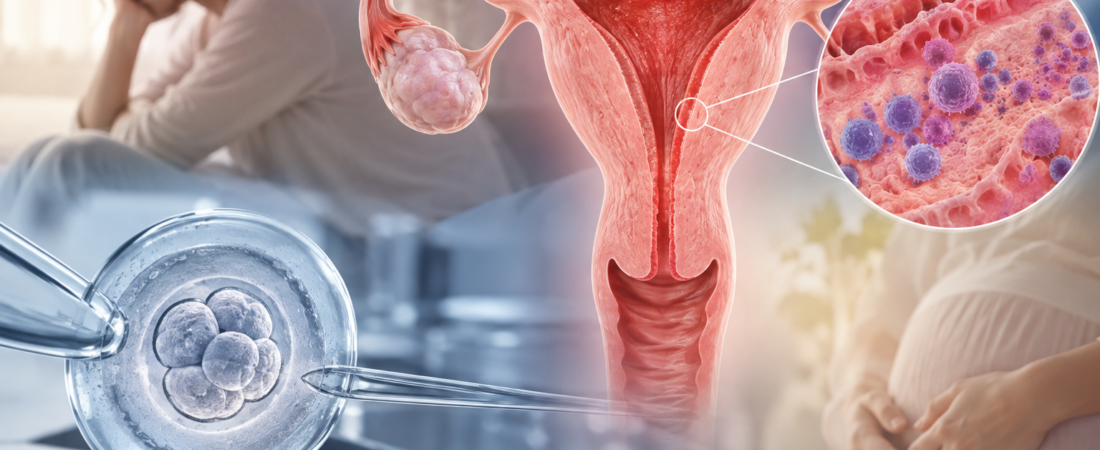
The illustration was generated using ChatGPT (OpenAI). It is not a clinical image or a photograph of actual patients.
Copyright © 2026 THE FERTILITY NOTES. All rights reserved. Unauthorized republication, reproduction, redistribution, scraping, AI training and data use of any content, including articles, photographs and images, are strictly prohibited. Violations may result in legal liability.