
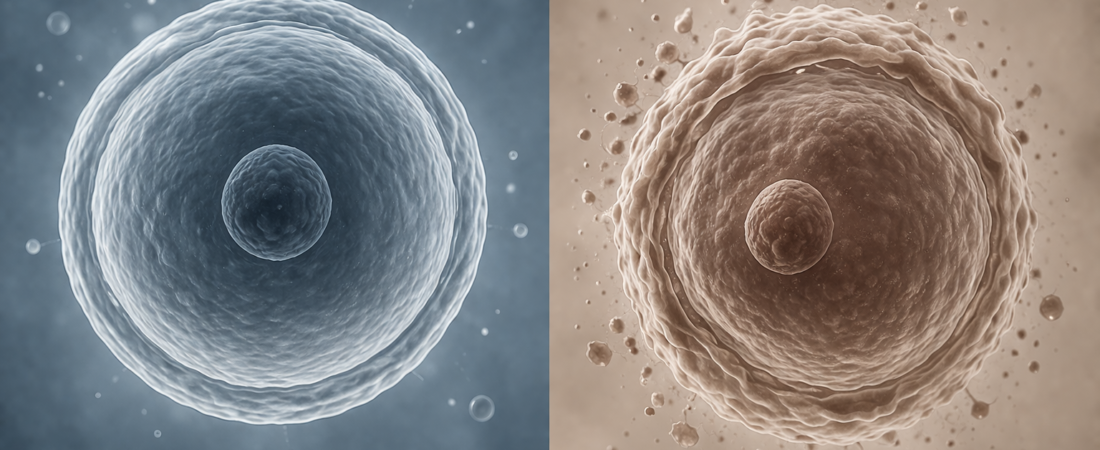
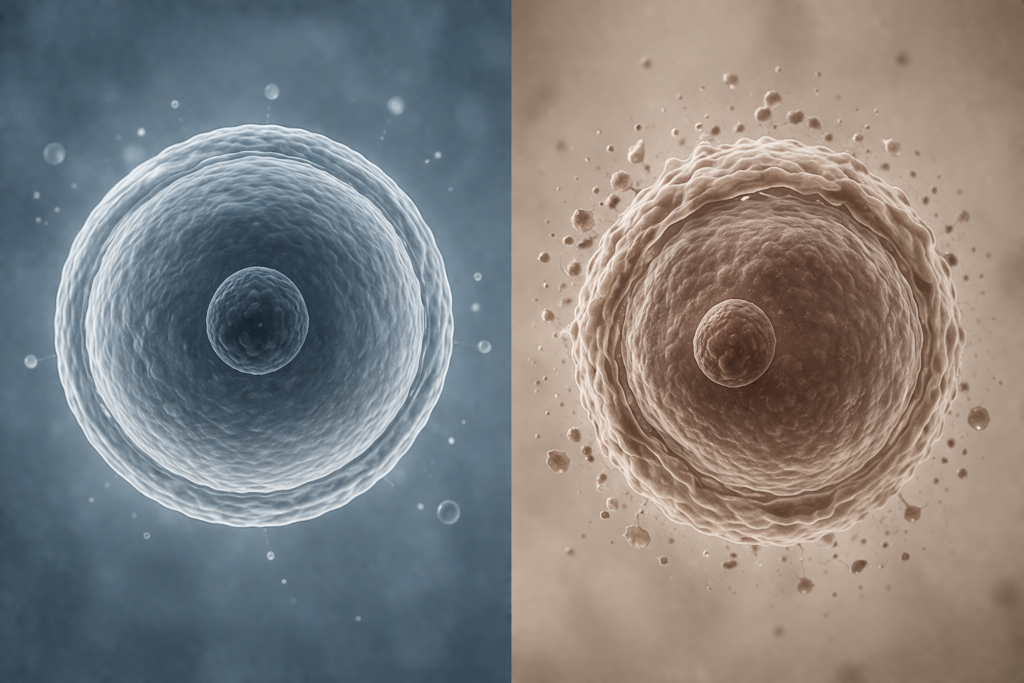
The core principle of infertility treatment has long been singular: find the best eggs, create embryos, and select the healthiest ones for transfer. Modern IVF has essentially been a sophisticated game of “selection technology.” However, recent research is shattering this paradigm, proposing a radical shift: instead of merely picking the best eggs, why not “reverse” their aging process altogether?
The SGO1 Protein: The Genetic Glue of Oocyte Division The breakthrough focuses on a protein called Shugoshin-1 (SGO1). In a youthful egg, SGO1 acts as a “genetic glue,” ensuring that chromosomes are perfectly aligned and separated during division. As an egg ages, the levels of this protein decline, leading to errors in chromosomal segregation—specifically, aneuploidy, where a chromosome is either missing or duplicated. This is the primary driver of maternal age-related infertility.
Researchers are now exploring the possibility of artificially replenishing SGO1—using mRNA or protein delivery to restore the egg’s ability to divide correctly. Early laboratory results have been compelling, with reports showing a nearly 50% reduction in chromosomal errors in experimental models. The implication is profound: it may be possible to make aging eggs “young” again.
The Gap Between Laboratory Promise and Clinical Reality However, we must temper this excitement with clinical reality. Currently, this technology remains strictly in the laboratory phase; it has not yet reached human clinical trials. Furthermore, we do not know if these restored eggs will successfully progress to pregnancy and healthy live births.
More importantly, oocyte aging is not a monocausal event. It is a systemic breakdown involving mitochondrial dysfunction, metabolic failure, and cumulative DNA damage. SGO1 is just one piece of a much larger puzzle. Repairing a single component does not necessarily mean the entire system is restored to its prime state.
From Screening to Intervention Despite these hurdles, the research is pivotal. It signals a shift in the philosophy of reproductive medicine:
- Past: We relied on PGT-A (Preimplantation Genetic Testing for Aneuploidy) to screen out “wrong” embryos after they were formed.
- Future: We are moving toward “preventative intervention”—correcting the egg before the embryo is ever created.
If validated in clinical settings, this technology would fundamentally restructure fertility treatment. We would see lower embryo discard rates and a complete change in how we approach maternal age as a clinical barrier.
A Word of Caution For now, the term “egg rejuvenation” is a hope, not yet a science. In the field of reproductive medicine, new technology is often preceded by a wave of over-expectation and hype. While the possibility of intervention is now open, reality is still lagging far behind.
The essential phase we are entering is not about “demonstration,” but “reproducibility.” We must verify that these findings translate into human clinical success without unforeseen long-term consequences. We are moving from an era of selecting the best, to an era of intervening to make things better. But let us be clear: the era has dawned, but the medicine is still in its infancy.
Sources: Recent reports (Jan 2026) in The New York Post, The Washington Post, Axios, People, and The Wall Street Journal.
Disclaimer: This content is provided for informational purposes, based on reporting on infertility and various public data. Medical judgments and treatment decisions must always be made in consultation with professional medical personnel. Image: AI-generated (ChatGPT, OpenAI) / Visual reference for illustrative purposes only.