
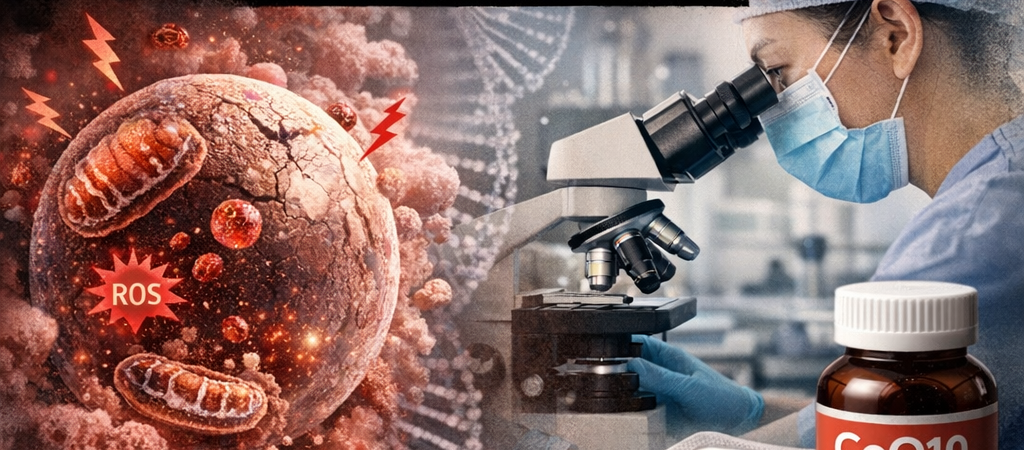

At some point, Coenzyme Q10 (CoQ10) quietly transformed into an absolute staple within the fertility market. While it is rarely found on a formal hospital prescription, it is almost never missing from a patient’s personal bag.
Whenever you open the internet, phrases like “improving oocyte quality” and “elevating pregnancy success rates” are endlessly repeated, and within those promising lines, individuals carefully select their hope. However, this clinical paradigm must be challenged at least once: Can CoQ10 genuinely alter the biological quality of an oocyte? Or are we simply consuming yet another highly plausible narrative?
To address the absolute core of the matter: the scientific direction is accurate, but the clinical expectations are drastically exaggerated. CoQ10 is not a magical substance engineered to reverse cellular aging. To be more precise, it operates merely as a secondary support device that subtly enhances metabolic energy efficiency within a cellular system that is already steadily aging. If a patient fails to comprehend this crucial biological distinction, the downstream efficacy becomes heavily distorted, and clinical disappointments are destined to repeat.
The definitive essence of an oocyte is raw energy. Following initial fertilization, an early-stage embryo initiates its rapid cellular divisions relying entirely on the native energy reserves packed within the maternal egg, without any external maternal assistance. At this critical juncture, if the adenosine triphosphate (ATP) volume manufactured by the intracellular mitochondria proves insufficient, proper chromosomal segregation fractures, and embryonic development undergoes a complete, immediate arrest.
Consequently, contemporary reproductive endocrinology is moving away from viewing the oocyte as a mere passive cell, classifying it instead as a highly complex power plant. This is the precise reason why CoQ10 returned to the center of clinical focus; it is a vital co-factor designed to facilitate ATP synthesis within the mitochondrial electron transport chain while aggressively mitigating localized oxidative stress.
In controlled animal models, the biological outcomes are highly promising. Administering CoQ10 to aged mice consistently yields a distinct upregulation in overall oocyte viability and functional capacity. The foundational caveat, however, is that human reproductive biology does not mirror murine models. Human clinical trials yield highly inconsistent and heterogeneous data. Certain longitudinal studies document a measurable improvement in overall oocyte maturation rates, whereas parallel randomized trials report zero statistically significant variance in ultimate live birth rates.
In essence, the scientific consensus regarding CoQ10’s capacity to optimize oocyte quality resides strictly at the level of “biological plausibility and possibility,” rather than the definitive phase of “guaranteed clinical efficacy.” Despite this lack of absolute verification, the primary reason CoQ10 has infiltrated the consumer market so deeply lies elsewhere: it represents a choice, rather than a forced treatment.
While an In Vitro Fertilization (IVF) cycle is an invasive environment strictly governed by medical infrastructure and clinical practitioners, purchasing CoQ10 grants patients a powerful psychological sense of agency—the belief that they are actively doing something to control their outcome. The longer the waiting period stretches, the more aggressively individuals seek action. CoQ10 serves as the most accessible tool to systematically buffer that profound biological anxiety. At this specific intersection, raw reproductive science frequently blurs with patient psychology.
A more critical hazard materializes when the multi-factorial etiology of infertility is oversimplified down to a single variable: “oocyte energy deficiency.” The moment a patient adopts this narrow focus, they completely lose sight of the global reproductive architecture. Achieving a live birth requires four highly distinct biological axes to synchronize flawlessly: functional sperm, high-potential oocytes, stable embryonic development, and a highly receptive uterine environment. If even a single axis fractures, the ultimate clinical outcome remains entirely unattainable. The cultural hype surrounding CoQ10 oversimplifies this incredibly complex puzzle, creating a false illusion that ensuring oocyte quality is the sole barrier to reproductive success.
What, then, is the definitive clinical conclusion? Is CoQ10 completely devoid of utility? Absolute non-utility is inaccurate. Under highly specific clinical parameters, it possesses undeniable strategic value. For patients navigating advanced maternal age or severe diminished ovarian reserve, it can be responsibly deployed as a targeted therapeutic strategy to optimize remaining mitochondrial efficiency.
However, it must be treated strictly as a supportive adjuvant strategy, never an absolute resolution. It is a tool utilized to subtly recalibrate parameters at the periphery, not the absolute epicenter of medical treatment.
Ultimately, this entire conversation distills down to a single, direct question: What exactly are we expecting this supplement to achieve? Are we actively searching for an unscientific compound to turn back the biological clock, or are we simply attempting to optimize the mathematical probability of success within our pre-existing baseline parameters? CoQ10 applies strictly to the latter scenario. The exact millisecond a patient expects the former, this tiny co-factor becomes dangerously overvalued, and the cycle inevitably concludes in profound emotional grief.
The field of reproductive medicine is becoming increasingly transparent. Clinicians are beginning to draw a sharp, honest line between what “holds potential for improvement” versus what “guarantees a definitive result.” CoQ10 stands directly upon that precise boundary line. It possesses the capacity to offer hope, but it lacks the biological power to guarantee the final outcome. The moment you comprehend this distinction, this popular supplement ceases to be an exaggerated marketing myth and becomes a calibrated clinical strategy.
📚 Medical References
- Fertility and Sterility
- Significance: Documented clinical evidence demonstrating measurable, localized improvements in overall oocyte maturation and early embryo morphology following targeted CoQ10 supplementation within cohorts presenting with diminished ovarian reserve (DOR).
- Reproductive Biology and Endocrinology
- Significance: Comprehensive peer-reviewed research mapping out the precise molecular pathways of CoQ10 in optimizing mitochondrial ATP synthesis rates and aggressively buffering aging oocytes against unchecked oxidative stress.
Editor’s Note: This content is an analytical commentary prepared by a specialized fertility journalist through the collection and evaluation of domestic and international reproductive medicine research, clinical policies, and statistical data. All medical diagnoses and treatment decisions must exclusively be established through direct consultation with a qualified medical professional.
Image Source: AI-generated (ChatGPT, OpenAI) / Provided solely as a supplemental visual aid for conceptual understanding.