
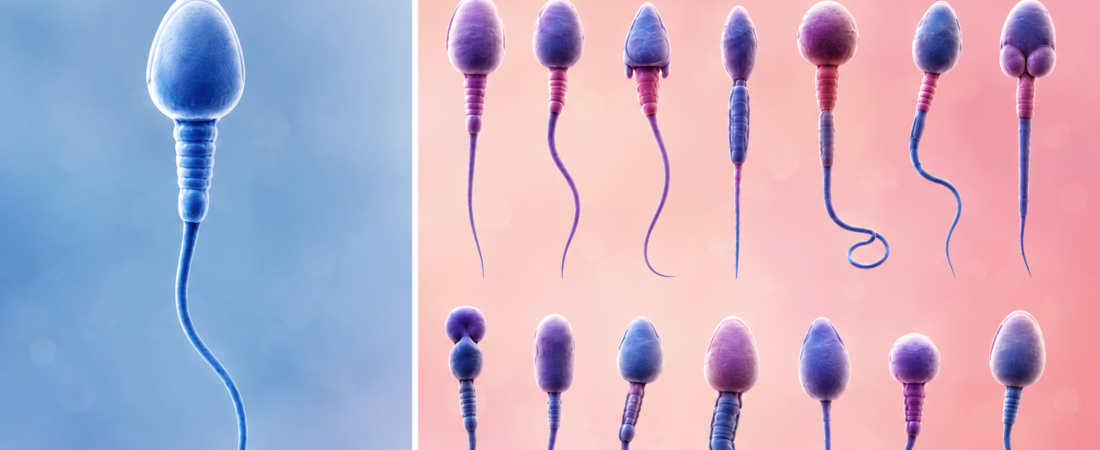
Sperm morphology measures how sperm look under strict laboratory criteria. A result near 4% can sound alarming, yet it is not a dividing line between fertile and infertile. Interpreting a semen analysis requires the whole picture, including count, motility, repeat results and both partners’ circumstances.
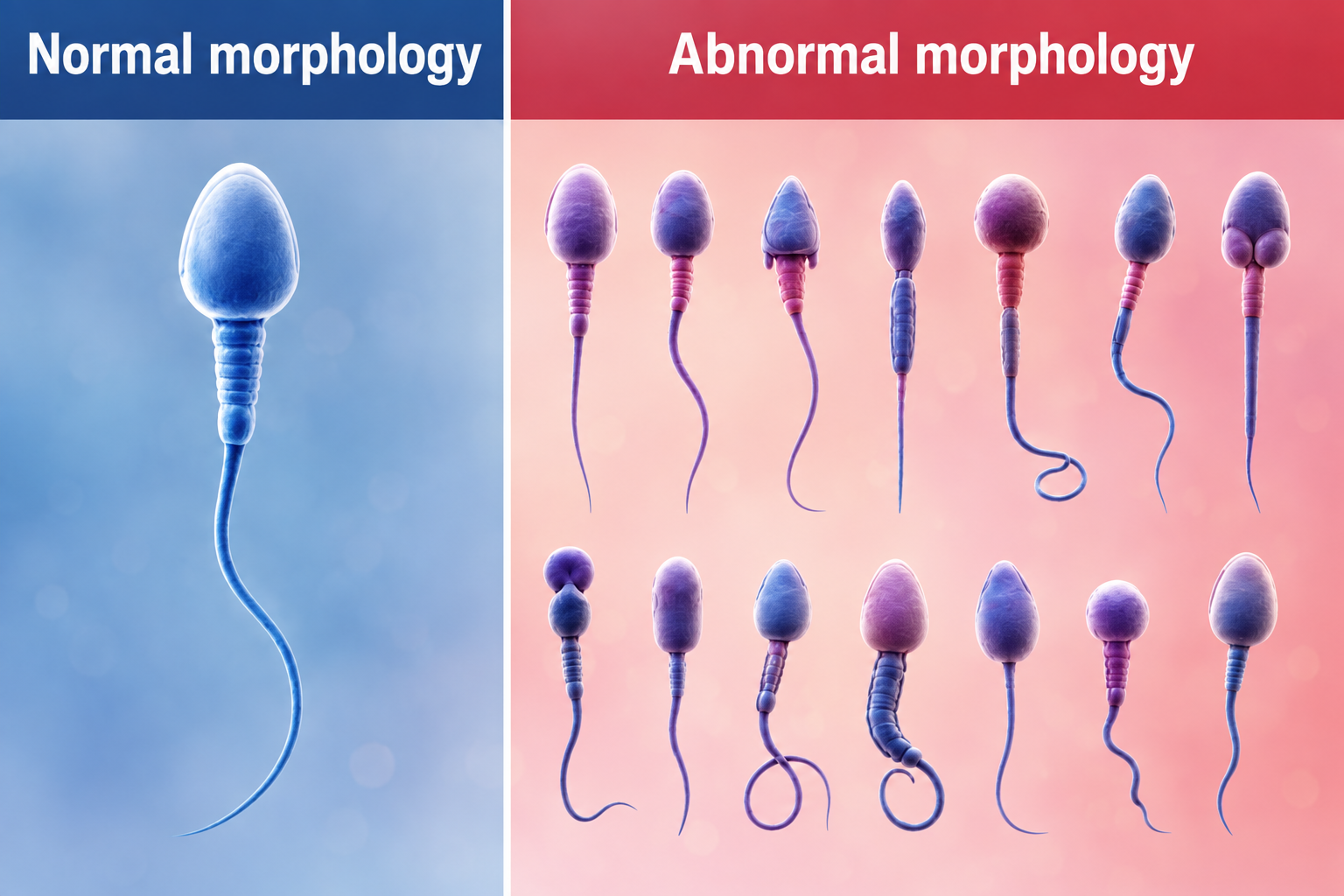
One of the most shocking numbers for men reviewing their semen analysis is the morphology score. When a report indicates that only 3%, 2%, or even 1% of sperm are “normal,” many men immediately conclude they are infertile. A common question in the clinic is, “Does this mean the remaining 99% are defective?”
To understand this, we must accept an uncomfortable truth: humans are naturally a species that produces a high percentage of morphologically abnormal sperm.
What the 4% reference value means.
The commonly cited 4% value is a lower reference point derived from a fertile population using strict morphology assessment. It is not a pass–fail cutoff for an individual’s ability to conceive.
Sperm are composed of a head, mid-piece, and tail. If the head is slightly too large or too small, it is classified as abnormal. If the tail is slightly bent or the mid-piece is misshapen, it is also classified as abnormal. Because the criteria are so rigorous, many sperm that are perfectly capable of fertilization are categorized as “abnormal”.
Evolutionary Strategy: Mass Production over Quality Control
Why does the human body produce so many “imperfect” sperm?
- The testes are high-volume manufacturing plants, producing tens of millions of sperm daily.
- In this complex process of rapid cell division and DNA replication, a certain rate of error is biologically inevitable.
- Evolutionarily, this is an efficient strategy: rather than crafting a few “elite” sperm, the human system produces a vast quantity and lets natural competition filter out the anomalies, favoring a “volume-based” survival strategy.
Why Morphology Isn’t the Only Predictor
A low morphology score does not mean pregnancy is impossible. In reality, fertility is a complex equation involving sperm count, motility, DNA integrity, the female partner’s age, ovulation status, and tubal health.
- At 2% normal forms and 100 million sperm per mL, the arithmetic gives 2 million normal forms per mL. That calculation alone cannot predict natural conception.
- Morphology does not directly measure DNA integrity. Sperm DNA-fragmentation testing has selected uses but is not a routine replacement for standard semen analysis.
- In IVF, Intracytoplasmic Sperm Injection (ICSI) allows embryologists to manually select the healthiest-looking, most motile sperm and inject it directly into the egg, effectively bypassing structural limitations.
Lifestyle is only one influence.
Sperm production and maturation take several months. Health and exposures can affect results, but morphology is not a direct score of personal effort or a guarantee that a lifestyle change will normalize a future test.
- Temperature Matters: The testes function best at 2–3°C below core body temperature. Avoiding saunas, hot tubs, prolonged sitting, and laptop use on your lap may reduce heat exposure.
- Lifestyle Optimization: Quitting smoking, managing weight, exercising, and getting adequate sleep can support health, although semen changes vary and are not guaranteed within three months.
Do not be discouraged by a single number on a report. View it as a mirror of your current health and an opportunity to optimize your systemic well-being for the future.
Disclaimer: This report is for informational purposes. If you have concerns about your fertility, consult with a urologist or reproductive specialist for a personalized evaluation.
A reference distribution, not a verdict
Morphology alone cannot distinguish fertile from infertile men, and semen parameters vary between samples. A normal-looking sperm is not necessarily genetically normal, nor does abnormal shape alone prove genetic damage. WHO semen laboratory manual, sixth edition.
Related reading
Testicular Sperm and ICSI: Why Finding One Sperm Is Only the Beginning