
Resveratrol and IVF attract attention because of research on oxidative stress and cellular aging. Yet laboratory promise does not establish better live-birth outcomes, and some human embryo-transfer data raise safety concerns. Before taking this supplement, the key questions are the evidence, dose and timing—not its anti-aging reputation.
When discussing fertility treatment, the conversation usually centers on hormone injections or IVF procedures. However, in modern fertility clinics, clinicians are increasingly focusing on the fundamental biology of cells: mitochondria, oxidative stress, cellular aging, and inflammation. At the center of this focus is resveratrol.
The Origin of a Fertility Supplement
Resveratrol first gained fame through red wine, famously cited as the reason the French population maintained low cardiovascular disease rates despite high fat consumption. It is a polyphenol—a natural defense compound found in grape skins—that plants produce to protect themselves against environmental stress. Scientists discovered that this “survival molecule” exerts complex effects on human cells, including antioxidant and anti-inflammatory properties, the activation of anti-aging pathways, and the protection of mitochondrial function.
Why Oocytes Need Protection
Oocytes (eggs) are among the most unique cells in the human body. Unlike skin cells that constantly regenerate, a woman’s eggs are formed during fetal development and remain dormant in the ovaries for decades. A 40-year-old woman’s eggs have endured 40 years of time, during which oxidative damage and mitochondrial decline accumulate.
When oxidative stress is severe, chromosomal segregation errors increase, leading to failed fertilization or embryos that stop developing during the 5-day blastocyst culture stage. This is why fertility specialists prioritize “quality over quantity”; the goal is not just to retrieve eggs, but to ensure those eggs are metabolically healthy enough to result in a successful pregnancy.
A research question, not an established IVF strategy.
Resveratrol affects pathways such as SIRT1 in experimental systems. These mechanisms do not demonstrate improved live-birth rates, and routine use for diminished ovarian reserve or repeated IVF failure is not established.
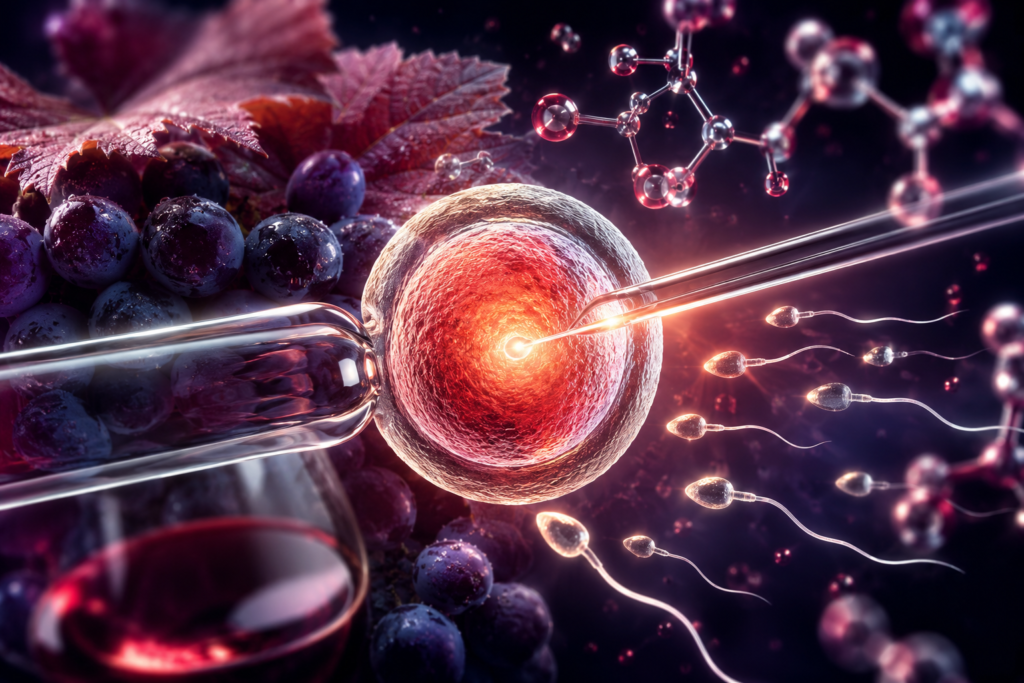
Furthermore, resveratrol is gaining attention in other areas of reproductive medicine:
- Male Fertility: Experimental work has examined sperm and oxidative stress, but clinical benefit for male fertility is not established.
- Endometriosis: As a chronic inflammatory condition, endometriosis involves constant oxidative stress. Experimental anti-inflammatory findings do not establish resveratrol as an effective treatment for endometriosis, adenomyosis or fibroids.
Promise does not equal a treatment recommendation.
Resveratrol is not a proven way to reverse reproductive aging. Its effects may differ by dose, timing and experimental setting.
Before using resveratrol, discuss the uncertain benefit and the timing of supplementation with the treating clinic. Animal and cell findings cannot settle the safety of exposure during human embryo transfer or pregnancy.
- Sinclair, D. A., et al., “The therapeutic potential and in vivo effects of resveratrol,” Nature Reviews Drug Discovery, 2006.
- American Society for Reproductive Medicine (ASRM) clinical resources on antioxidants.
Disclaimer: This report is for informational purposes. Resveratrol is a supplement, not a replacement for clinical diagnosis or standardized fertility treatment. Please consult with your reproductive endocrinologist before beginning any new supplementation.
Human embryo-transfer evidence and its limits
A 2019 single-center retrospective study by Ochiai and colleagues from Juntendo University and Sugiyama Clinic compared 204 transfer cycles in 102 women taking 200 mg/day continuously with 7,073 cycles in 2,958 women not taking resveratrol. Supplement use was associated with lower clinical pregnancy odds (OR 0.539, 95% CI 0.341–0.853) and higher miscarriage odds (OR 2.602, 95% CI 1.070–6.325). This observational study cannot prove causation and does not settle every dose or timing schedule. It does challenge blanket claims of benefit during embryo transfer. Original study: Reproductive BioMedicine Online (2019), DOI 10.1016/j.rbmo.2019.03.205. Grapes in a normal diet are not equivalent to a concentrated supplement, and wine is not a fertility treatment.