
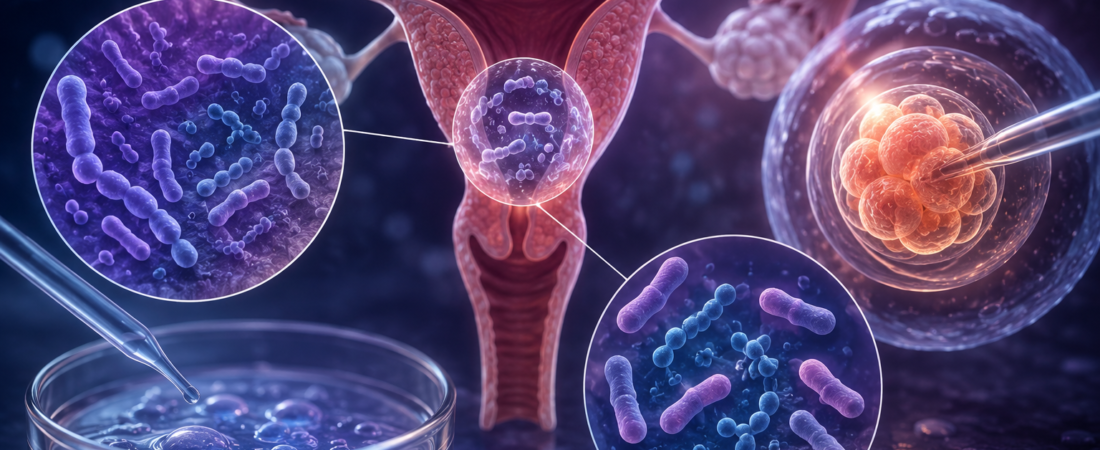
Chronic endometritis and the endometrial microbiome are often discussed after repeated implantation failure. They are related areas of investigation, not interchangeable diagnoses. Selected assessment may be considered, while routine microbiome testing, probiotics or broad immune treatments should not be presented as proven routes to a live birth.
For the past two decades, the field of In Vitro Fertilization (IVF) has been defined by the pursuit of the perfect embryo. Advances in incubation technology, cryopreservation, and preimplantation genetic testing (PGT-A) turned IVF into a high-precision industry of “embryo selection.” Yet, clinicians have increasingly faced a frustrating clinical paradox: patients with genetically normal, high-quality embryos who continue to face repeated implantation failure (RIF).
Repeated implantation failure can have several explanations. Inflammation is one area of investigation, not a single answer that replaces assessment of embryo and other factors.
Chronic endometritis
CE may have few symptoms and is assessed using clinical and endometrial findings. Diagnostic thresholds and treatment evidence vary; it should not be described as tissue that inevitably rejects an embryo.
The endometrial microbiome
Microbial studies are technically challenging because of low biomass and possible sampling contamination. A reported microbial pattern is not itself a validated treatment target.
Some studies associate Lactobacillus-dominant patterns with reproductive outcomes. Association does not prove that changing those patterns improves live birth.
Separate the proposed interventions
Each requires its own indication and evidence:
- Antibiotics: May be considered when CE is diagnosed in an appropriate context.
- Probiotics: Do not assume that altering a microbial profile improves live birth.
- Immune treatment: Requires a specific indication and supporting evidence.
ESHRE’s RIF recommendations allow consideration of CE assessment in selected circumstances, while routine uterine or vaginal microbiome profiling is not recommended. Probiotic or immune treatments should not be presented as established implantation optimization.
Conclusion: Pregnancy as a Systemic Event
The philosophy of IVF is undergoing a fundamental change. We are moving from a focus on the “cell” to a focus on the “system.”
A successful or unsuccessful transfer is not a judgment on whether the patient’s body was sufficiently welcoming. Use careful assessment and transparent discussion of uncertainty rather than a poisoned-soil metaphor.
Disclaimer: This content is provided for informational purposes, based on recent advancements in reproductive medicine. Medical judgments and treatment decisions must always be made in consultation with professional medical personnel. Image: AI-generated (ChatGPT, OpenAI) / Visual reference for illustrative purposes only.
Recommendations distinguish the tests
Clinical endometritis assessment and routine microbiome profiling are different proposals. Consider the evidence for each intervention. ESHRE good practice recommendations on recurrent implantation failure (2023), DOI: 10.1093/hropen/hoad023.
Related reading
"Beyond the Embryo": The Paradigm Shift from Selection to Environment in IVF