
Once considered a niche procedure, egg freezing (oocyte cryopreservation) has surged into the mainstream. Over the past few years, procedure volumes have risen by nearly 50%, with the average age of women opting for the procedure dropping from 37 to 35. This trend signals a fundamental shift: egg freezing is evolving from a reactive “last resort” to a proactive “preemptive strategy.”
However, a common misconception persists—the belief that the technology of freezing is the ultimate determinant of success. In reality, the success of egg freezing is dictated not by the sophistication of the lab, but by the biological age of the eggs at the moment of cryopreservation.
The Biological Reality: Youth vs. Time The quality of an egg is inextricably linked to time.
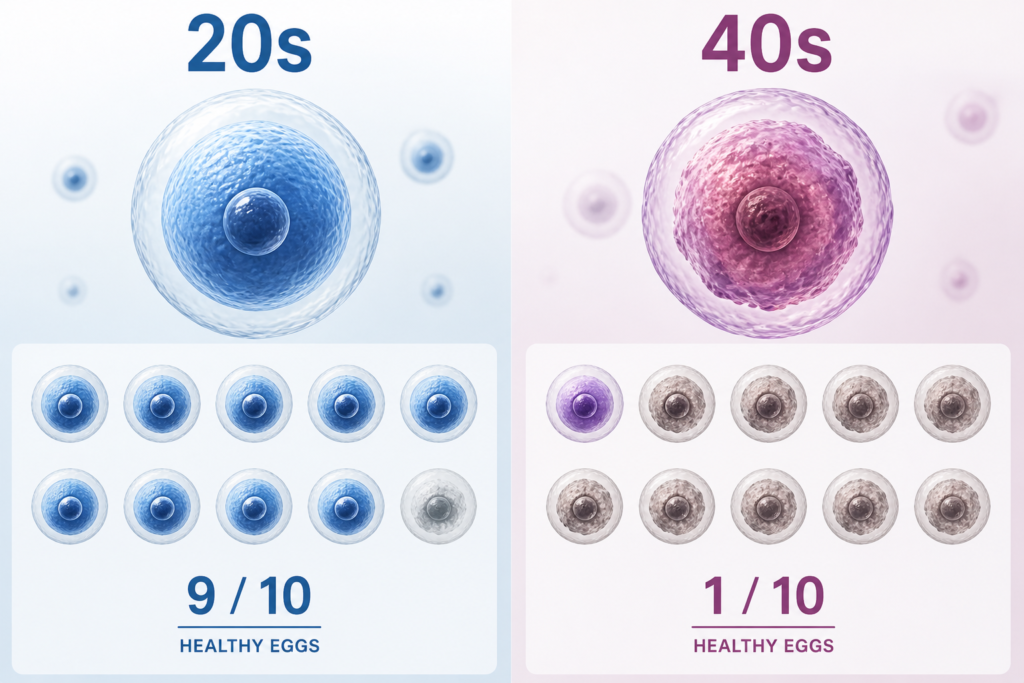
- Eggs in the 20s: These are essentially pristine. They harbor minimal chromosomal abnormalities and DNA damage. When these eggs are frozen, we are effectively capturing “biological youth” and transporting it into the future.
- Eggs in the 40s: These are the products of cumulative biological stress. Many exhibit chromosomal aneuploidy and diminished cellular energy. Freezing them does not increase the probability of success; it merely “locks in” the diminished potential that remains.
While both procedures share the same name—egg freezing—the clinical implications are vastly different.
The Misconception of Guaranteed Pregnancy Egg freezing does not guarantee a pregnancy. It secures the opportunity for one. If a woman utilizes high-quality eggs frozen in her 20s when she is in her 40s, her pregnancy success rates often mirror those of her 20-year-old self. In this sense, the technology acts not as a “time machine” that reverses aging, but as a “quality preservative” that halts the clock.
The gap in opportunity is stark. A woman in her 20s can often secure a sufficient cohort of eggs in a single cycle, providing multiple “chances” for the future. A woman in her 40s may require multiple, grueling cycles to retrieve even a few eggs, with a significantly higher attrition rate. The conditions of the “fight” for pregnancy are fundamentally different.
A Societal and Policy Imperative The decision to freeze eggs remains constrained by uncertainty—uncertainty about marriage, career paths, and the high financial burden of long-term storage. Yet, the social narrative is shifting. We are seeing a move toward corporate-sponsored fertility benefits and a growing consensus among fertility specialists that “the younger, the better” is the most pragmatic clinical advice.
Moreover, the conversation is expanding beyond the private sphere. As low fertility becomes a structural systemic crisis, egg banking is evolving into a matter of public policy. Experts are increasingly calling for state-supported initiatives—such as health insurance coverage for freezing—arguing that reproductive preservation is a public good, not merely a personal luxury.
Conclusion Egg freezing is not a guarantee of a future baby; it is a technology that preserves your current biological state. And that “current state” changes year by year. The essence of the technology is not the freezer—it is the timing. If you have decided that reproductive options are a priority for your future, the most valuable variable you have at your disposal is your present.
Sources: Assisted Reproductive Technology (ART) international research; comprehensive review of egg cryopreservation clinical data.
Disclaimer: This content is provided for informational purposes, based on current reproductive medicine trends. Medical judgments and treatment decisions must always be made in consultation with professional medical personnel. Image: AI-generated (ChatGPT, OpenAI) / Visual reference for illustrative purposes only.