
Sleep and fertility are connected in research, but association is not proof that poor sleep causes infertility or IVF failure. Sleep deserves attention as part of health and well-being. It should not become another test patients feel they must pass before they are allowed to hope for pregnancy.
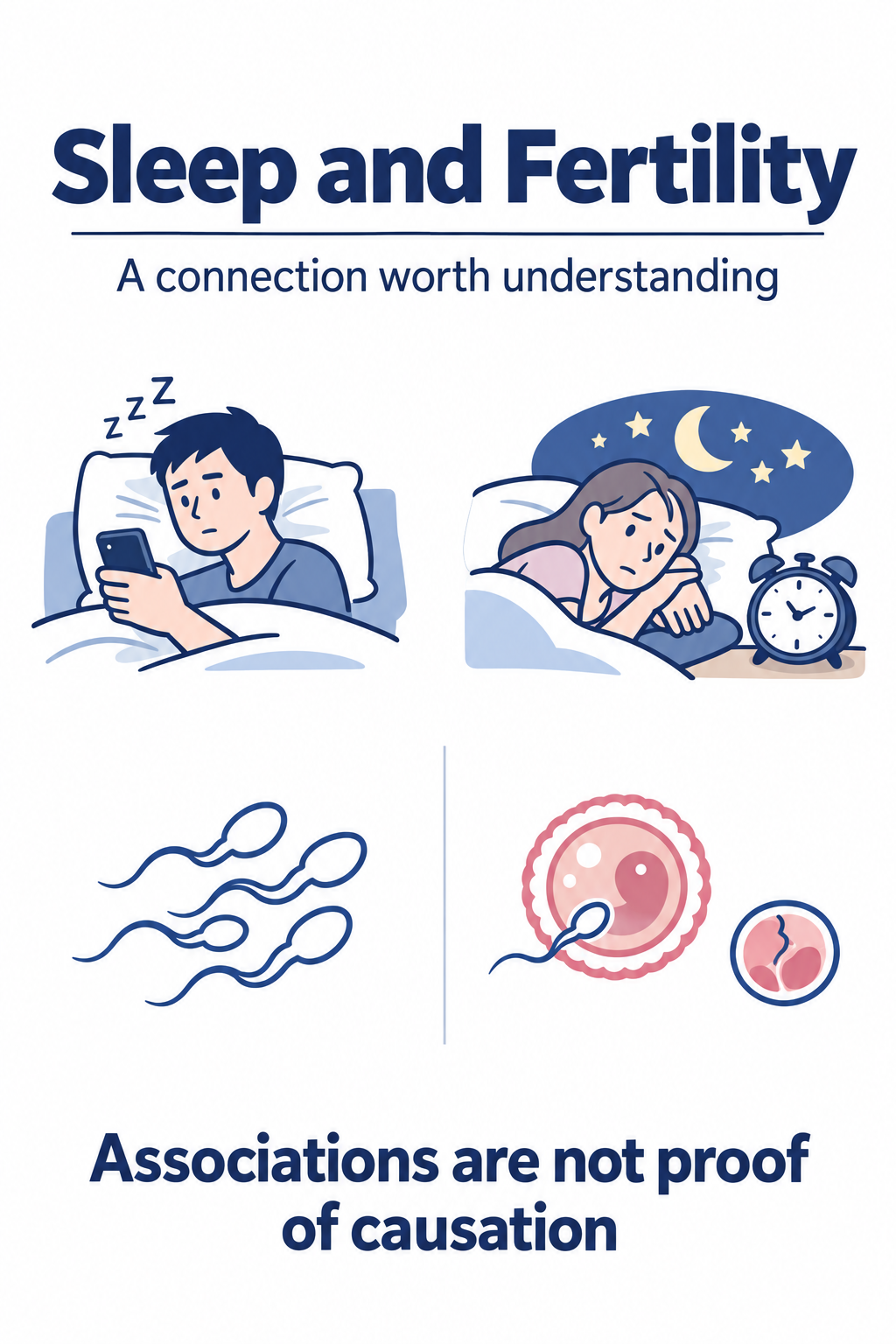
Fertility discussions often focus on age, test results and treatment protocols. Sleep adds another dimension worth discussing, without displacing those established clinical considerations.
Sleep is part of health and daily functioning. Calling it a conductor of reproduction is a metaphor, not evidence that a restless night switches fertility off.
Studies have examined sleep patterns and male reproductive measures. Differences between groups do not establish that poor sleep caused an individual’s semen findings or that improving sleep will necessarily produce a pregnancy.
Studies of female infertility also report associations with sleep disturbance. Definitions, populations and other health factors differ, so there is no single risk multiplier that applies to every patient.
Rhythm is a research question, not a verdict
Biological rhythms offer plausible mechanisms to study. They do not show that disrupted sleep inevitably derails ovulation or egg maturation.
IVF studies may assess eggs, embryos, implantation or pregnancy. Those are different endpoints, and an association at one stage should not be turned into a universal prediction of live birth.
Support without blame
Insomnia and irregular sleep can be distressing in their own right. Patients deserve help without hearing that it is already too late or that they caused a failed cycle.
Asking about sleep can open a useful conversation about well-being and daily demands. It should not become another way to measure how hard someone is trying to conceive.
The evidence supports a more careful message: sleep and reproductive health are connected in research, but cause, direction and the effect of an intervention need closer examination.
A difficult night is not a decision about the next generation. Improving rest is a worthwhile health goal without making it a promise—or a prerequisite—of pregnancy.
Disclaimer: This content is provided for informational purposes, based on reporting on infertility and various public data. Medical judgments and treatment decisions must always be made in consultation with professional medical personnel. Image: AI-generated (ChatGPT, OpenAI) / Visual reference for illustrative purposes only.
What a review can establish
A systematic review brings together studies with differing populations and sleep measures. Associations do not establish that changing sleep improves IVF outcomes. Sleep disturbances and female infertility: a systematic review (2024).