
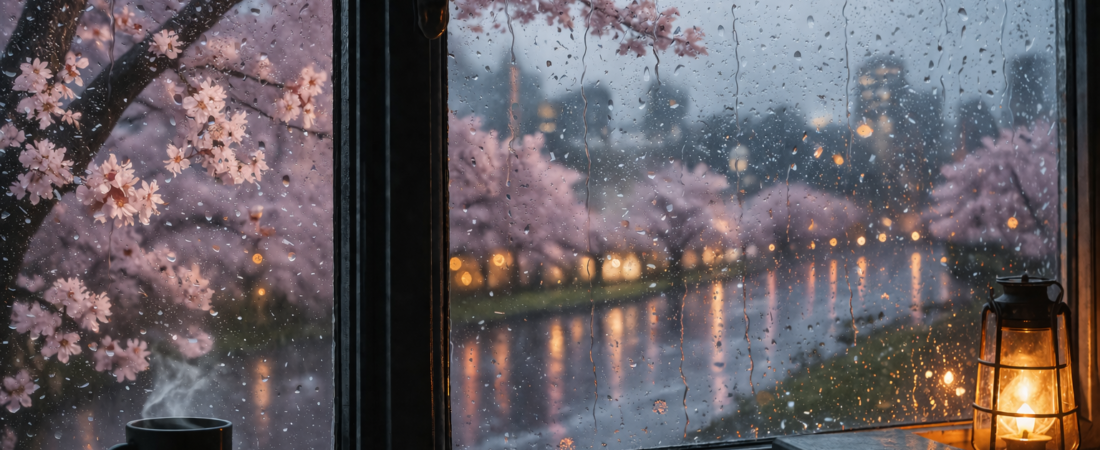

Love initiates on rainy days.
Rain acts with absolute equality; it leaves no one completely dry.
Certain individuals appear entirely impenetrable, as if they will never allow themselves to be drenched. They meticulously calculate their emotional output, maintain interpersonal distance like a practiced habit, and refuse to let their facial expressions falter under ordinary circumstances. They are widely categorized as cold or aloof. Yet, even this specific demographic behaves differently when confronted with spring rain. This shift is not driven by mere romance; it is the definitive biological outcome of perfect environmental conditions aligning simultaneously.
It is spring. The human somatic system lacks the capacity to ignore the structural transition of the seasons.
As daily sunlight exposure scales upward, systemic serotonin production spikes, and dopamine pathways are actively stimulated. This biochemical shift elevates overall mood, drives the desire for human connection, and compels individuals to step outside into social spaces.
In real-world data analyzed by dating applications such as Tinder and Match Group, user matching frequencies and conversation volumes consistently experience a repetitive upward trend during the spring season. It is, by all metrics, the definitive season for initiating relationships. In essence, spring hardwires the human brain to seek immediate connection.
The true transformation, however, materializes immediately afterward. The exact millisecond rain enters this equation, the psychological narrative alters completely.
Rain forcefully pulls a person’s focus inward. As natural sunlight exposure sharply plummets, serotonin levels experience a transient drop, systematically driving up emotional sensitivity. The rhythmic auditory frequency of falling rain remains constant, visual clarity blurs, and the surrounding environment falls into deep silence.
As external stimuli are aggressively minimized, the brain redirects its processing away from the outside world, focusing strictly inward. During this phase, historical memories resurface, and unregulated emotions rise to the surface of consciousness. Sentiments that would comfortably be dismissed on a clear day suddenly catch a person’s awareness. This is the absolute core mechanism of spring rain.
Spring pushes a person outward, while rain pulls a person inward.
The exact moment spring and rain overlap, the emotional matrix ceases to be a state of superficial fluctuation and transforms into a state of deep, lingering immersion.
This environment renders individuals who routinely suppress their feelings exceptionally vulnerable. They are not devoid of emotional capacity; rather, they are simply highly disciplined in execution and control. When this demographic collides with the intersection of spring and rain, their systemic psychological defenses loosen, constructing a precise crack where suppressed emotions can quietly seep through. Superficially, they retain their rigid, unyielding armor, but internally, a subtle structural fracture has already initiated.
When spring arrives and the rain falls, human beings reflexively recall specific people.
The underlying evolutionary explanation is remarkably straightforward: within an isolated environmental setting, the brain systematically functions to reinforce social bonds. Dopamine manufactures intense anticipation, while oxytocin drives a powerful craving for physical and emotional intimacy.
Consequently, a rainy day induces a distinct, spontaneous urge to reach out to someone, to secure companionship, and to anchor oneself next to another. Within the conscious mind, this deep bio-behavioral drive manifests as the powerful desire to fall in love.
Spring rain operates as a powerful baseline condition where human endocrine physiology and environmental psychology synchronize flawlessly, creating a structural vulnerability that allows raw emotion to penetrate the mind with ease. And that biological condition functions with absolute precision, sparing not even the most guarded, iron-willed individuals.
Importantly, a person does not permanently break down on that day; they simply choose to temporarily release their tension. At this precise, highly calibrated timing, an unexpected confession can be delivered, or a life-altering encounter can comfortably manifest. This is why on a day spent walking through the rain, a person ultimately betrays their own heart—exposing a vulnerability they never even realized they possessed.