
For decades, the fundamental protocol for treating endometriomas was simple: if it is visible, excise it. Surgical removal was the gold standard—it confirmed the diagnosis, resolved the lesion, and aimed to prevent recurrence. It was the textbook approach, and for years, patients have followed this established path.
Recently, however, this doctrine is beginning to fracture. A subtle yet significant transformation is underway, as ethanol sclerotherapy—a minimally invasive approach utilizing only a needle—regains its footing in clinical practice.
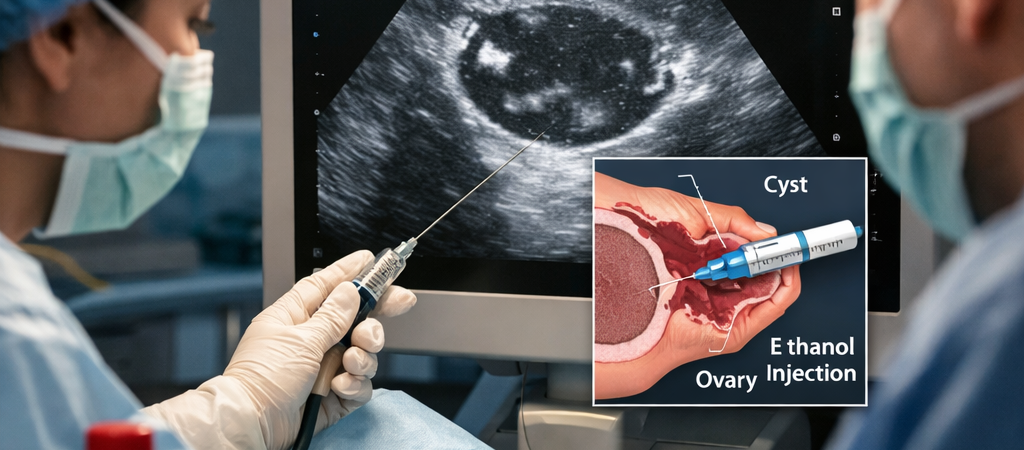
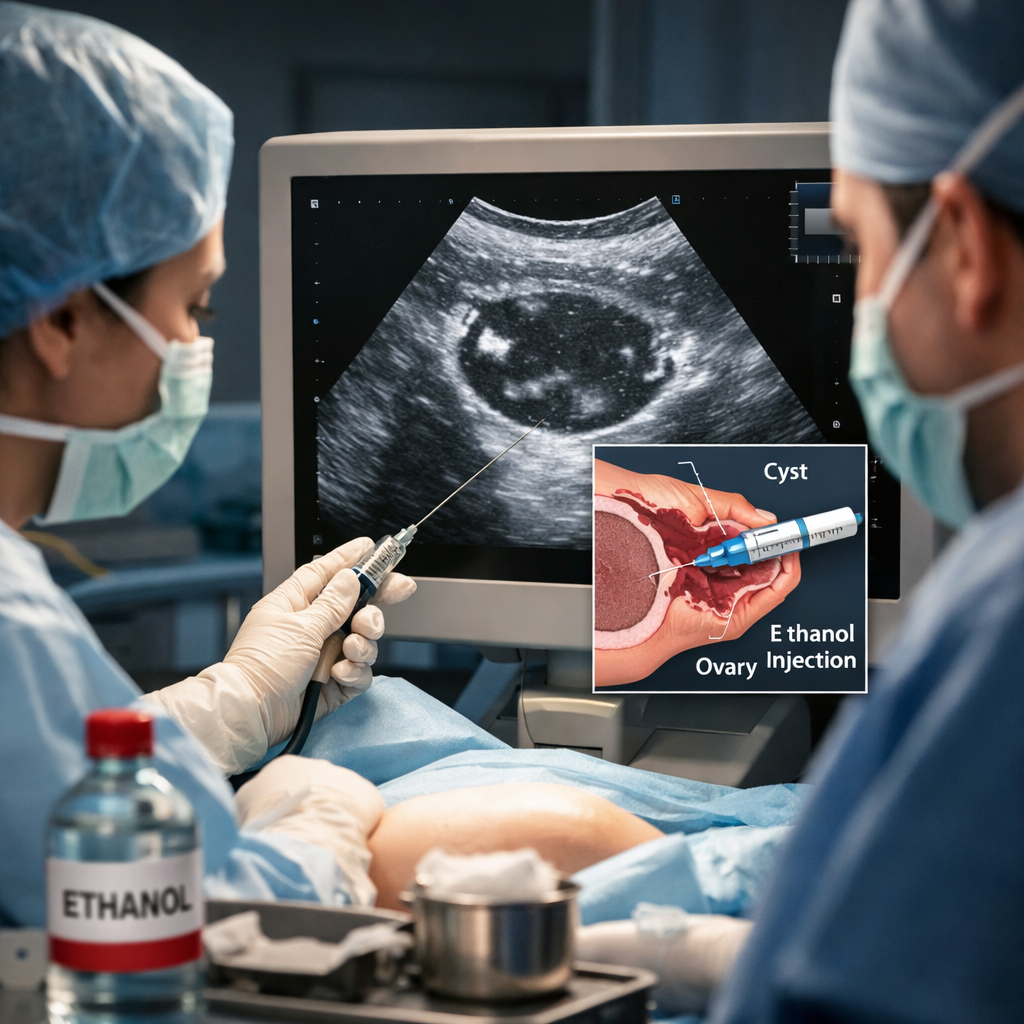
The procedure is deceptively straightforward: under ultrasound guidance, a needle is inserted to aspirate the cyst fluid, followed by the injection of ethanol into the cystic space. After a short dwell time, the alcohol is aspirated. Rather than physically cutting away the tissue, the method chemically ablates the cyst wall to suppress recurrence. It is, in essence, a “drain, burn, and resolve” strategy.
The reason this approach is being revisited is clear: the preservation of ovarian function is paramount.
Surgery for endometriomas is rarely limited to the lesion itself. In the process of dissection, healthy ovarian tissue is often inadvertently damaged. This can significantly diminish the ovarian reserve—the critical metric that determines a woman’s reproductive potential. For patients preparing for In Vitro Fertilization (IVF), this consequence is particularly sensitive.
This is where sclerotherapy offers a distinct advantage. Because it avoids the use of a scalpel, it preserves ovarian integrity. Studies consistently demonstrate that, compared to traditional surgery, sclerotherapy is associated with a smaller decline in Anti-Müllerian Hormone (AMH) levels and helps maintain a higher yield of eggs during subsequent retrievals. In terms of pregnancy outcomes, it is increasingly viewed as a choice that does not incur an unnecessary “cost” to future fertility.
However, viewing this treatment as a panacea is dangerous. It carries distinct limitations:
- Incomplete Eradication: The lesion is not fully excised; the risk of recurrence remains a persistent reality.
- Symptom Management: Endometriosis is a complex disease involving deep-pelvic inflammation, nerve involvement, and adhesions. Sclerotherapy may fail to provide sufficient relief for patients suffering from severe chronic pain.
- Safety Concerns: The risk of ethanol leakage into the surrounding tissue and the inability to rule out malignancy remain primary reasons why surgery remains the standard of care in high-risk cases.
Ultimately, the dilemma boils down to a single question: What is our priority? Is it pain relief, long-term recurrence prevention, or the preservation of ovarian function?
The clinical landscape is no longer driven by a one-size-fits-all surgical approach. Strategies are increasingly tailored: if a patient presents with severe pain or deep infiltrative endometriosis, surgery remains the cornerstone. Conversely, for those with minimal symptoms where ovarian preservation is the priority—especially in women with diminishing ovarian reserve or those in their 40s—sclerotherapy is becoming a pragmatic choice.
The paradigm of endometrioma treatment is quietly shifting from “remove what you see” to “how do we preserve what remains?”
While ethanol sclerotherapy is perhaps better described as a “compromise” rather than a clinical revolution, in the practice of medicine, it is often not the most “perfect” solution that changes the outcome, but the one that ensures the least amount of loss. At this very intersection, the future of endometrioma management stands.
Disclaimer: This content is provided for informational purposes, based on reporting on infertility and various public data. Medical judgments and treatment decisions must always be made in consultation with professional medical personnel. Image: AI-generated (ChatGPT, OpenAI) / Visual reference for illustrative purposes only.