

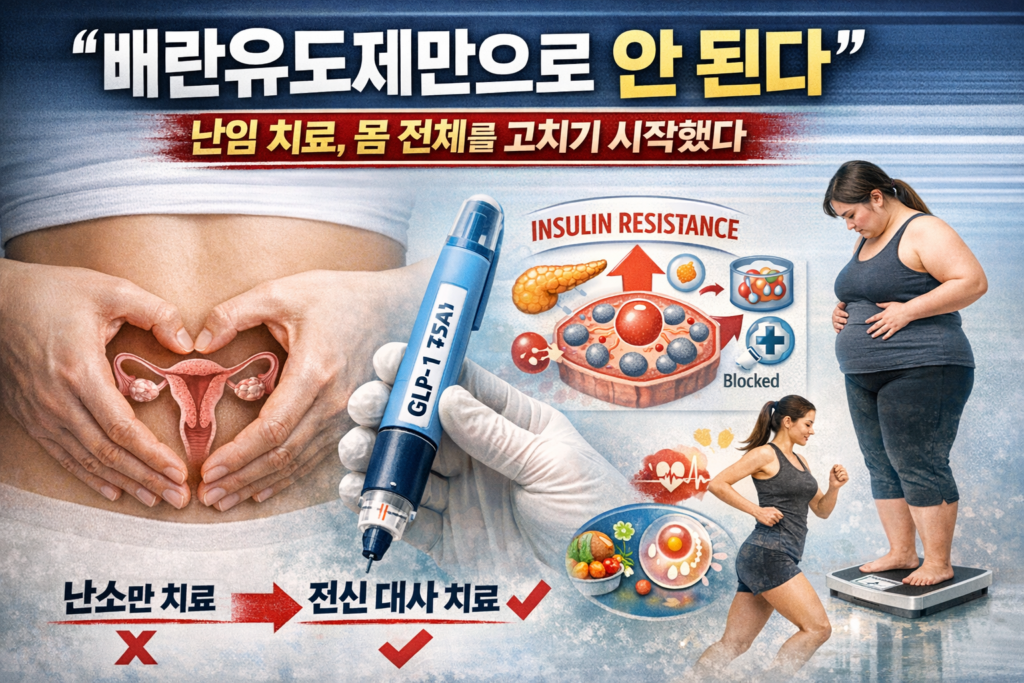
The core of infertility treatment is quietly shifting. We are moving away from the era of focusing solely on ovulation-inducing drugs—aiming to directly “force” the ovaries to produce eggs—and toward a new approach that prioritizes the correction of the body’s overall metabolic state before any stimulation occurs. At the heart of this transformation are GLP-1 receptor agonists.
Drugs such as semaglutide, originally developed for diabetes and obesity, are capturing the attention of the reproductive medicine community. The reason lies not just in their weight-loss effects, but in their capacity to improve insulin sensitivity.
Insulin resistance is a pervasive pathology in many infertility patients, particularly those with Polycystic Ovary Syndrome (PCOS). It is far more than a simple blood sugar issue; it is a profound “metabolic signal error” that destabilizes the entire hormonal balance.
This is where the paradigm shift begins. When GLP-1 agonists are administered, insulin sensitivity improves, and hyperinsulinemia is stabilized. Consequently, androgen production in the ovaries—which is often excessive in these patients—decreases. The result is straightforward: ovulation resumes, menstrual cycles normalize, and patients who were previously resistant to standard fertility drugs begin to respond. We are no longer “forcibly waking up” the ovaries; we are restoring the internal environment necessary for eggs to mature naturally.
Clinical practice is increasingly reflecting this trend. In the past, the immediate response to anovulation was to prescribe Clomiphene or Letrozole. Today, clinicians ask more fundamental questions first: What is the patient’s metabolic status? Is there underlying insulin resistance? What is the current state of inflammation and body composition?
The therapeutic sequence has been inverted: Metabolic correction comes first; ovulation induction follows.
This is not simply the addition of a new drug to the fertility toolkit; it is a fundamental shift in the starting point of treatment. Clinical evidence shows that when the same ovulation-inducing agents are used in patients with improved metabolic profiles, the growth of follicles, ovulation rates, and pregnancy outcomes all significantly improve. The same drug yields different results; the difference is not in the ovary, but in the entire body.
We must change the way we frame our clinical inquiries. The question is no longer, “Why isn’t the ovary producing eggs?” but rather, “Is this body prepared to nurture an egg?”
The perspective that views infertility solely as an ovarian problem is losing ground. Adipose tissue, gut microbiota, insulin signaling, and inflammatory responses—all these are interconnected along a single axis. Infertility is not a localized condition; it is a systemic disorder. This realization is effectively rewriting our treatment strategies.
We have moved beyond the stage of believing that a single ovulation-inducing pill is a panacea. We are transitioning toward a design-based approach that addresses the body’s systemic infrastructure first. Fertility treatment is no longer just about the technology of producing eggs; it is about the process of cultivating a body capable of sustaining them.
Disclaimer: This content is provided for informational purposes, based on reporting on infertility and various public data. Medical judgments and treatment decisions must always be made in consultation with professional medical personnel. Image: AI-generated (ChatGPT, OpenAI) / Visual reference for illustrative purposes only.