

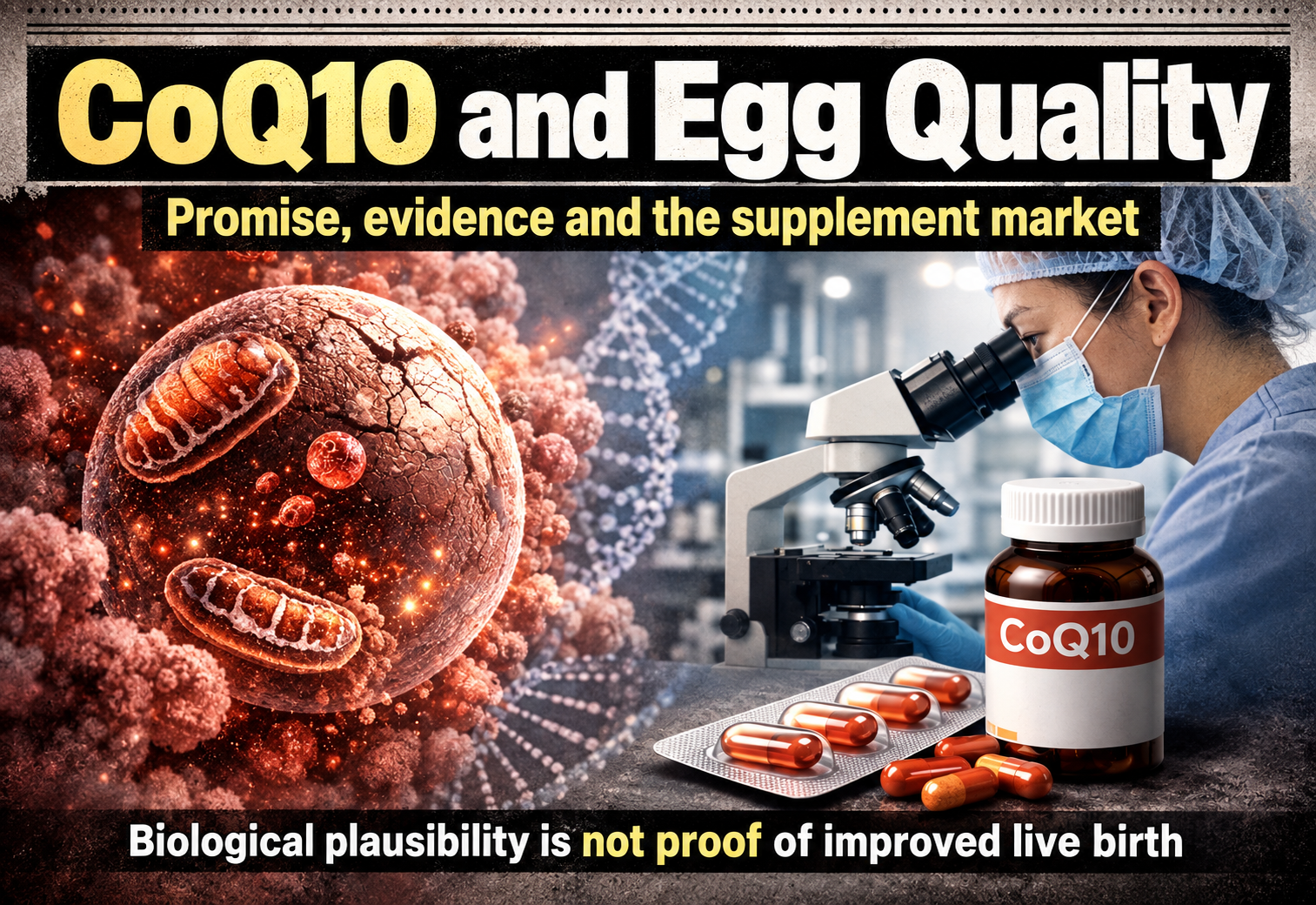
CoQ10 and egg quality are frequently linked in supplement marketing. Mitochondrial biology provides a rationale for research, but a plausible mechanism is not proof of improved live birth. Clinical expectations should distinguish animal experiments, intermediate outcomes and patient benefit.
At some point, Coenzyme Q10 (CoQ10) quietly transformed into an absolute staple within the fertility market. While it is rarely found on a formal hospital prescription, it is almost never missing from a patient’s personal bag.
Whenever you open the internet, phrases like “improving oocyte quality” and “elevating pregnancy success rates” are endlessly repeated, and within those promising lines, individuals carefully select their hope. However, this clinical paradigm must be challenged at least once: Can CoQ10 genuinely alter the biological quality of an oocyte? Or are we simply consuming yet another highly plausible narrative?
The biological rationale is worth studying, but it should not be translated into an established improvement in human egg quality or live birth.
Mitochondrial function contributes to oocyte and embryo biology. Energy metabolism is one part of a complex process, not a single switch whose failure explains every developmental arrest.
CoQ10 participates in mitochondrial electron transport and has antioxidant functions. Those roles help explain research interest without demonstrating a benefit from supplementation.
Animal and human studies answer different questions. Improvements in laboratory measures or egg yield are not equivalent to evidence of more live births.
The useful distinction is between biological rationale, clinical study findings and demonstrated patient benefit. Neither a promising mechanism nor a better intermediate measure guarantees improved live birth.
While an In Vitro Fertilization (IVF) cycle is an invasive environment strictly governed by medical infrastructure and clinical practitioners, purchasing CoQ10 grants patients a powerful psychological sense of agency—the belief that they are actively doing something to control their outcome. The longer the waiting period stretches, the more aggressively individuals seek action. CoQ10 serves as the most accessible tool to systematically buffer that profound biological anxiety. At this specific intersection, raw reproductive science frequently blurs with patient psychology.
Infertility has many contributors. Focusing only on “egg energy” risks overlooking sperm, embryo development, uterine factors and the broader treatment context.
A supplement may be discussed in selected settings, but its value should not be described as undeniable or proven for every older patient or person with low reserve.
Any proposed use should account for evidence, interactions, cost and the patient’s treatment plan.
The practical question is which outcome the supplement is expected to change and how strong the evidence is. Hope should not be packaged as a reliable increase in success probability.
The distinction is between a hypothesis and an established clinical benefit. Understanding it supports an informed choice rather than turning a supplement into a calibrated guarantee.
Editor’s Note: This content is an analytical commentary prepared by a specialized fertility journalist through the collection and evaluation of domestic and international reproductive medicine research, clinical policies, and statistical data. All medical diagnoses and treatment decisions must exclusively be established through direct consultation with a qualified medical professional.
Image Source: AI-generated (ChatGPT, OpenAI) / Provided solely as a supplemental visual aid for conceptual understanding.
From biological rationale to patient benefit
Supplement claims should be assessed against clinical evidence and outcomes that matter to patients. A plausible mitochondrial mechanism alone cannot establish an improvement in live birth. HFEA: understanding evidence for fertility add-ons.
Related reading
CoQ10 for IVF: Egg Quality and Live Birth Evidence
English visual adaptation: AI-generated conceptual illustration. It is not a clinical image, product endorsement or photograph documenting the cited study.