

IVF laboratory quality matters from egg handling to embryo culture. Diminished ovarian reserve describes expected egg quantity and response; it does not automatically mean every egg is fragile or poor quality. Training, validated protocols and quality assurance work together.
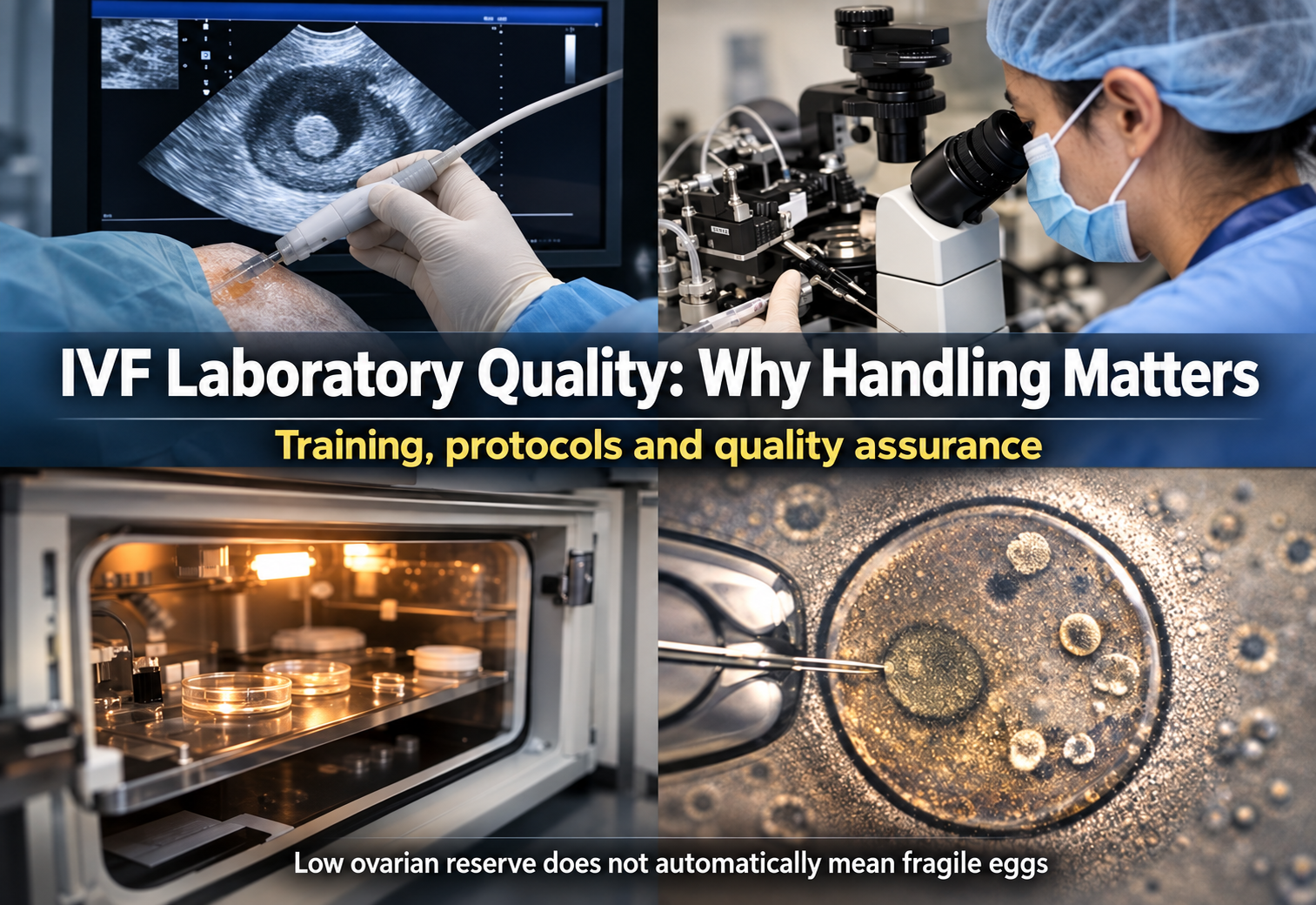
Does diminished ovarian reserve mean that every retrieved egg is unusually fragile? Reserve and egg quality need to be distinguished.
Low reserve primarily describes quantity and expected response. It does not establish an intrinsic handling defect in every oocyte.
Low reserve does not automatically mean fragile eggs
Age and other factors can affect developmental potential, with variation between individuals.
A small cohort makes each oocyte feel especially precious. It does not prove a universal absence of biological resilience.
Retrieval and handling require appropriate technique. Low reserve alone does not diagnose thin follicular walls or dictate a universal aspiration-pressure change.
Training and validated procedures support the clinician’s judgment during retrieval.
Experience is valuable, but a claim that one practitioner uniquely rescues low-reserve eggs requires outcome evidence.
The laboratory then contributes to the next stages of care.
Quality control in the embryology laboratory
Temperature, gas conditions, pH and exposure time are monitored as part of quality control.
- Temperature should be controlled and monitored; a single tiny fluctuation is not a universal threshold for failure.
- Exposure and handling time should follow validated laboratory procedures.
- Culture conditions, including gas and pH, need consistent quality control.
These considerations apply to all oocytes. They do not support a simple division between robust young eggs and fragile low-reserve eggs.
ICSI is a skilled procedure with recognized risks, but neither injection speed nor operator experience alone predicts an individual result.
Quality assurance combines training, standardized processes and review of performance.
Evaluating the whole care system
Differences between centers require careful comparisons that account for patients and treatment pathways.
A different outcome does not automatically isolate handling as the cause.
Medication planning, patient biology and laboratory quality all matter. Selecting a charismatic operator is not a substitute for evaluating the whole care system.
Patients can ask how eggs are handled, how performance is monitored and how a disappointing cycle is reviewed.
Precision matters most when it is supported by transparent systems, not promises that experience can remove all uncertainty.
Editor’s Note: This content is an analytical commentary prepared by a specialized medical journalist through the collection and evaluation of domestic and international reproductive medicine research, clinical policies, and statistical data. All medical diagnoses and treatment plans must exclusively be established through direct consultation with a qualified fertility specialist.
Image Source: AI-generated (ChatGPT, OpenAI) / Provided solely as a supplemental visual aid for conceptual understanding.
Quantity, quality and interpretation
Ovarian-reserve measures primarily inform expected quantity and response. They should not be treated as direct tests of egg quality or a complete prediction of reproductive potential. ASRM: testing and interpreting ovarian reserve.
Related reading
Egg Quality in IVF: Why a Perfect-Looking Oocyte Can Still Fail
English visual adaptation: AI-generated conceptual illustration. It is not a clinical image, product endorsement or photograph documenting the cited study.