
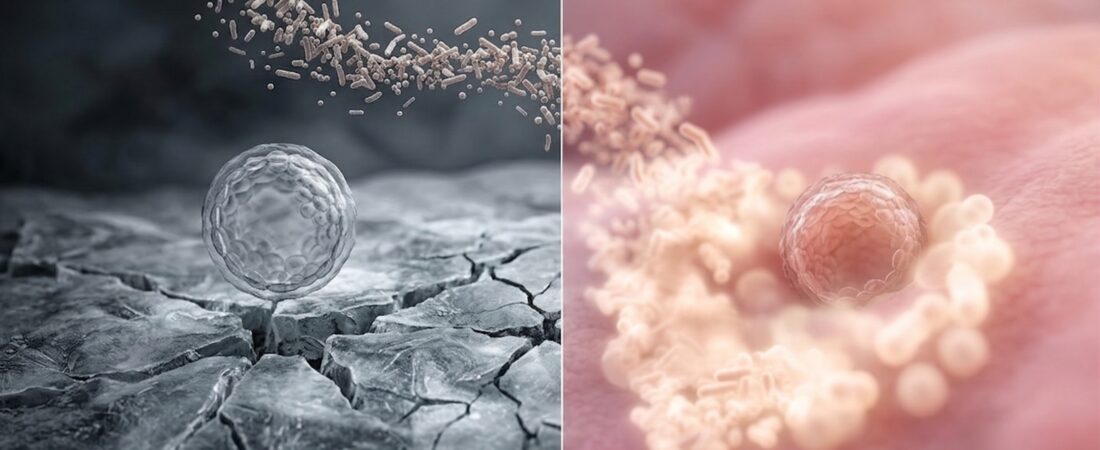
Probiotics and IVF are often linked through stories about gut health and implantation. Research on microbial communities is not the same as proof that a supplement increases live birth. Effects may differ by organism, product, population and outcome.
Gut microbes and implantation: the research question

Among women undergoing fertility treatments, the phrase “probiotics are an absolute non-negotiable” is increasingly becoming accepted as common sense. In fact, within online fertility communities, it is not uncommon to hear anecdotes of women who conceived during In Vitro Fertilization (IVF) cycles after rigorously taking probiotic supplements. This raises a straightforward question: Do probiotics genuinely improve pregnancy success rates, or are they simply another overhyped wellness trend?
Animal experiments have explored links between microbes and reproduction. They cannot establish that a probiotic improves human IVF outcomes, and the species, product and study design need to be identified.
Different microbial communities and products may have different effects. A proposed change in vaginal or gut conditions is not proof of better implantation.
Constipation can occur during treatment or pregnancy. It deserves symptom-specific advice rather than being assumed to diagnose a fertility-relevant microbiome problem.
Digestive discomfort does not establish systemic immune dysfunction or a need for probiotics. Management should match the symptom and individual situation.
Immune pathways are under investigation. Claims that probiotics normalize NK-cell activity and thereby improve fertility require clinical evidence.
Routine immune testing or treatment should not be inferred from a general account of maternal–embryo interactions.
However, a strict clinical line must be drawn here: probiotics are not a pharmaceutical drug that manufactures an implantation.
The benefit of a supplement must be assessed for its specific use. Calling it an environmental primer does not establish a fertility effect.
General gut-health research is not proof that every patient needs supplementation before conception.
The practical question is what a particular product has been shown to do, for whom and with what risks or limitations.
A supportive routine can improve well-being without being a proven implantation intervention.
A proposed mechanism is not a treatment result
Microbiome research does not establish that probiotics improve IVF live birth. The specific product, population and measured outcome must be examined before inferring clinical benefit. HFEA: evaluating fertility treatment add-ons.