
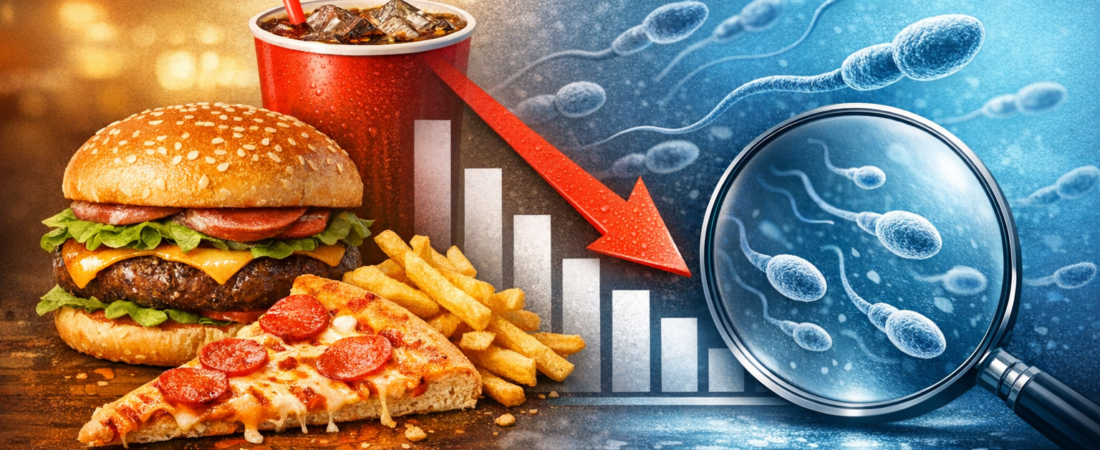
Dietary patterns and sperm count have been associated in observational research, including a large study of young Danish men. Such findings cannot show that one hamburger damages fertility. The comparison, measured outcome and possible confounding deserve as much attention as the headline.
Food patterns can support general health, but one serving of pizza or fried food does not determine the chance of pregnancy.
The claim that consuming junk food depletes your sperm count has become a fairly familiar sentence. It is a narrative that repeatedly surfaces in health articles and broadcast segments, accepted almost as common sense among men preparing for conception.
But to what extent is this statement biologically true? Does eating a single hamburger genuinely diminish your sperm supply, or have we mistakenly interpreted a mere correlation as a definitive cause?
A cross-sectional study of 2,935 young Danish men reported associations between dietary patterns and testicular-function measures. It did not demonstrate that eating one food caused a particular reduction in sperm count.
Dietary patterns can overlap with other behaviors. This makes confounding important and prevents a simple causal interpretation of the association.
Diet can overlap with other characteristics and behaviors. Such overlap is a reason to consider confounding, not proof that every person eating convenience food has an unhealthy lifestyle.
Several biological explanations can be proposed, but the observational design cannot identify a single causal pathway.
Hormonal signaling supports sperm production. Describing that system does not show that it mediated the dietary association in this study.
The study cannot establish that junk food inevitably creates deficiencies or that the brain deliberately shuts down reproduction in response to it.
A headline about food “killing sperm” goes beyond the evidence.
Dietary patterns, health and clinical assessment should be considered together without turning an association into personal blame.
Ultimately, the core question steers back to its origin. It is not simply a matter of what we are putting on our plates, but how we are choosing to live.
Sperm development unfolds over weeks. Changes in habits cannot be promised to produce a specific semen result or pregnancy on a fixed timeline.
The observational study and its limits
Nassan and colleagues studied 2,935 young Danish men in a cross-sectional analysis, published in JAMA Network Open in 2020 (3[2]:e1921610; DOI: 10.1001/jamanetworkopen.2019.21610). Dietary-pattern associations with testicular-function measures do not establish that a food caused the difference. Primary study: dietary patterns and testicular function.
Related reading
Diet and Sperm DNA Fragmentation: Interpreting the Reported Links