
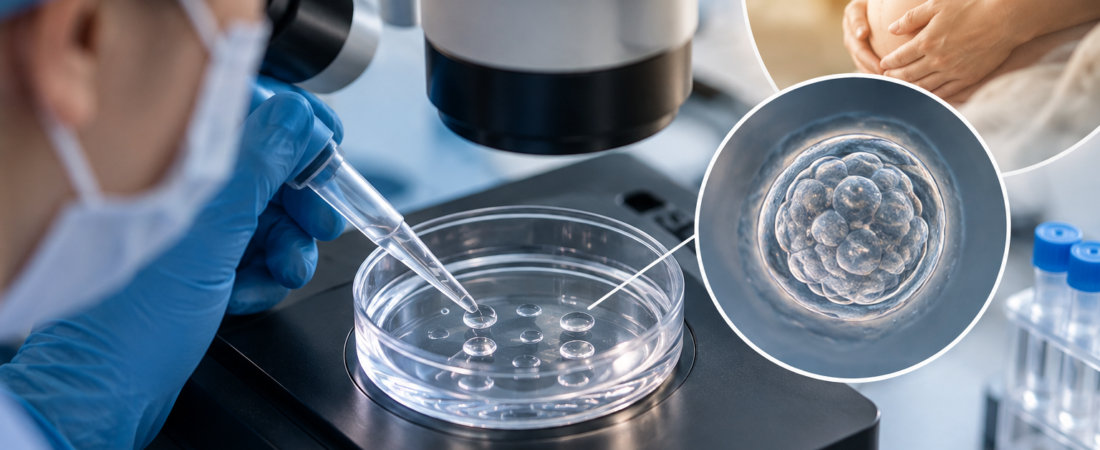
In 101 couples undergoing fertility treatment, live-birth rates were 47.0% after day-5 embryo transfer and 28.0% after day-3 transfer.
Oxidative-stress markers differed between the culture media, but did not independently predict clinical pregnancy.

Which embryo is most likely to lead to pregnancy? This remains an important question in IVF.
Researchers are increasingly examining the composition of embryo culture medium alongside embryo appearance and developmental speed. Assessing an embryo without directly disturbing it could offer a less invasive way to obtain useful information.
Could measuring oxidative stress in the medium predict pregnancy? A recent study investigated this possibility but found that the markers were not yet useful as independent predictors of clinical pregnancy.
Researchers at Istanbul University and Karadeniz Technical University in Türkiye published their analysis of oxidative-stress markers in frozen-thawed embryo culture medium and pregnancy outcomes in Scientific Reports on September 22, 2026.
What can used culture medium reveal?
Embryos grow in culture medium for part of the IVF process, exchanging substances with their surroundings. Researchers believe that the medium left behind may contain clues to their physiological condition.
Oxidative stress is one area of interest. It occurs when the balance between oxidizing substances and antioxidant defenses is disrupted. Excessive oxidative stress can adversely affect cellular function and development.
The team measured total antioxidant status (TAS), total oxidant status (TOS) and the oxidative stress index (OSI). TAS reflects antioxidant defenses, TOS the overall oxidant level, and OSI the balance between them.
They examined whether these measurements related to pregnancy as well as to embryo developmental stage.
Higher live birth after day-5 transfer in this cohort
The prospective study included 101 couples undergoing IVF or intracytoplasmic sperm injection (ICSI). Researchers compared 50 women receiving frozen-thawed day-3 embryos with 51 receiving day-5 blastocysts.
Clinical pregnancy rates were 52.9% in the day-5 group and 32.0% in the day-3 group. Live-birth rates were 47.0% and 28.0%, respectively.
The medium from day-5 embryos had higher antioxidant status and lower oxidant status and oxidative stress index than medium from day-3 embryos, indicating a relatively lower oxidative-stress profile.
This does not mean that lower oxidative stress caused the higher pregnancy rate. Biological selection may occur as embryos develop to day 5. The study therefore distinguished differences associated with developmental stage from the markers’ own predictive ability.
Better oxidative-stress values did not identify successful pregnancies
The additional analyses accounting for developmental stage were particularly important.
Within the day-3 and day-5 groups separately, none of the three markers differed significantly between women who achieved pregnancy and those who did not.
Logistic regression adjusted for embryo developmental stage likewise did not identify TAS, TOS or OSI as independent predictors of clinical pregnancy.
Although day-5 embryo media showed more favorable measurements, those measurements did not reliably distinguish pregnancy outcomes among embryos at the same stage.
The researchers suggested that the markers might reflect developmental stage or biological selection during development more than the likelihood of pregnancy itself.
Non-invasive assessment still warrants research
The study does not rule out the potential of culture-medium analysis. It illustrates the need to establish which measurements are clinically useful before developing non-invasive embryo-selection tests.
Embryo selection currently considers developmental stage and morphology. Adding biochemical information from the medium might eventually allow a more comprehensive assessment.
However, this prospective observational study involved only 101 couples. It was not randomized, so the comparison of day-3 and day-5 transfers cannot establish that one strategy is superior.
The researchers emphasized the need for larger prospective studies before using oxidative-stress markers for embryo selection.
A comprehensive assessment matters more than a single number
The findings illustrate how new tests should be interpreted in fertility care. A biochemical measurement that varies between groups or developmental stages is not automatically a useful pregnancy prediction test.
Developmental stage, age, endometrial condition and embryo morphology can all influence outcomes. A single marker has limited ability to capture that complexity.
The higher live-birth rate in the day-5 group does not mean that day-5 transfer is preferable for every patient. Timing and transfer methods require consideration of embryo number, development and treatment history.
Used culture medium contains biological information. How accurately that information predicts pregnancy and birth is a separate question.
The study points to the potential of culture-medium analysis while reinforcing that clinical use requires adequate scientific validation.
This article is based on “Oxidative stress profiles in spent culture media of day 3 and day 5 frozen-thawed embryos: a prospective cohort study,” published in Scientific Reports on September 22, 2026, by researchers at Istanbul University and Karadeniz Technical University, with collaboration from the Istanbul University Faculty of Medicine IVF Center. DOI: 10.1038/s41598-026-72773-8. This article explains research findings; individual transfer and treatment decisions should be discussed with a fertility specialist.
The accompanying image was created using generative AI (ChatGPT, OpenAI); any people depicted are fictional.
Related guide: Understanding implantation failure after euploid embryo transfer
Copyright © 2026 Fertility Information TokTok Fertility News | THE FERTILITY NOTES. All rights reserved. Unauthorized reproduction, copying, redistribution, scraping, AI training, and other data use of any articles, photographs, images, or other content are strictly prohibited. Violations may result in legal liability.