
Why do some sperm develop abnormal heads or tails and struggle to move? A genetic study of 1,826 men linked variants in GALNT3, GALNT8 and GALNTL5 to distinct sperm defects.
The structural abnormalities differed by gene. The researchers also reported ICSI treatment outcomes comparable to controls, suggesting that assisted fertilization may overcome some barriers without correcting the underlying genetic defect.
Male infertility investigations measure sperm count, movement and shape, but often cannot explain why abnormalities developed. This study connects different defects of the sperm head and tail with specific genetic variants.
Researchers at West China Second University Hospital, Sichuan University, and collaborating institutions in China reported that pathogenic variants in the three genes may contribute to abnormal sperm morphology and motility in different ways. The findings were published in Fertility and Sterility.
The study offers a potential genetic explanation for some otherwise unexplained male infertility. By linking different defects with different genes, it also points toward more precise diagnosis and treatment planning.
Genetic analysis of 1,826 men found more variants in infertile participants
The researchers analyzed men recruited in southwestern China between 2018 and 2024. Of the 1,826 participants, 1,148 had asthenoteratozoospermia—abnormalities in both sperm movement and shape—and 678 had proven fertility.
Whole-exome sequencing examined protein-coding regions of the genome, with analysis of variants in the GALNT family. Immunofluorescence staining and electron microscopy were then used to assess protein expression and sperm microstructure.
Infertile men carried more GALNT-family variants than men with proven fertility. Some variants predicted to impair function were found only in the infertile group.
These findings suggest that abnormalities in sperm movement and shape can be associated with dysfunction in specific genes, rather than only reflecting nonspecific physiological changes.
GALNT3, GALNT8 and GALNTL5 were associated with different defects
A central finding was that the three genes were linked to abnormalities in different parts of the sperm.
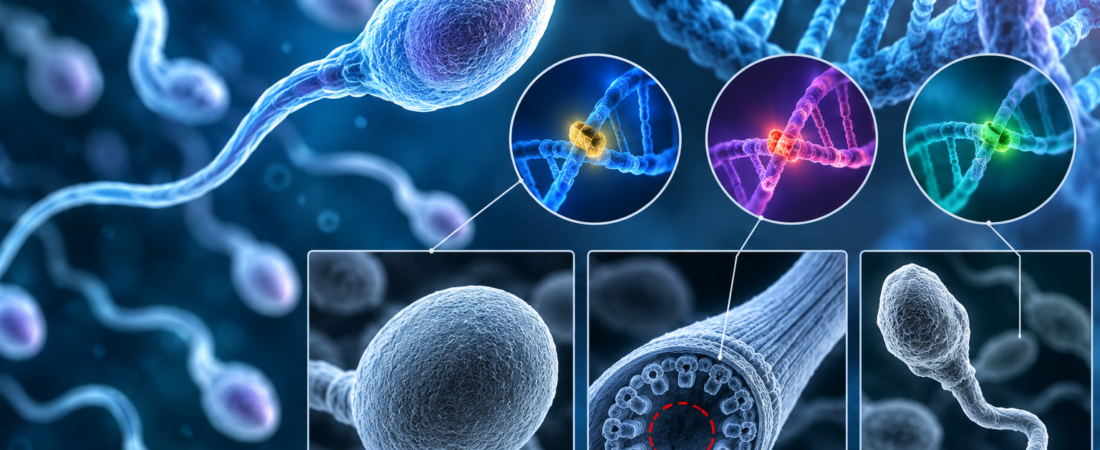
GALNT3 variants were associated with globozoospermia, in which sperm heads are round. Normally, the sperm head contains an acrosome that plays an important role in fertilization. In globozoospermia, the acrosome is often absent or abnormally formed, which can make fertilization difficult.
GALNT8 variants were associated with tail abnormalities. Microtubules inside the tail normally form an organized structure needed for movement. Sperm carrying these variants showed loss of the central pair of microtubules, a defect that can impair motility.
GALNTL5 variants were associated with combined abnormalities of both the head and tail, suggesting possible effects on shape as well as movement.
The proteins produced by the three genes also differed in their distribution. GALNT3 was mainly located in the acrosome, GALNT8 in the tail, and GALNTL5 in both head and tail. In sperm carrying variants, expression of the corresponding proteins was markedly reduced or undetectable.
These observations offer clues to how dysfunction of a particular gene may produce defects in a particular part of the sperm.
ICSI outcomes were comparable to controls
A key question for patients is whether pregnancy remains possible when a genetic abnormality is identified.
The researchers followed intracytoplasmic sperm injection, or ICSI, treatment outcomes in infertile patients with GALNT variants. ICSI places a single selected sperm directly into an egg's cytoplasm and is used when impaired motility or abnormal morphology makes conventional fertilization difficult.
Treatment outcomes in patients with GALNT variants were comparable to those in controls. This suggests that ICSI may bypass some barriers to fertilization even when sperm structure and movement are impaired.
The finding does not necessarily apply to every patient with a GALNT variant. Outcomes may differ according to the variant and the severity of sperm defects, and ICSI does not repair the genetic abnormality itself.
Larger studies are needed to establish pregnancy and birth outcomes in more patients.
Could genetic testing explain more cases of male infertility?
Semen analysis remains a basic part of male infertility assessment, measuring sperm count, motility and the proportion with normal morphology. Yet an abnormal result does not always reveal a precise cause.
This study suggests that genetic variants may explain structural sperm defects in some of these patients.
GALNT-family genes are involved in adding sugar components to proteins, a process called glycosylation. These modifications help maintain cellular structure and function and may influence sperm formation and maturation.
Because the study involved a particular population in southwestern China, the findings need to be tested in other populations.
Finding a variant alone does not establish the cause of infertility. Further validation is also needed before deciding how broadly testing of these genes should be used in clinical practice.
Nevertheless, the research provides a molecular genetic perspective on sperm movement and shape beyond the values recorded on a semen analysis.
For some men, the explanation for impaired movement or abnormal head and tail formation may lie in their genes. Future diagnosis may increasingly move from describing sperm defects to identifying the genetic mechanisms behind them.
Source: Researchers at West China Second University Hospital, Sichuan University, and collaborating institutions. “Pathogenic variants in GALNT3, GALNT8, and GALNTL5 are associated with distinct sperm defects in human asthenoteratozoospermia.” Fertility and Sterility. DOI: 10.1016/j.fertnstert.2026.10.009. PMID: 42892435.
Related reading
Korean male infertility recommendations: looking beyond sperm counts
The image was created using generative AI (ChatGPT, OpenAI). Any people depicted are fictional, not real individuals.
Copyright © 2026 Fertility Information TokTok | THE FERTILITY NOTES. All rights reserved. Unauthorized republication, reproduction, redistribution, scraping, AI training and data use of any content, including articles, photographs and images, are strictly prohibited. Violations may result in legal liability.