
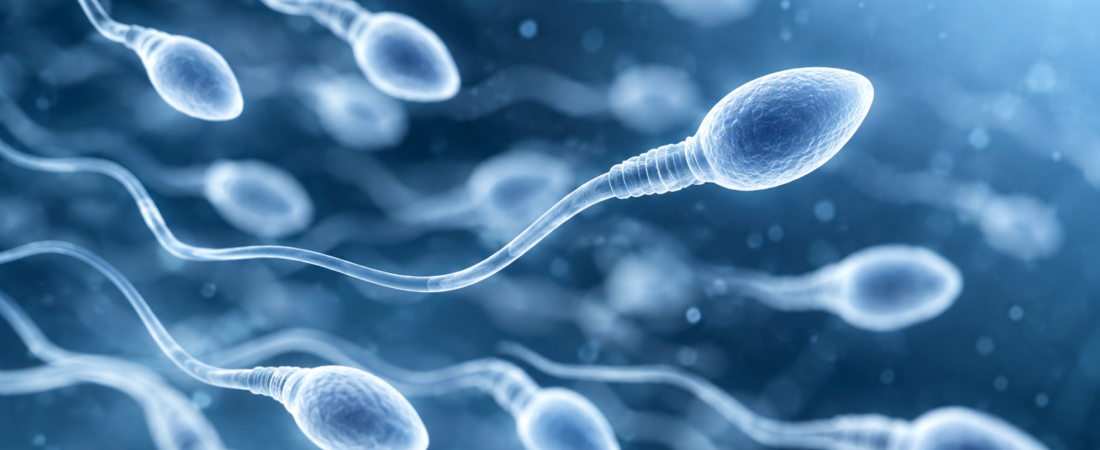
A new genetic clue may help explain male infertility when sperm count, motility and morphology are all impaired. Researchers at Sichuan University in China identified pathogenic variants in both copies of WFS1 in three men with infertility and investigated how disrupted gene function could affect sperm formation and fertilization.
The work links abnormalities in several sperm functions to molecular processes involving genes and protein stability.
The study was published in Advanced Science on October 4, 2026.
When count, movement and shape are all affected
Semen analysis commonly assesses sperm count, motility and morphology. A low count, poor movement and a low proportion of normally shaped sperm can be associated with reduced chances of natural conception.
When all three abnormalities occur together, the condition is called oligoasthenoteratozoospermia, or OAT. It may reflect problems across sperm production and maturation, although the cause often remains unclear.
The researchers found pathogenic variants affecting both WFS1 alleles in three men with infertility.
WFS1 is involved in cellular protein function and homeostasis. This study adds evidence that it also has an important role in normal sperm development.
Removing WFS1 disrupted sperm movement and structure in mice
To test its function, the team studied mice lacking WFS1.
Male mice were infertile and had reduced sperm counts and motility. Several structural abnormalities were also observed.
One prominent change involved disorganized mitochondria in the sperm midpiece. Mitochondria supply energy for movement, and abnormal organization can compromise that function.
Defects were also found in the head–neck connection, which helps maintain the structural link between the head and tail.
The acrosome was affected as well. This structure at the front of the sperm head contains enzymes involved in passage through the layers surrounding an egg during fertilization.
The researchers suggested that these combined abnormalities could contribute to impaired movement and fertilization function.
A protein-protection mechanism was weakened
The team also examined WFS1's molecular role in sperm development.
According to the study, WFS1 interacts with PIAS4 to help maintain the stability of proteins needed for spermatogenesis.
This involves SUMOylation, a process in which a small protein modifier is attached to another protein to regulate its activity and stability.
Normally, WFS1 promoted SUMOylation of proteins including SUN5, HSF5, CFAP74 and IZUMO4, helping protect them from excessive degradation.
Disrupted WFS1 function weakened that protection and could increase breakdown of proteins required for sperm formation.
The researchers linked these changes to combined defects in the head, neck, mitochondria and acrosome.
They also observed disrupted pairing of sex chromosomes during meiosis, the cell-division process involved in producing sperm.
A possible diagnostic clue, with important limits
The study moves beyond semen measurements to explore genetic and protein-regulation mechanisms behind infertility.
It suggests that some men with low count, poor motility and abnormal morphology may have previously unrecognized genetic causes.
However, the human evidence involved only three patients and cannot be generalized to all men with infertility.
Larger studies are needed to establish how often WFS1 variants occur and how different variants affect sperm development and fertilizing capacity.
The findings alone do not justify introducing WFS1 testing into routine evaluation or establish a new treatment. Effects on IVF or ICSI pregnancy and live-birth outcomes remain insufficiently understood.
Even with those limitations, the study offers a clue for genetic diagnosis in some unexplained cases.
Combined semen abnormalities may sometimes reflect disruption of a system that protects proteins needed for sperm formation, rather than an isolated change in a single semen parameter.
Further patient studies and functional research could help make diagnosis more precise.
Study source
This article is based on research from Sichuan University, China: “WFS1 Deficiency Impairs PIAS4-Associated SUMOylation and Increases Ubiquitin-Mediated Spermatogenesis-Related Protein Degradation Leading to Testicular Male Infertility,” Advanced Science, October 4, 2026. DOI: 10.1002/advs.78060. PMID: 42829918.
Related reading
Korean Male Infertility Guidelines: Why Treatment Must Look Beyond Sperm Counts
The image was created using generative AI (ChatGPT, OpenAI); any people depicted are fictional.
Copyright © 2026 Fertility Information TokTok | THE FERTILITY NOTES. All rights reserved. Unauthorized republication, reproduction, redistribution, scraping, AI training and data use of any content, including articles, photographs and images, are strictly prohibited. Violations may result in legal liability.